
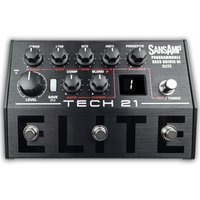
The Tech 21 SansAmp Programmable Bass Driver ELITE represents the next evolution of Andrew Bartas long standing mission to capture authentic tube amp feel in a compact format. Developed only after digital processing could meet the responsiveness and dynamics of analogue circuitry this pedal combines classic SansAmp character with modern flexibility. It delivers familiar warmth drive and punch while expanding control far beyond previous generations making it suitable for demanding studio and live environments. Two operating modes shape its workflow. Performance mode keeps three core presets instantly accessible while Studio mode unlocks up to 128 programmable locations for detailed sound design. A dedicated Red mode reassigns controls to advanced parameters including preamp shaping filters ambience dynamics and chorus effects. With MIDI integration blendable impulse responses onboard compression and comprehensive connectivity the SansAmp Programmable Bass Driver ELITE functions as a stompbox full preamp recording interface or direct DI solution with consistent results across any setup.
Tech 21 SansAmp Programmable Bass Driver ELITE
This is a New Tech 21 SansAmp Programmable Bass Driver ELITE from Tech 21 is in our Specialist Effects Pedals category on Just Pedals. Read More below.
As an affiliate partner, we may earn a small commission when you buy through our links — at no extra cost to you.
Related videos
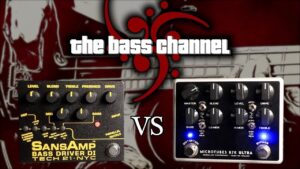

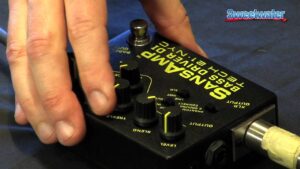
Brand
Tech 21
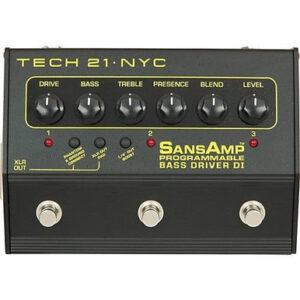
Tech 21 began in Manhattan in 1989 when designer Andrew Barta introduced SansAmp, an all-analogue amplifier and speaker-emulation circuit for direct recording. SansAmp remains central to the company’s guitar and bass range, appearing in standalone preamps, DI pedals, rack units and Fly Rig products. JustPedals listings include the GT2, Programmable Bass Driver DI, Para Driver DI and Character Series VT Bass DI, as well as the MIDI Mouse. These products shape or send a direct instrument signal, rather than providing only conventional modulation or ambience; compare instrument voicing and output connections.
Category
Specialist Effects Pedals
Specialist effects alter the signal in ways that do not sit cleanly inside one established family. They may use granular processing, frequency shifting, resonators, freeze or sustain, bit reduction, ring modulation, feedback networks or combinations of several techniques. The relevant distinction is the underlying process, its tracking or latency, and how completely the dry signal can be blended or replaced.
Tags
Analogue
The signal is shaped by continuously varying electronic circuitry rather than being converted into a digital effect algorithm. Component choice, operating voltage and circuit tolerances influence headroom, noise, clipping texture and the small variations in response between designs.
Bass
Voiced or equipped to retain low-frequency fundamentals and the higher headroom of a bass signal. Clean blends, crossovers and bass-specific filter ranges can preserve weight and articulation while the effected portion adds harmonics, movement or ambience.
Digital
Converts the signal or control process into numerical data for algorithmic processing. Digital designs can provide precise timing, long memory, complex routing and repeatable presets; sample rate, conversion, internal resolution and latency influence fidelity and response.
MIDI
Sends, receives or responds to Musical Instrument Digital Interface messages rather than carrying the instrument audio itself. Program changes recall presets, continuous controllers move parameters, and MIDI clock or transport messages synchronise timing between devices.
Presets
Stores complete groups of parameter values for later recall. The number of locations, switching time, spillover behaviour and whether presets include routing, expression and MIDI assignments determine how completely one sound can change into another.
Others Just Ordered :
- I Love A Happy Accident… – Animals Pedal

- Animals Pedal Vintage Van Driving is Very Fun Overdrive

- Animals Pedal Sunday Afternoon Is Infinity Bender

- Ninevolt Pedals | Bath Time Reverb (Animals Pedal)

- This Fuzz Pedal Makes No Sense… But It Sounds Incredible

- ANIME Pedals | Animals Pedal Custom Illustrated Series
