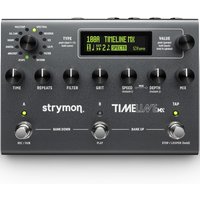
The Strymon TimeLine MX Delay Pedal is a next-generation multi-delay workstation. Powered by a tri-core 800 MHz ARM processor it can run two effects simultaneously with Serial Parallel or Split routing options. Alongside updated versions of the original TimeLine delay machines it introduces Spectral MultiTap Oil Can and Drum delay engines opening up a huge range of creative options. A dedicated reverb engine is also built in transforming the TimeLine MX into a comprehensive delay and reverb solution for stage and studio alike. Designed to inspire without slowing you down the intuitive interface features a large OLED display and controls that respond naturally to your playing. A 5-minute stereo looper with reverse and half-speed playback expands your possibilities while comprehensive stereo connectivity full MIDI support via DIN and TRS USB-C connectivity and an analogue dry path make integration into professional rigs effortless. From refining classic delay sounds to exploring entirely new sonic landscapes the TimeLine MX delivers the power precision and musicality you need.
Strymon TimeLine MX Delay Pedal
This is a New Strymon TimeLine MX Delay Pedal from Strymon is in our Delay Pedals category on Just Pedals. Read More below.
As an affiliate partner, we may earn a small commission when you buy through our links — at no extra cost to you.
Related videos

Brand
Strymon
Strymon specialises in detailed digital effects and amp tools designed for pedalboard, studio and direct-recording setups. The company grew from the Damage Control team and is known for deep delay and reverb processing, alongside modulation, amp modelling and tape-inspired effects. JustPedals listings include the TimeLine delay, BigSky reverb, Iridium amp and cabinet simulator, Deco tape-saturation pedal, DIG dual delay and Flint tremolo and reverb. Strymon states its products are designed and built in the USA, in the Los Angeles area. Check MIDI, preset storage, stereo I/O and expression options when comparing its larger-format pedals.
Category
Delay Pedals
Delay records the incoming signal for a chosen interval and repeats it after the original note. Feedback returns repeats to the delay line, while tone, filtering, modulation and saturation determine whether echoes remain clear, darken progressively, wobble like tape or degrade like analogue bucket-brigade circuits. Delay time and rhythmic subdivisions govern the spacing and musical pattern of the repeats.
Tags
Analogue
The signal is shaped by continuously varying electronic circuitry rather than being converted into a digital effect algorithm. Component choice, operating voltage and circuit tolerances influence headroom, noise, clipping texture and the small variations in response between designs.
MIDI
Sends, receives or responds to Musical Instrument Digital Interface messages rather than carrying the instrument audio itself. Program changes recall presets, continuous controllers move parameters, and MIDI clock or transport messages synchronise timing between devices.
Stereo
Processes, creates or passes two audio channels. True stereo preserves separate left and right inputs, while mono-to-stereo effects generate spatial differences internally; routing, phase behaviour and whether trails remain stereo determine the resulting image. Some outputs sum to mono when only one socket is connected, which can change level or modulation depth.
USB
Provides a Universal Serial Bus connection for power, audio, MIDI, firmware or editing data. The supported USB class and connector do not by themselves show its purpose; channel count, sample format, host compatibility and power demand define the actual function.
Others Just Ordered :
- I Love A Happy Accident… – Animals Pedal

- Animals Pedal Vintage Van Driving is Very Fun Overdrive

- Animals Pedal Sunday Afternoon Is Infinity Bender

- Ninevolt Pedals | Bath Time Reverb (Animals Pedal)

- This Fuzz Pedal Makes No Sense… But It Sounds Incredible

- ANIME Pedals | Animals Pedal Custom Illustrated Series