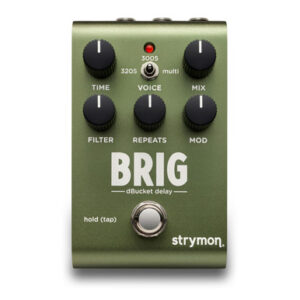
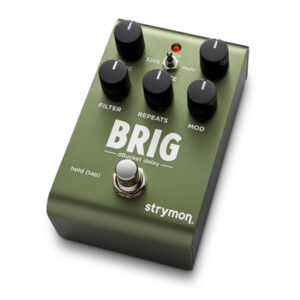
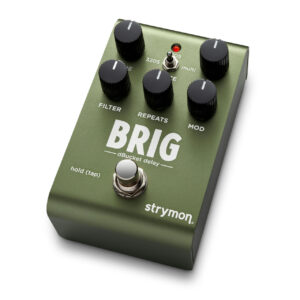
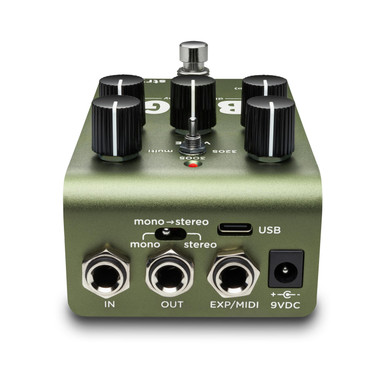
Strymon Brig dBucket Delay Pedal

£249.00

On the menu for January 2026 are the Strymon Guitar Pedals, freshly added and carefully selected. These New units are available to order online with fast, secure delivery from trusted UK retailers. Read on for full details, specifications, demos, videos, reviews, and the best places to buy the Strymon Guitar Pedals today.


Spread the love

Description

Spread the love

On the menu for January 2026 are the Strymon Guitar Pedals, freshly added and carefully selected. These New units are available to order online with fast, secure delivery from trusted UK retailers. Read on for full details, specifications, demos, videos, reviews, and the best places to buy the Strymon Guitar Pedals today.

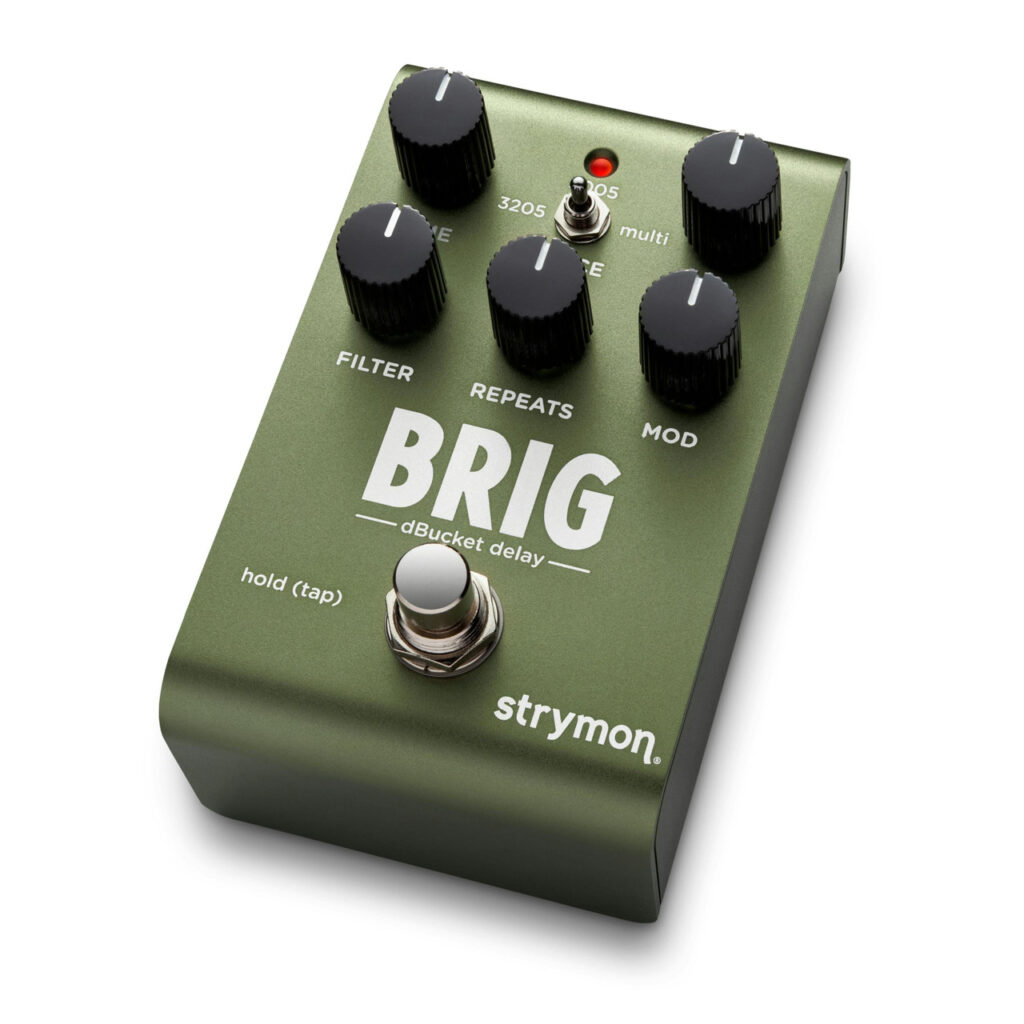
There's nothing quite like the sound of a classic bucket brigade (BBD) delay — offering warm, rich tones and a distinctive yet organic gooey-ness on the repeats. The Strymon Brig dBucket delay pedal is designed to recreate all of the signature behaviour that these vintage BBD chips deliver, while providing the modern flexibility, power and performance that you'd come to expect from a premium Strymon product. Plug into Brig, play a note, and you'll instantly be drawn in by the repeats that evolve with captivating complexity!

Strymon's Brig pedal boasts three different, meticulously-crafted BBD voices that are based on iconic bucket brigade circuits. These offer you everything from gritty repeats and sci-fi psychedelia, to soft and dream-like soundscapes that you can float on top of. Warm bucket brigade modulation gives your repeats exciting movement and, at the shortest delay times, Brig works as a killer standalone BB chorus pedal too!

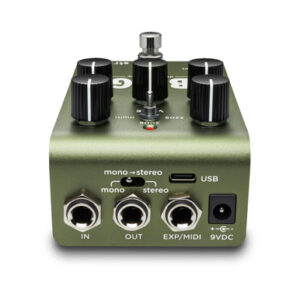
Add in full stereo I/O, TRS MIDI, 300 presets, USB-C connectivity for DAW MIDI control and firmware updates, a discrete JFET analogue input circuit for unrivaled feel and touch response, and seamless tap tempo functionality that allows you both artifact-free tempo tapping or bucket brigade chaos when you tweak the 'Time' knob — and you have a seriously powerful BBD workstation in compact form.

Key Features

  • Three distinct bucket brigade voicings based on classic BBD circuit configurations.
  • Premium, discrete stereo JFET analogue input circuit for exceptional feel and touch response.
  • TRS MIDI/expression jack allows for external control via an expression pedal or TRS MIDI connection.
  • Full MIDI integration: 300 onboard presets, real-time parameter control and more!
  • Full stereo inputs and outputs via TRS jacks.
  • Mono-to-mono, mono-to-stereo and stereo-to-stereo operation.
  • Artifact-free tap tempo function for on-the-fly time changes.
  • Unique 'Filter' control enables you to precisely shape the tone of the repeats.
  • USB-C jack for controlling via MIDI from a computer or for performing firmware updates.
  • Super low-noise 24-bit 96kHz A/D and D/A converters provide uncompromising audio quality.
  • High-performance 520MHz ARM Superscalar processor.
  • 32-bit floating point processing.
  • True or buffered bypass, for a 100% unprocessed signal when the pedal is bypassed or a conditioned signal with preserved high-end integrity.
  • Strong and lightweight anodized aluminium chassis.
  • Designed and built in the USA.

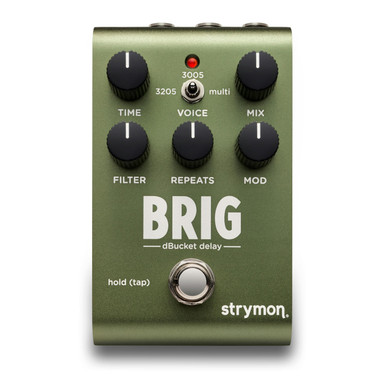
3 Delay Voices

  • 3205: 30-300ms. Recreates the character of vintage delay pedals that used a single low-voltage MN3205 BBD chip (synonymous with '80s Japanese analogue delay pedals) for gritty repeats that can morph as it feeds back — great for slapback echoes, leads, and psychedelic sci-fi sounds.
  • 3005: 100ms-1 sec. Emulates the vibe of old-school delay stompboxes that used dual MN3005 BBD chips at higher voltage (like those famous "Memory" pedals, specifically examples made in the '90s) for longer delay times and warm repeats with a soft, dream-like quality.
  • Multi: Features two cross-coupled, super-clean dBucket delay lines with golden ratio timing to create complex soundscapes and a huge stereo soundfield that remains musical and clean even while sitting on the edge of self-oscillation!

Controls

  • Time: Controls the delay time according to the selected voice. Delay clock is continuously variable so that turning it while repeats are happening can produce interesting pitch effects.
  • Mix: Sets the delay mix from full dry at minimum, to full wet with no dry signal at maximum. A 50/50 mix occurs at approximately 3 o'clock on the knob.
  • Filter: Adjusts the EQ filtering, noise, and bucket loss of the repeats based on the selected voice.
  • Repeats: Varies the number of delay repeats from one to runaway oscillation. Set to 3 o'clock for sustained, infinite repeats without runaway.
  • Mod: Adds LFO modulation to the delay time. Modulation is off at the minimum setting. The modulation speed is slow in the first half, and fast in the second half — increasing in intensity as the knob is turned clockwise.
  • Footswitch: Engages and bypasses the effect. A red LED indicates the effect is engaged. This is also used to enter 'Tap Mode' to manually tap in delay times.

Specifications

  • Input Impedance: 1M Ohm
  • Output Impedance: 100 Ohm
  • A/D & D/A Conversion: 24-bit, 96kHz
  • Frequency Response: 20Hz to 20kHz
  • Signal to Noise Ratio: 116dB
  • Dimensions (D x W x H): 4.5" x 1.7" x 2.2" / 11.43 x 4.32 x 5.59 cm)
  • Power Requirements: 9V DC Centre Negative, 250mA Minimum (PSU Sold Separately)
Additional information

Weight 0.5 kg

Brand

Strymon

Strymon is an American company renowned for producing high-end, digitally-powered guitar effects pedals that deliver studio-quality sound. Founded in 2009 as a part of Damage Control Engineering, Strymon quickly gained a reputation for its innovative approach to effects, particularly in areas like delay, reverb, and modulation. Their pedals are known for their pristine sound quality, versatility, and deep customization options, often utilizing powerful digital signal processing (DSP) to emulate and enhance analogue sounds. Strymon’s products, such as the Timeline delay, BigSky reverb, and Mobius modulation, are highly regarded by both professional and amateur musicians for their ability to create rich, complex soundscapes. The pedals also feature intuitive controls and rugged construction, making them a staple on pedalboards worldwide.

Category

Guitar Pedals

Tags

Chorus

Delay

A delay pedal records your signal and plays it back after a set time, creating echoes that can range from tight, slapback repeats to long, atmospheric trails. It’s one of the most versatile effects, used to thicken tones, add rhythmic depth, or build spacious, ambient layers. Analogue delays offer warm, decaying repeats that blend naturally with your tone, while digital units provide pristine echoes with precise control over time, feedback, and mix levels.

From classic rockabilly and tape-style echoes to modern looping and shimmer effects, delay pedals have become essential tools for shaping sound. They can make solos soar, rhythms pulse, or transform simple chord progressions into cinematic textures. Whether used subtly to add dimension or boldly to create soundscapes, a good delay pedal can completely redefine the feel and atmosphere of your music.

EQ

While Ed Sheeran primarily relies on the natural sound of his acoustic guitar and vocals, he occasionally uses EQ (Equalization) to shape and enhance his tone during live performances or in the studio. EQ pedals or onboard preamps can allow him to adjust the frequency response of his guitar signal to suit the acoustics of different venues or to achieve specific tonal characteristics. Here’s how EQ might be utilized in Ed Sheeran’s setup:

1. **Tonal Shaping**: EQ can be used to adjust the balance of frequencies in the guitar signal, allowing Ed Sheeran to shape his tone to his liking. For example, he might boost the midrange frequencies to bring out the warmth and presence of his acoustic guitar, or cut certain frequencies to reduce any harshness or mud in the sound.

2. **Feedback Control**: In a live setting, EQ can help control feedback by notching out problematic frequencies that might cause the guitar signal to feed back through the amplification system. This can be particularly useful when performing in venues with challenging acoustics or high volume levels.

3. **Room Correction**: In situations where the venue’s acoustics are less than ideal, EQ can be used to compensate for any deficiencies in the sound. By adjusting the EQ settings, Ed Sheeran can tailor the guitar tone to sound more balanced and natural, regardless of the room’s acoustic properties.

4. **Matching Gear**: EQ can also be used to match the tone of Ed Sheeran’s guitar to the sound of other instruments or equipment in his setup. For example, he might adjust the EQ to complement the tonal characteristics of his vocal microphone or to blend seamlessly with backing tracks or other instruments.

Overall, while EQ may not be a central component of Ed Sheeran’s guitar effects setup, it can still play a valuable role in shaping his tone and ensuring that he achieves the desired sound in different performance environments. Whether used subtly for tonal shaping or more aggressively for feedback control, EQ allows Ed Sheeran to tailor his guitar tone to suit his musical vision and performance needs.

Expression

Expression pedals allow real-time control over specific parameters on compatible guitar pedals, such as volume, delay time, modulation depth, or filter sweep. Used with an expression input, they let players shape effects dynamically with their foot, adding movement and performance control that cannot be achieved with fixed knob settings.

Filter

MIDI

MIDI pedals use the Musical Instrument Digital Interface standard to communicate with other guitar pedals, effects units, and hardware. They allow control over presets, parameters, and switching across multiple devices from a single controller. MIDI integration makes it possible to build complex, synchronised pedal setups while keeping control simple and consistent.

New

This is brand new, fresh in, and a UK warranty is included. New Gear always comes from trusted UK music retailers.

Pitch

Pitch pedals alter the frequency of your guitar signal, changing the perceived note or adding harmony. They can shift notes up or down by fixed intervals, create harmonies, or produce dive-bomb and whammy-style effects without a tremolo arm. Pitch shifters and harmonisers are great for thickening solos, simulating multiple guitars, or experimenting with creative, otherworldly sounds that expand your tonal range.

used

Vibe

Available for Amazon Prime