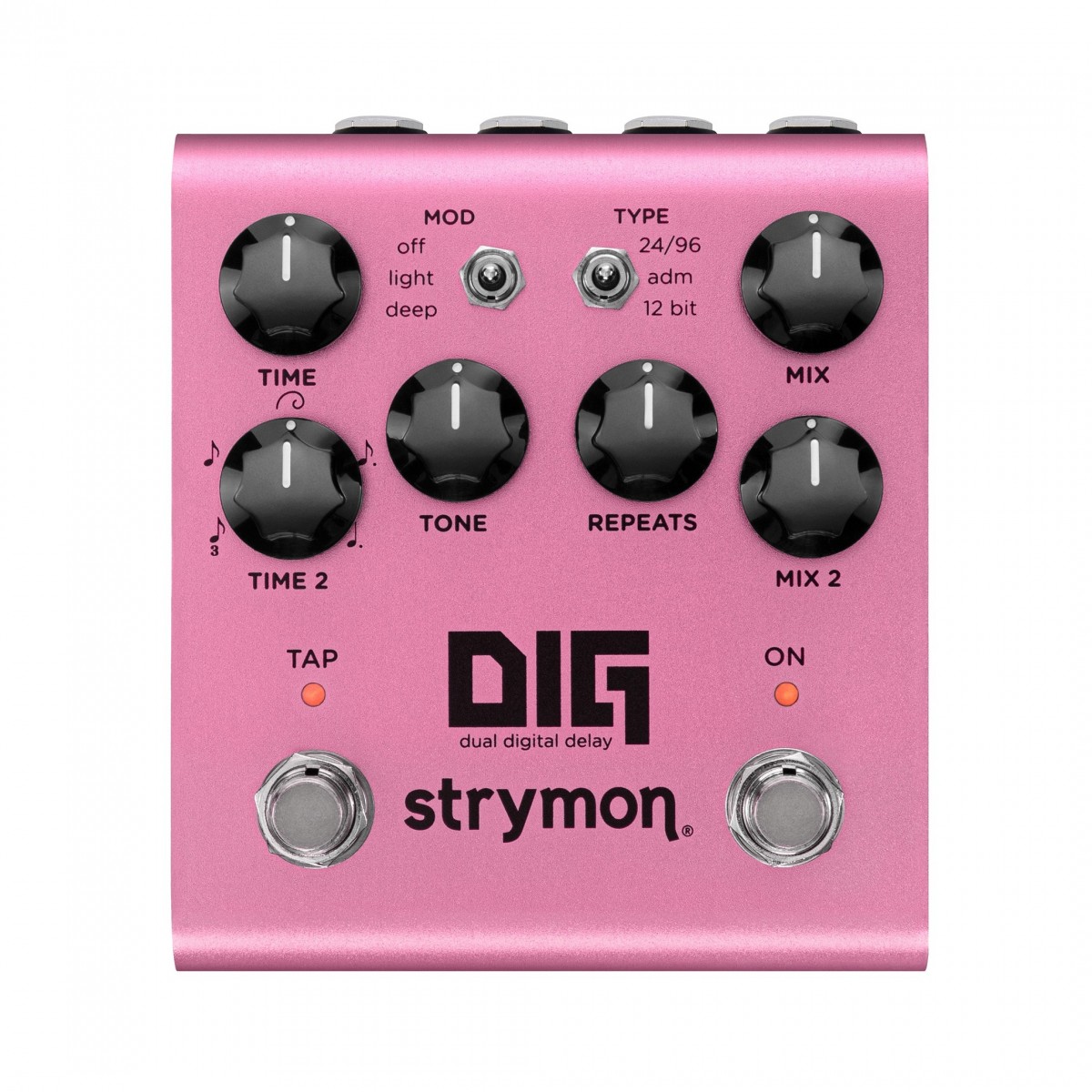

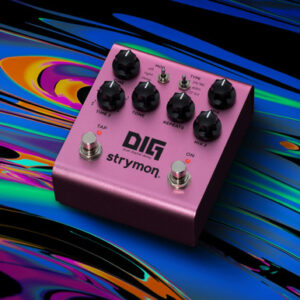
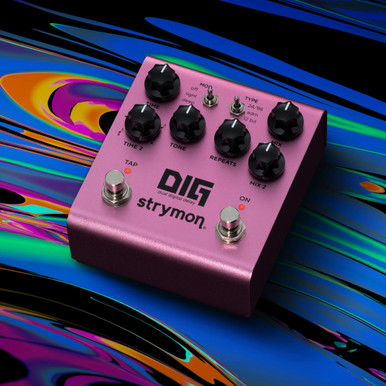
The rack-mounted digital delays of the ’80s remain as popular today as they were some forty years ago. Renowned for their crystal clean delay repeats, digital delays had their own special and intriguing sonic characteristics that made them a must-have for guitarists everywhere. The Strymon DIG captures the soul of these rack-style delays in a compact, pedalboard-friendly package, making it a valuable asset on your pedalboard and ushering in a new era of digital delay!
New for 2022, Strymon have updated the original DIG with a number of improvements and technological advancements, making it even better than before (if that is even possible)! The DIG V2 now boasts two simultaneous integrated delays with five rhythmic subdivisions and three dual delay routing options. There are also three distinctly different voicing options on tap – the early ’80s adaptive delta modulation mode, the mid-’80s 12 bit pulse code modulation mode, and the modern high-resolution 24/96 mode, opening up a wealth of musical possibilities.
Other upgrades include full MIDI implementation, a premium analogue JFET input circuit and a new and improved user interface, all whilst boasting the same great features that made the original DIG so popular!
Key Features
- MIDI – The DIG’s full MIDI implementation allows to you control every parameter remotely via MIDI commands, giving you complete control over the effect.
- True & Buffered Bypass – Chose between an electromechanical relay switched true bypass, which will keep your bypassed signal 100% untouched, or a high-quality buffered bypass that gives your signal a boost when using long cables runs.
- JFET Input – A high impedance ultra-low noise discrete Class A JFET preamp input delivers uncompromised dynamics and feel with a super-responsive touch.
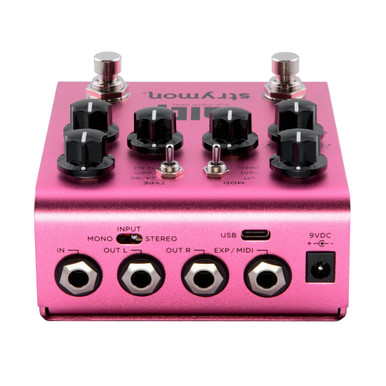
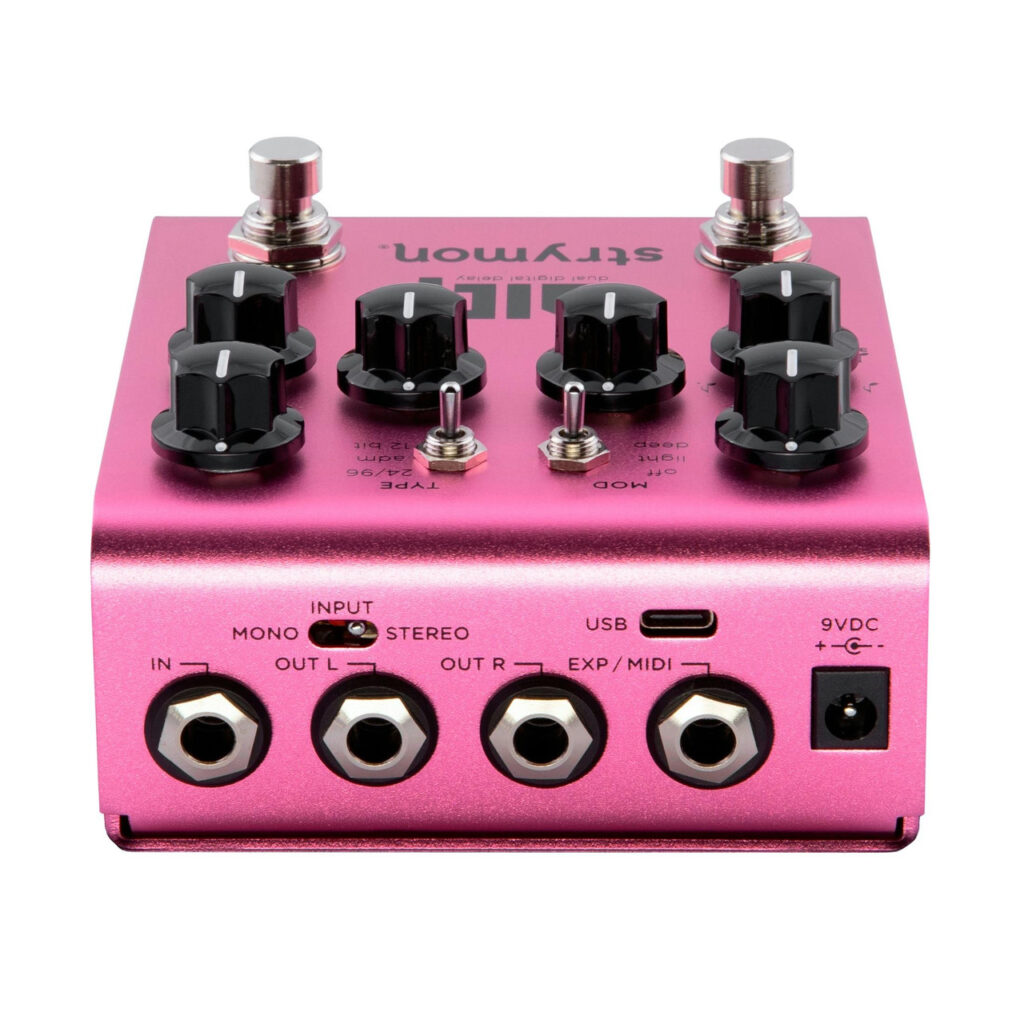
- Stereo In & Out – DIG features full stereo in/out capabilities allowing you to experience immersive, studio-quality digital delays in your stereo rig or recording environment.
- Line/Instrument Level – DIG’s adjustable input signal level makes it versatile option on stage and in the studio, for a number of a different instruments including synthesizers and keyboards.
Here’s what Strymon say about the DIG Dual Digital Delay V2
Delay Types
Don’t all digital delays sound the same? What gives a digital delay its own unique personality? Digital conversion technologies in the late 70s were advancing rapidly, and clever electronics designers were on a quest to squeeze out the best possible performance specs, with fidelity not possible from tape or analog circuits. Their imaginative solutions to the limitations of the conversion process resulted in delays that possessed some unintended, unique characteristics.
DIG accurately and beautifully reveals their individual personalities.
ADM – A one bit, high sample rate conversion technique that evolved from telecommunications voice coding. The conversion and supporting signal conditioning, limiting, and pre-emphasis/deemphasis create a percussive wide-band delay that adds more character when
input dynamics increase.
12 bit – A 12 bit, 32kHz PCM conversion made possible by monolithic IC chips developed in the late ’70s. Pre-emphasis/de-emphasis and companding combine with the converters to produce a warm delay with a dimensional sense.
24/96 – A clean, high-resolution, high-bandwidth delay with a hint of dynamics that allow the delay to sit nicely with the analog dry signal. 24 bit resolution and a 96kHz sampling rate ensure uncolored, artifact-free repeats.
Two Delays
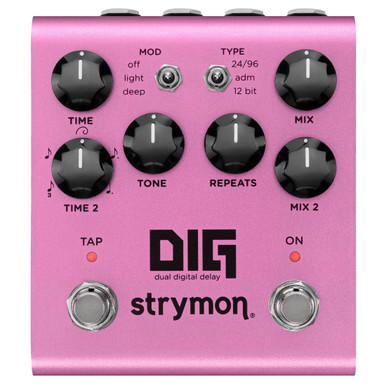
At the heart of DIG are two simultaneous, integrated delay machines. Delay 1 is the master delay — Its free-running delay time allows you to easily dial in delays from 20ms to 1.6s with the Time knob or Tap Tempo switch. Longer delay times lend themselves to more ambient soundscapes while doubling and slapback effects can be achieved at short delay times.
Delay 2 follows as the companion delay. A dedicated subdivision control determines the ratio between the two delays with one of five rhythmic subdivisions: triplet, eighth note, dotted eighth note, dotted quarter note, and the golden ratio. Don’t want your delays to be synchronized? DIG’s Free Mode secondary function disables time sync and subdivisions between Delay 1 and Delay 2, giving the Time 2 knob a full delay range from 20ms to 1.6s. This lets you use both of DIG’s delays as truly independent, standalone delay machines.
Routing Options
Series, Parallel, Ping Pong — Set up your two delays in one of three configurations.
Series is like setting up pedals in a chain on your board one after the other, with Delay 2 feeding into Delay 1. Parallel will orient your delay lines so that they remain independent — Delay 1 in the left channel and Delay 2 in the right channel. If used in mono, both delays are heard at once without
feeding into each other. With Ping Pong, each delay acts as a ping pong delay, interacting together when both Mix knobs are turned up. Use in stereo for captivating back and forth rhythms.
Delay Controls
DIG features a full suite of practical delay controls to dial in your dream reverb tone, from the studio to the stage. Two dedicated Mix controls let you determine just the right amount of wet to dry signal, from no delays at all, to 50/50 at 3 o’clock, all the way to full wet, delay-only tones, for both of DIG’s two delay machines.
DIG’s Repeats knob adjusts the repeat amount for both delays. From singular repeats for short slapback delays, all the way to infinitely repeating echoes at its max position. Want a different amount of repeats for Delay 2? DIG features a secondary function to choose between individually dialing in Delay 2’s repeats amount, or having them controlled by the main Repeats knob.
DIG also features two individual Time knobs for each of its two delay machines, giving you access to everything from super snappy quick delays, to long, spacey delays. Time 2 can be used to sync Delay 2’s delay time to one of 5 different delay subdivisions, or used in Free Mode to independently dial in your desired delay time. Delay time for Delay 1 can also be set with the Tap Tempo switch for easy on-the-fly tempo adjustments.
Modulation
Need to add some extra character to your repeats? DIG features three levels of delay line modulation, perfect for adding richness and dimension to your delays. Choose between no modulation to hear only your delays, light mod for subtle modulation, or deep mod for lush, thick increased modulation.
Tone
Our new generation of DIG lets you fine tune your delay tone with a dedicated Tone control that adjusts the feedback filter response. Turn Tone to the left to cut out high frequencies for dark, washed out repeats, set it to noon for a neutral, flat response, or go past that for sparkly, shiny delays with reduced low frequencies.
Circular Repeats
Want to infinitely let your repeats echo on and on to create rhythmic soundscapes at the press of a button? Holding down the TAP footswitch enables circular repeats, where both delay lines maintain a static volume and repeat continuously until the TAP footswitch is disengaged. At this point, all previous settings will be restored.
Specifications
Ins, Outs, and Switches
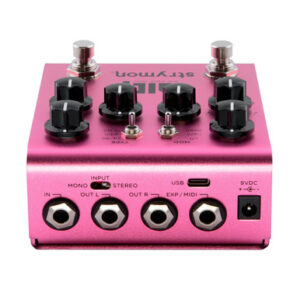
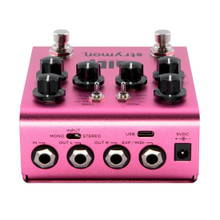
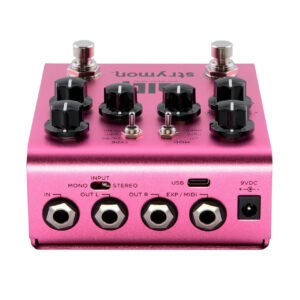
- High impedance ultra low-noise discrete Class A JFET TRS stereo input.
- Low impedance independent TS stereo outputs.
- Expression pedal input allows the connection of a TRS expression pedal, MiniSwitch, MultiSwitch Plus, or TRS MIDI connection.
- USB jack for controlling via MIDI from a computer or for performing firmware updates.
- Dedicated Tap Tempo & On/Off footswitches
Audio Quality
- Premium JFET analog front end
- Ultra low noise, high performance 24-bit 96kHz A/D and D/A converters provide uncompromising audio quality
- 520MHz ARM Superscalar processor
- 32-bit floating point processing
- 20Hz to 20kHz frequency response
- Audio Input Impedance: 1M Ohm
- Audio Output Impedance: 100 Ohm
More
- Strong and lightweight anodized pink aluminum chassis
- Power requirements: maximum 9 volts DC center-negative, with a minimum of 300mA of current.
- Dimensions: – 4.5” deep x 4” wide x 1.75” tall (11.4 cm deep x 10.2 cm wide x 4.4 cm tall)
- Designed and built in the USA