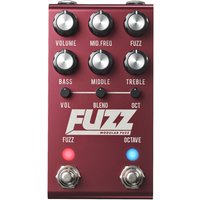
Fuzzy versatility. The Jackson Audio FUZZ Modular Analog Fuzz Pedal w/ Octave is the ultimate solution for those seeking the perfect fuzz. The modular design allows you to set the fundamentals the detailed controls and parametric EQ let you dial-in and fine-tune the timbre then the fully-analog construction executes your fuzz tone in immaculate fashion. The integrated octave circuit and dedicated footswitch allow you to elevate your tone further especially since this also acts as a clean boost with Blend set to 0. Unrivalled functionality with ridiculously powerful performance and gloriously fat fuzz.
Jackson Audio FUZZ Modular Analog Fuzz Pedal w/ Octave
£279.00
This is a New Jackson Audio FUZZ Modular Analog Fuzz Pedal w/ Octave from Jackson Audio its found in our Octave Pedals on the Just Pedals menu. Read More below.
View Just Jackson Audio
As an affiliate partner, we may earn a small commission when you buy through our links — at no extra cost to you.
Brand
Jackson Audio
In the current JustPedals catalogue, Jackson Audio is represented by Octave Pedals and Tremolo & Vibrato Pedals. Current listings include Twin Trem Dual Tremolo and FUZZ Modular Analog Fuzz. That makes the range relevant to players looking for modulation and movement. Check each model for its exact circuit or processing platform, controls, power requirements and connections, particularly where the catalogue includes both pedals and supporting gear.
Category
Octave Pedals
An octave effect generates notes one or more octaves above or below the input. Analogue circuits often create raw monophonic sub-octaves, while digital pitch tracking can follow chords and provide several intervals with cleaner separation. Tracking speed, polyphonic accuracy, latency and the balance of dry, upper and lower voices determine whether the result feels tight, organ-like, synthetic or deliberately unstable.
Tags
Analogue
The signal is shaped by continuously varying electronic circuitry rather than being converted into a digital effect algorithm. Component choice, operating voltage and circuit tolerances influence headroom, noise, clipping texture and the small variations in response between designs.
Fuzz
Pushes the signal into extreme clipping, often approaching a square wave and producing dense harmonics. Transistor type, bias, input loading and filtering govern whether the texture is smooth, woolly, gated, spluttering, octave-rich or highly responsive to the instrument volume.
Others Just Ordered :
- I Love A Happy Accident… – Animals Pedal

- Animals Pedal Vintage Van Driving is Very Fun Overdrive
- Animals Pedal Sunday Afternoon Is Infinity Bender

- Ninevolt Pedals | Bath Time Reverb (Animals Pedal)

- This Fuzz Pedal Makes No Sense… But It Sounds Incredible

- ANIME Pedals | Animals Pedal Custom Illustrated Series