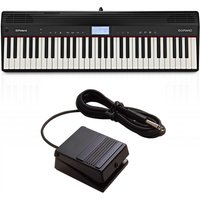
The perfect choice for beginners. The Roland Go:Piano Digital Piano in black presents a 61-key keyboard that is both compact and lightweight for ultimate convenience. Featuring expressive touch response the standard full-size keys are inspired by the keyboards on acoustic grand pianos. They feature an ivory touch surface for a comfortable feel thatll support your developing technique. Offering premium performance the Go:Piano is designed to be operated fully wirelessly with battery power and Bluetooth connectivity. Featuring onboard Bluetooth speakers this Roland digital piano allows wireless smartphone connection. Connect via Bluetooth to Rolands free Piano Partner 2 app to access a host of great learning aids. SPECIAL OFFER: For a limited time Roland are offering three free months access to Skoove an online learning platform. Simply register your Roland piano purchase to get unlimited access to hundreds of songs and interactive courses available anytime on your computer smartphone or tablet.
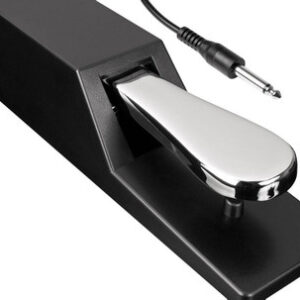
Roland Go:Piano 61 Key Digital Piano with DP-2 Damper Pedal
This is a New Roland Go:Piano 61 Key Digital Piano with DP-2 Damper Pedal from Roland its found in our Specialist Effects Pedals on the Just Pedals menu. Read More below.
As an affiliate partner, we may earn a small commission when you buy through our links — at no extra cost to you.
Related videos

Brand
Roland
Roland is a Japanese electronic-instrument company founded in Osaka in 1972. Its guitar-related products include effects, amplification, pedalboards and guitar synthesis. The GR-55 combines guitar and bass synth sounds with amp and effects modelling, while the BCB series provides purpose-built pedalboard and carry solutions. JustPedals listings include GR-55S-BK and GR-55GK guitar synthesizers, an FV-50H volume pedal and BCB90X board components. Roland is a broad instrument maker rather than a single-effect stompbox brand, so check whether a listing is a synth system, pedal or rig accessory before comparing it.
Category
Specialist Effects Pedals
Specialist effects alter the signal in ways that do not sit cleanly inside one established family. They may use granular processing, frequency shifting, resonators, freeze or sustain, bit reduction, ring modulation, feedback networks or combinations of several techniques. The relevant distinction is the underlying process, its tracking or latency, and how completely the dry signal can be blended or replaced.
Tags
Acoustic
Voiced for the wider dynamics, strong transient detail and pickup characteristics of acoustic instruments. High input impedance, phase reversal, notch filtering and restrained processing help preserve body resonance while controlling piezo harshness and feedback. Balanced outputs may also carry the corrected signal directly to a mixer or interface.
Bluetooth
Provides a short-range wireless data or audio connection. Depending on the design it may carry backing audio, editing commands, preset management or MIDI rather than the live instrument signal; codec delay and supported Bluetooth profiles determine what the connection can do.
Digital
Converts the signal or control process into numerical data for algorithmic processing. Digital designs can provide precise timing, long memory, complex routing and repeatable presets; sample rate, conversion, internal resolution and latency influence fidelity and response.
Others Just Ordered :
- I Love A Happy Accident… – Animals Pedal

- Animals Pedal Vintage Van Driving is Very Fun Overdrive
- Animals Pedal Sunday Afternoon Is Infinity Bender

- Ninevolt Pedals | Bath Time Reverb (Animals Pedal)
- This Fuzz Pedal Makes No Sense… But It Sounds Incredible

- ANIME Pedals | Animals Pedal Custom Illustrated Series