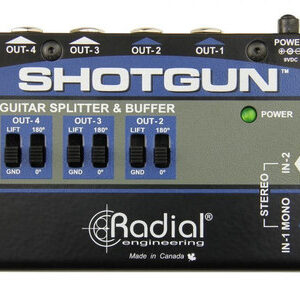
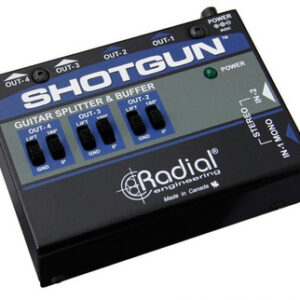
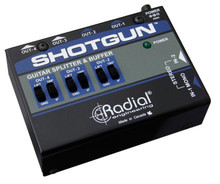

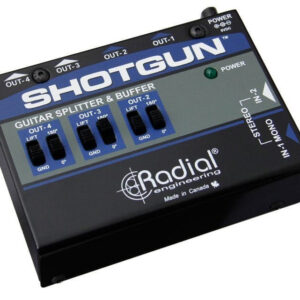
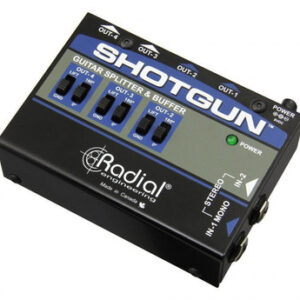
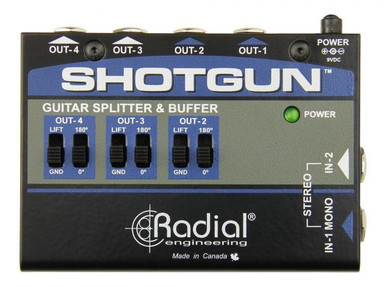
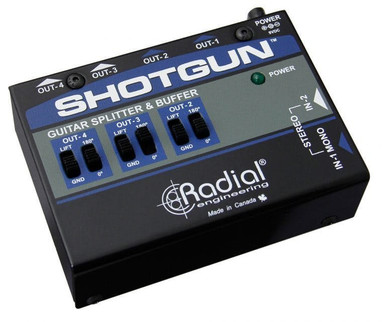
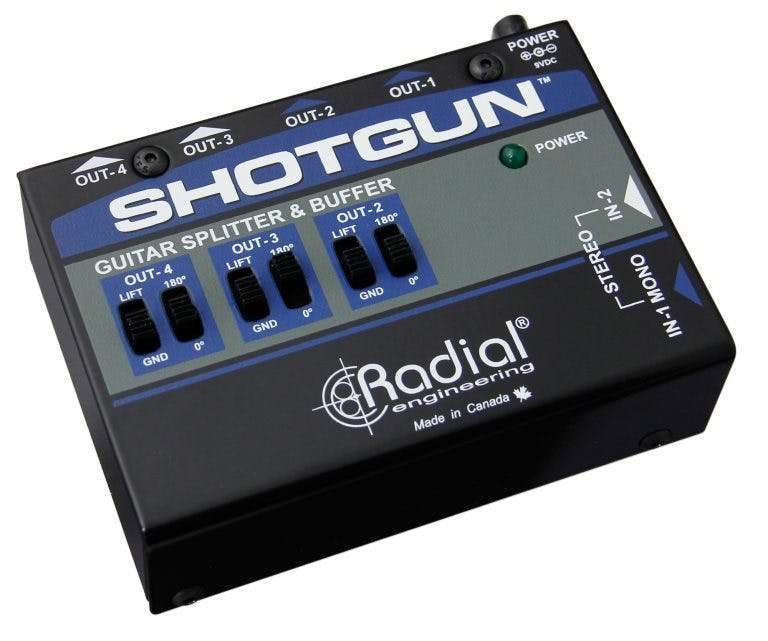
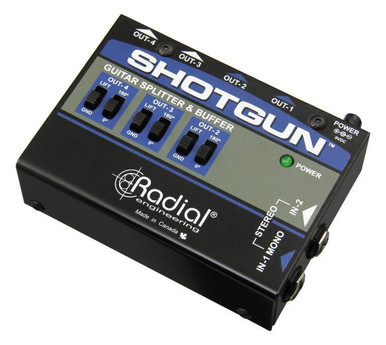
Here's what Radial say about the ShotGun Instrument Buffer & Splitter
The Shotgun makes it easy to drive multiple amplifiers cleanly and in phase without buzz or hum from ground loops. In mono operation, connect to input-1 of the Shotgun and you can feed up to four amps simultaneously. For stereo setups, the Shotgun automatically reconfigures when both inputs are used; feeding input-1 to the first two amplifiers, and input-2 to the second pair. Isolation transformers and ground lifts are included on the outputs to eliminate ground loop noise, along with 180° polarity reverse switches to ensure all amps are phase-matched.
Key Features
- 1×4 mono or 2×2 stereo operation
- Isolated outputs eliminate buzz and hum
- Buffered outputs prevent signal loss
- 180° polarity switches to phase-match amps
Using the Shotgun in 1×4 mono-mode
The Shotgun gives you total freedom to connect your pedalboard output to amps, effects or the PA. The isolated outputs eliminate nasty ground loop hum.
Using the Shotgun in 2×2 stereo-mode
Plug in your stereo chorus and the Shotgun delivers a noise-free stereo signal as it automatically rebalances the load to retain your tone.
Using the Shotgun in the studio
Use the Shotgun to split your guitar signal to various effects, amps and a direct box so that you can Reamp your guitar solo later on.