
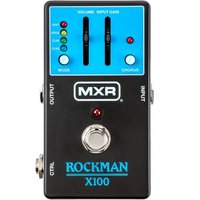
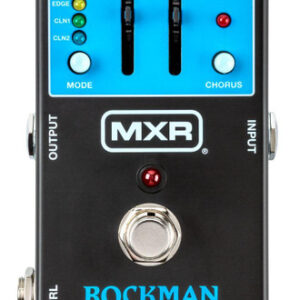
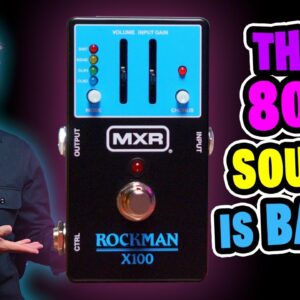
The MXR Rockman X100 is perfect for guitarists seeking the signature tones of 1980s arena rock in a compact versatile stompbox. Inspired by Tom Scholzs original Rockman X100 headphone amp this tone processor delivers four expertly crafted presets ranging from crystalline cleans to gritty overdrive.Its advanced compression circuitry adapts dynamically to your input ensuring clarity across all tones. A built-in bucket brigade chorus chip offers shimmering modulation for lush soundscapes. Complete with mono and stereo modes and sliders for fine-tuning Input Gain and Volume it provides both studio-quality sound and live performance reliability.
MXR Rockman X100
£233.50
This is a New MXR Rockman X100 from MXR its found in our Specialist Effects Pedals on the Just Pedals menu. Read More below.
View Just MXR
As an affiliate partner, we may earn a small commission when you buy through our links — at no extra cost to you.

Related videos


Brand
MXR
MXR’s first product was the Phase 90, released in 1972. Dunlop’s official MXR history traces the early line from that compact phaser to the Distortion+, Dyna Comp compressor and Blue Box octave fuzz—circuits that remain central reference points for the brand. JustPedals carries those classic families alongside the Carbon Copy analog delay, Micro Amp, Talk Box and bass effects. MXR’s range is deliberately broader than one effect category: compare the model number and version, especially where a classic circuit has later reissues, mini enclosures or expanded controls.
Category
Specialist Effects Pedals
Specialist effects alter the signal in ways that do not sit cleanly inside one established family. They may use granular processing, frequency shifting, resonators, freeze or sustain, bit reduction, ring modulation, feedback networks or combinations of several techniques. The relevant distinction is the underlying process, its tracking or latency, and how completely the dry signal can be blended or replaced.
Tags
Presets
Stores complete groups of parameter values for later recall. The number of locations, switching time, spillover behaviour and whether presets include routing, expression and MIDI assignments determine how completely one sound can change into another.
Stereo
Processes, creates or passes two audio channels. True stereo preserves separate left and right inputs, while mono-to-stereo effects generate spatial differences internally; routing, phase behaviour and whether trails remain stereo determine the resulting image. Some outputs sum to mono when only one socket is connected, which can change level or modulation depth.
Others Just Ordered :
- I Love A Happy Accident… – Animals Pedal

- Animals Pedal Vintage Van Driving is Very Fun Overdrive

- Animals Pedal Sunday Afternoon Is Infinity Bender

- Ninevolt Pedals | Bath Time Reverb (Animals Pedal)
- This Fuzz Pedal Makes No Sense… But It Sounds Incredible

- ANIME Pedals | Animals Pedal Custom Illustrated Series