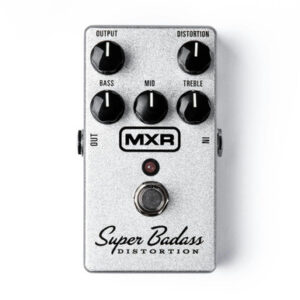
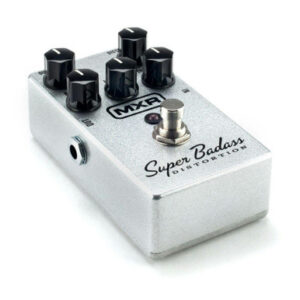
Brand
MXR’s first product was the Phase 90, released in 1972. Dunlop’s official MXR history traces the early line from that compact phaser to the Distortion+, Dyna Comp compressor and Blue Box octave fuzz—circuits that remain central reference points for the brand. JustPedals carries those classic families alongside the Carbon Copy analog delay, Micro Amp, Talk Box and bass effects. MXR’s range is deliberately broader than one effect category: compare the model number and version, especially where a classic circuit has later reissues, mini enclosures or expanded controls.
Category
Distortion clips the waveform more firmly than overdrive, generating dense upper harmonics, longer sustain and a more compressed response. Circuit topology and filtering decide whether the sound is tight and focused, broad and aggressive, smooth or deliberately abrasive. Gain sets the amount of clipping, while pre- and post-distortion tone controls strongly influence low-end definition, midrange presence and high-frequency texture.
Tags
The signal is shaped by continuously varying electronic circuitry rather than being converted into a digital effect algorithm. Component choice, operating voltage and circuit tolerances influence headroom, noise, clipping texture and the small variations in response between designs.
Voiced or equipped to retain low-frequency fundamentals and the higher headroom of a bass signal. Clean blends, crossovers and bass-specific filter ranges can preserve weight and articulation while the effected portion adds harmonics, movement or ambience.
Connects input directly to output through mechanical or relay switching when the effect is off, removing the active circuit from the audio path. It avoids buffer colour but leaves cable capacitance and switching design to influence high-frequency loss and possible switching noise.