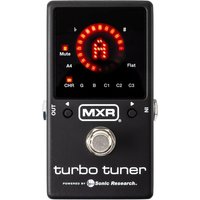
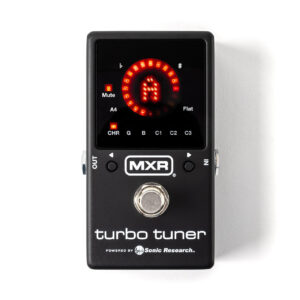
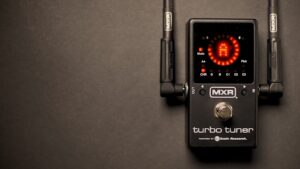
The MXR M400 Turbo Tuner Pedal is a professional-grade strobe tuner developed in collaboration with Sonic Research combining exceptional accuracy with a roadworthy MXR stompbox design. Engineered by Sonic Research founder Roger Schlichtig it uses the core tuning engine of the original Turbo Tuner to deliver fraction-of-a-cent precision. Its real-time strobe display provides immediate feedback helping you tune quickly and confidently. A large bright LED display with four selectable brightness levels ensures clear visibility during rehearsals live performances and studio sessions. Five customisable presets support instruments with up to 12 strings while ±50 cent offsets provide additional flexibility. Switchable true and buffered bypass modes allow the pedal to accommodate different signal chains. A 9V passthrough output can power an additional pedal and a USB-C connection supports firmware updates and upcoming editor software. Built to the dependable standards associated with MXR and Sonic Research the Turbo Tuner combines advanced tuning capabilities with practical pedalboard features making it a versatile choice.
MXR M400 Turbo Tuner Pedal
This is a New MXR M400 Turbo Tuner Pedal from MXR its found in our Tuner Pedals on the Just Pedals menu. Read More below.
As an affiliate partner, we may earn a small commission when you buy through our links — at no extra cost to you.
Related videos

Brand
MXR
MXR’s first product was the Phase 90, released in 1972. Dunlop’s official MXR history traces the early line from that compact phaser to the Distortion+, Dyna Comp compressor and Blue Box octave fuzz—circuits that remain central reference points for the brand. JustPedals carries those classic families alongside the Carbon Copy analog delay, Micro Amp, Talk Box and bass effects. MXR’s range is deliberately broader than one effect category: compare the model number and version, especially where a classic circuit has later reissues, mini enclosures or expanded controls.
Category
Tuner Pedals
A tuner pedal measures the input frequency and shows whether the played note is sharp, flat or in tune. Detection speed, display resolution and note range affect accuracy, especially for low tunings and extended-range instruments. Buffered or true-bypass switching changes the signal path, while mute, strobe display, reference-pitch calibration and alternate-tuning modes shape operation.
Tags
Bass
Voiced or equipped to retain low-frequency fundamentals and the higher headroom of a bass signal. Clean blends, crossovers and bass-specific filter ranges can preserve weight and articulation while the effected portion adds harmonics, movement or ambience.
Buffered Bypass
Keeps an active buffer in the signal path when the effect is bypassed. The buffer converts a high-impedance input to a lower-impedance output, helping long cables and multiple pedals retain level and high frequencies, although its headroom and noise remain part of the path.
Presets
Stores complete groups of parameter values for later recall. The number of locations, switching time, spillover behaviour and whether presets include routing, expression and MIDI assignments determine how completely one sound can change into another.
USB
Provides a Universal Serial Bus connection for power, audio, MIDI, firmware or editing data. The supported USB class and connector do not by themselves show its purpose; channel count, sample format, host compatibility and power demand define the actual function.