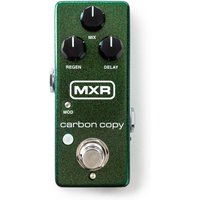
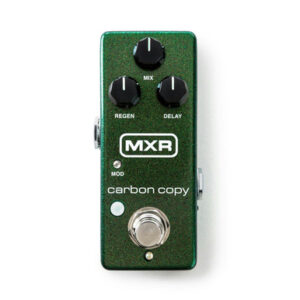
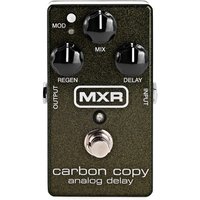
Dazzling delay. In a pedal thats straightforward compact and superbly easy to use. The MXR Carbon Copy Mini Analog Delay is an all-encompassing delay unit based on the original world-renowned Carbon Copy. And just like its iconic older brother this model will give you the dark brooding delay tones that are certain to add a unique edge to your music.But MXR have only gone and made it even better. Theres a “Bright” switch that emphasises high-end frequencies helping your solos to sing with added sharpness and clarity. Youll enjoy a ton of presence and gorgeous repeats. The “Mod” switch – adjustable with internal “Speed” and “Depth” controls – can lend your guitar a wealth of delay effects from ringing tape echo to massive shimmering chorus. And it all comes in a mini housing thatll slot comfortably onto your pedalboard. Dont delay – this is a legendary effect at its finest.
MXR M299 Carbon Copy Mini Analog Delay
This is a New MXR M299 Carbon Copy Mini Analog Delay from MXR its found in our Delay Pedals on the Just Pedals menu. Read More below.
As an affiliate partner, we may earn a small commission when you buy through our links — at no extra cost to you.
Related videos



Brand
MXR
MXR’s first product was the Phase 90, released in 1972. Dunlop’s official MXR history traces the early line from that compact phaser to the Distortion+, Dyna Comp compressor and Blue Box octave fuzz—circuits that remain central reference points for the brand. JustPedals carries those classic families alongside the Carbon Copy analog delay, Micro Amp, Talk Box and bass effects. MXR’s range is deliberately broader than one effect category: compare the model number and version, especially where a classic circuit has later reissues, mini enclosures or expanded controls.
Category
Delay Pedals
Delay records the incoming signal for a chosen interval and repeats it after the original note. Feedback returns repeats to the delay line, while tone, filtering, modulation and saturation determine whether echoes remain clear, darken progressively, wobble like tape or degrade like analogue bucket-brigade circuits. Delay time and rhythmic subdivisions govern the spacing and musical pattern of the repeats.
Tags
Analogue
The signal is shaped by continuously varying electronic circuitry rather than being converted into a digital effect algorithm. Component choice, operating voltage and circuit tolerances influence headroom, noise, clipping texture and the small variations in response between designs.
Others Just Ordered :
- I Love A Happy Accident… – Animals Pedal

- Animals Pedal Vintage Van Driving is Very Fun Overdrive

- Animals Pedal Sunday Afternoon Is Infinity Bender

- Ninevolt Pedals | Bath Time Reverb (Animals Pedal)

- This Fuzz Pedal Makes No Sense… But It Sounds Incredible

- ANIME Pedals | Animals Pedal Custom Illustrated Series