Mooer Acoustikar Acoustic Guitar Simulator Pedal

£54.99

This is a New Mooer Acoustikar Acoustic Guitar Simulator Pedal from Mooer is in our Specialist Effects Pedals category on Just Pedals. Read More below.

View Just
more
and , ,

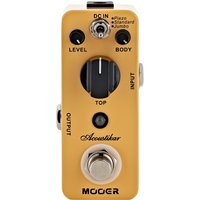
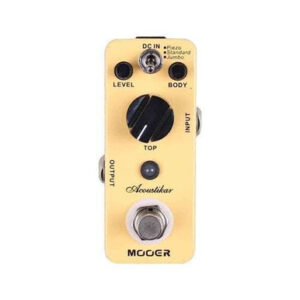
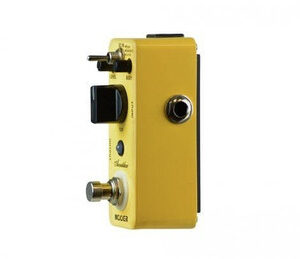
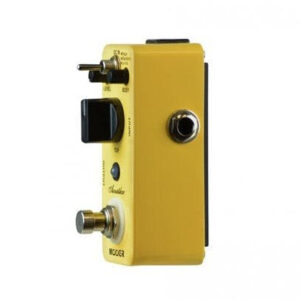
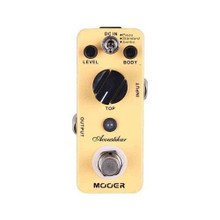
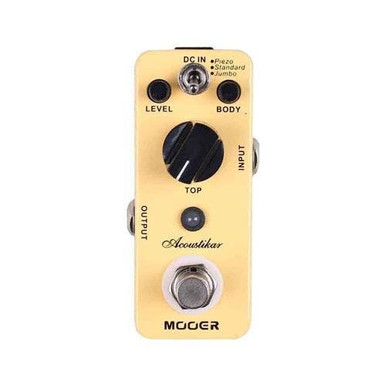
The Mooer Acoustikar Acoustic Simulator pedal is a neat addition to your pedalboard, allowing you to turn your electric guitar into an acoustic sound at just the touch of a button! Three modes allow you to either sound like a Piezo loaded electro acoustic, a standard acoustic guitar or a large body jumbo with increased bass and resonance.

The body control allows you to change the ‘size’ of the acoustic while the ‘top’ adjusts the brilliance, giving you loads of flexibility to get the exact acoustic sound you want!

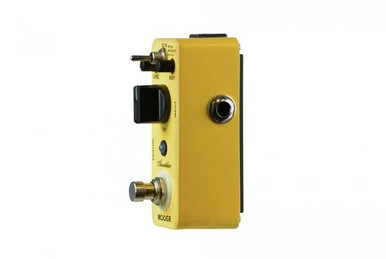
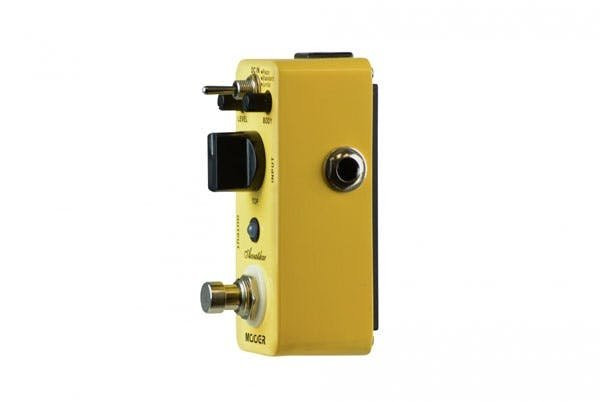
The compact form factor makes it super easy to add this to any pedalboard but please note it’s too small for fit a battery in so it needs to be supplied with standard 9v DC power

Specification

  • 3 Working Modes: Piezo/Standard/Jumbo
  • Full metal shell
  • Very small and exquisite
  • True bypass
  • Working Mode: 3 (Piezo/Standard/Jumbo)
  • Input: 1/4” monaural jack (impedance: 1M Ohms)
  • Output: 1/4” monaural jack (impedance: 1k Ohms)
  • Power Requirements: AC adapter 9V DC (center minus plug)
  • Current Draw: 17 mA
  • Dimensions: 93.5mm (D) × 42mm (W) × 52mm (H)
  • Weight:160g

Related videos

Brand

Mooer

MOOER entered the music-gear market in 2010 with miniature guitar effects pedals, conceived by four music-and-technology enthusiasts in Shenzhen, China. The company later expanded into preamp pedals, amp modelling, impulse-response loaders and multi-effects, including the GE200 and RADAR IR Loader. JustPedals listings show the compact effects side of the range: Reecho digital delay, Green Mile overdrive, Liquid Phaser, Triangolo tremolo and Pure Boost. MOOER’s small enclosures are a design choice, not a guide to how much control a model offers; check its modes, switching and power needs individually.

Category

Specialist Effects Pedals

Specialist effects alter the signal in ways that do not sit cleanly inside one established family. They may use granular processing, frequency shifting, resonators, freeze or sustain, bit reduction, ring modulation, feedback networks or combinations of several techniques. The relevant distinction is the underlying process, its tracking or latency, and how completely the dry signal can be blended or replaced.

Tags

Acoustic

Voiced for the wider dynamics, strong transient detail and pickup characteristics of acoustic instruments. High input impedance, phase reversal, notch filtering and restrained processing help preserve body resonance while controlling piezo harshness and feedback. Balanced outputs may also carry the corrected signal directly to a mixer or interface.

Bass

Voiced or equipped to retain low-frequency fundamentals and the higher headroom of a bass signal. Clean blends, crossovers and bass-specific filter ranges can preserve weight and articulation while the effected portion adds harmonics, movement or ambience.

True Bypass

Connects input directly to output through mechanical or relay switching when the effect is off, removing the active circuit from the audio path. It avoids buffer colour but leaves cable capacitance and switching design to influence high-frequency loss and possible switching noise.