
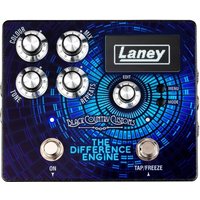
The Laney BCC The Difference Engine Delay Pedal brings together three generations of delay into one stunning pedal. Combining authentic Analogue tones with the digital delays of the 80s and the Dynamic digital era of the 90s you can truly create any tone you wish. Offering wide spacious sound the pedal allows you to utilise its stereo output to its maximum potential. Easy to control you can fully personalise your sound with an intuitive set of controls. This pedal is truly impressive and will shine on stage.
Laney BCC The Difference Engine Delay Pedal
£239.00
This is a New Laney BCC The Difference Engine Delay Pedal from Laney its found in our Delay Pedals on the Just Pedals menu. Read More below.
View Just Laney
As an affiliate partner, we may earn a small commission when you buy through our links — at no extra cost to you.
Brand
Laney
In the current JustPedals catalogue, Laney is represented by Preamp & DI Pedals, Boost Pedals and Pedal Amps & Headphone Amps. Current listings include Ironheart Loudpedal 60w, Lionheart Loudpedal 60w and Digbeth DB-PRE. That makes the range relevant to players looking for drive, gain and clipping, plus time-based effects and ambience. Check each model for its exact circuit or processing platform, controls, power requirements and connections, particularly where the catalogue includes both pedals and supporting gear.
Category
Delay Pedals
Delay records the incoming signal for a chosen interval and repeats it after the original note. Feedback returns repeats to the delay line, while tone, filtering, modulation and saturation determine whether echoes remain clear, darken progressively, wobble like tape or degrade like analogue bucket-brigade circuits. Delay time and rhythmic subdivisions govern the spacing and musical pattern of the repeats.
Tags
Analogue
The signal is shaped by continuously varying electronic circuitry rather than being converted into a digital effect algorithm. Component choice, operating voltage and circuit tolerances influence headroom, noise, clipping texture and the small variations in response between designs.
Digital
Converts the signal or control process into numerical data for algorithmic processing. Digital designs can provide precise timing, long memory, complex routing and repeatable presets; sample rate, conversion, internal resolution and latency influence fidelity and response.
Stereo
Processes, creates or passes two audio channels. True stereo preserves separate left and right inputs, while mono-to-stereo effects generate spatial differences internally; routing, phase behaviour and whether trails remain stereo determine the resulting image. Some outputs sum to mono when only one socket is connected, which can change level or modulation depth.
Others Just Ordered :
- I Love A Happy Accident… – Animals Pedal

- Animals Pedal Vintage Van Driving is Very Fun Overdrive

- Animals Pedal Sunday Afternoon Is Infinity Bender

- Ninevolt Pedals | Bath Time Reverb (Animals Pedal)

- This Fuzz Pedal Makes No Sense… But It Sounds Incredible

- ANIME Pedals | Animals Pedal Custom Illustrated Series
