
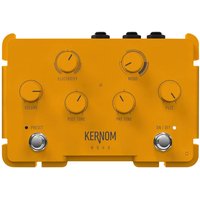
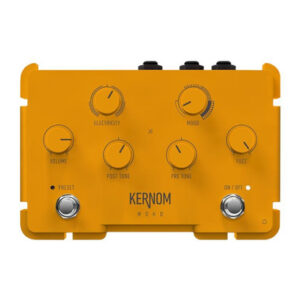
The Kernom MOHO Fuzz is a pedal that gives you complete mastery over fuzz tones from psychedelic warmth to razor-sharp grunge and beyond! It features an innovative EQ section that allow for a wide array of sounds and fuzz textures. The pre- and post-tone controls let you dial in and adjust for smooth rich sustain or gated choppy effects allowing for an almost limitless amount of fuzz possibilities. The Kernom MOHO Fuzz is equipped with full MIDI compatibility storing up to 128 presets ideal for experimentation and seamless transitions in live and studio settings. An expression pedal input further enhances customisation giving you absolute control over parameters to blend unique textures and tones.
Kernom Moho Fuzz
£205.00
This is a New Kernom Moho Fuzz from Kernom its found in our Fuzz Pedals on the Just Pedals menu. Read More below.
View Just Kernom
As an affiliate partner, we may earn a small commission when you buy through our links — at no extra cost to you.

Brand
Kernom
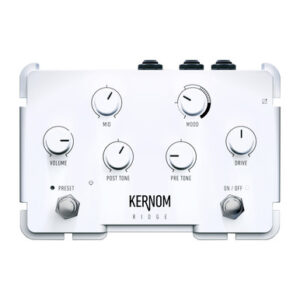
In the current JustPedals catalogue, Kernom is represented by Overdrive Pedals, Fuzz Pedals and Modulation Pedals. Current listings include Moho Fuzz, Ridge Overdrive and Elipse Multi Modulation. That makes the range relevant to players looking for drive, gain and clipping, plus modulation and movement. Check each model for its exact circuit or processing platform, controls, power requirements and connections, particularly where the catalogue includes both pedals and supporting gear.
Category
Fuzz Pedals
Fuzz drives the signal into extreme clipping, often flattening the waveform and generating a thick spectrum of harmonics. Transistor type, bias, input loading and tone filtering create markedly different responses, from loose and velvety to gated, spluttering or octave-rich. Some circuits interact strongly with pickup impedance and guitar volume, while others include buffers or blends for a more consistent response.
Tags
MIDI
Sends, receives or responds to Musical Instrument Digital Interface messages rather than carrying the instrument audio itself. Program changes recall presets, continuous controllers move parameters, and MIDI clock or transport messages synchronise timing between devices.
Presets
Stores complete groups of parameter values for later recall. The number of locations, switching time, spillover behaviour and whether presets include routing, expression and MIDI assignments determine how completely one sound can change into another.
Others Just Ordered :
- I Love A Happy Accident… – Animals Pedal

- Animals Pedal Vintage Van Driving is Very Fun Overdrive

- Animals Pedal Sunday Afternoon Is Infinity Bender

- Ninevolt Pedals | Bath Time Reverb (Animals Pedal)

- This Fuzz Pedal Makes No Sense… But It Sounds Incredible

- ANIME Pedals | Animals Pedal Custom Illustrated Series
