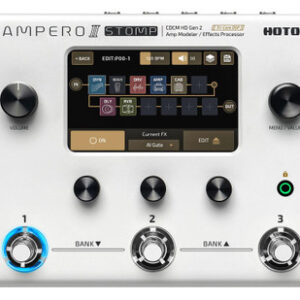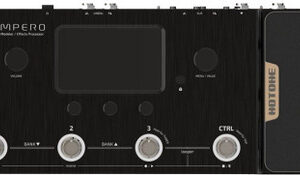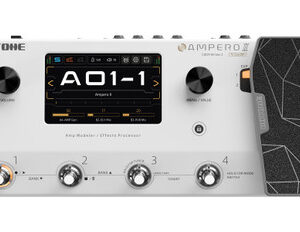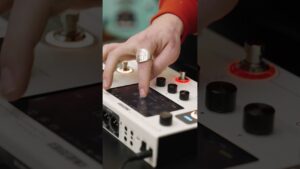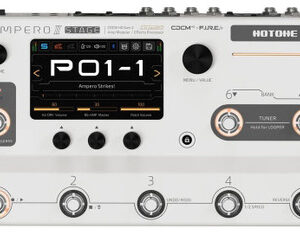
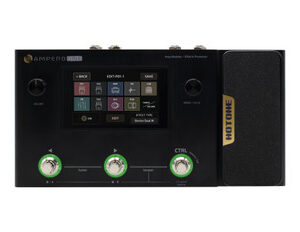
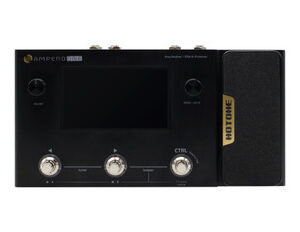

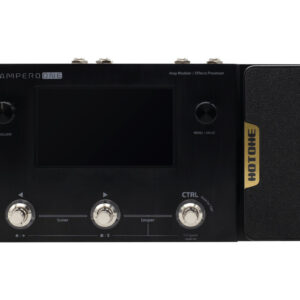
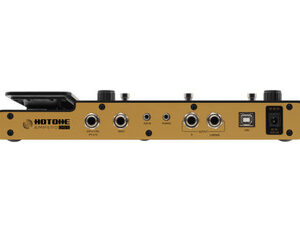
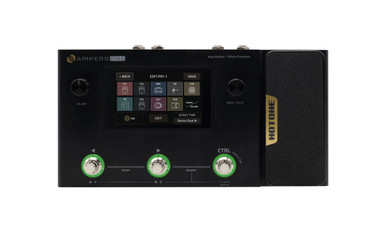
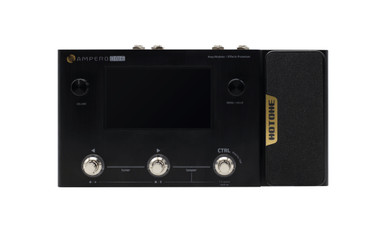
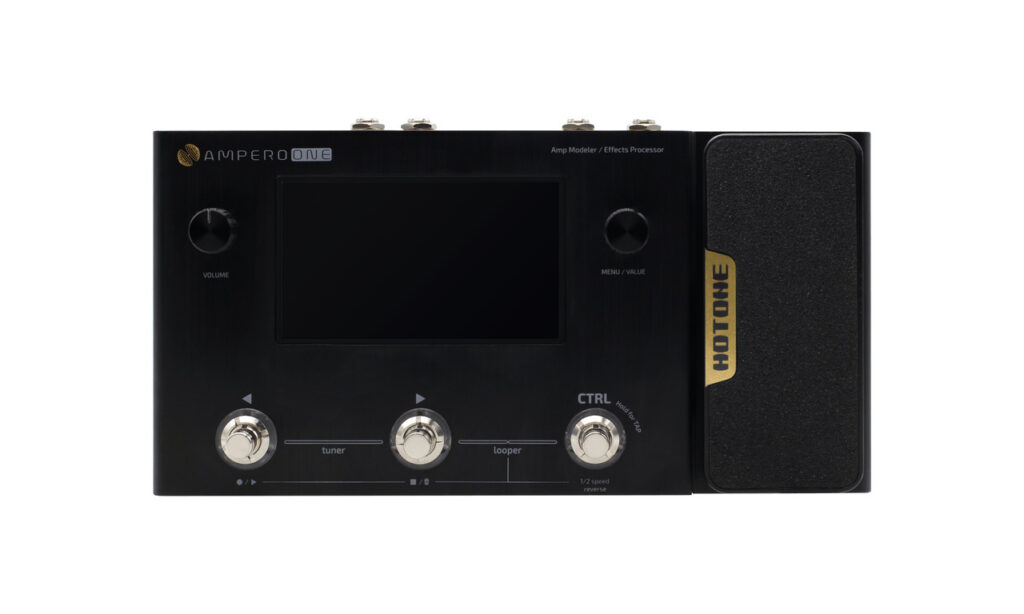
The Hotone Ampero One brings the same powerful amp and effects modelling that you find in the Ampero, in a more compact, slightly more streamlined model. The Ampero One has one less footswitch and sacrifices MIDI and XLR outputs but what you end up with is all the tones from the larger Ampero in a noticeably smaller format. The compact, all-in-one rig just became even more portable.
Advanced Modelling Technology
While the Ampero One may smaller, it doesn’t compromise on power or tone, featuring the same digital signal processing (DSP) and modelling as its larger counterpart. The Ampero One features dual-DSP with a main processor and a co-processor that gives it the power to handle high-quality modelling smoothly and allows you to use the 4″ touchscreen responsively.
Like the Ampero, the Ampero One features CDCM HD (Comprehensive Dynamic Circuit Modeling High Definition) and F.I.R.E. (Field Impulse Response Enhancement) modelling systems. These systems allow Hotone to create detailed and dynamic models as they digitally “rebuild” the circuitry of the object it’s modelling which makes for a great sounding model that responds like the real thing.
Huge Number of Tones
The Ampero One also does not compromise on the number of sounds available to you. Like the Ampero, you get 242 effects, 64 amps, and 60 cabs to shape your sound with, and it can handle up to 9 effects models simultaneously. There’s plenty to experiment with and explore here, giving you a huge number of options for building your tone. Some notable effects include a built-in looper for solo jamming, and acoustic simulation effects to make your electric guitar sound like a variety of different acoustic stringed instruments. If you’ve got an actual acoustic guitar, there are dedicated acoustic effects and presets that you can use. You can easily browse the amps, cabs, and effects using the 4″ LCD touch screen that you can also use for adjusting parameters.
Connectivity
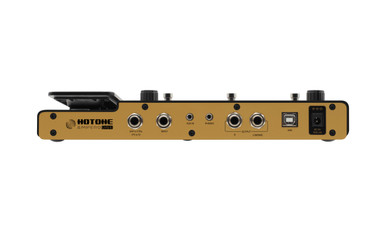
In exchange for the reduced size, you do lose some of the connectivity options you can find in the Ampero. While you lose out on MIDI and balanced XLR output, you get the rest of the I/Os. In addition to the input jack, there’s an expression pedal jack for a secondary expression pedal, an aux-in jack, a headphone out jack for silent practice, and stereo outputs for incorporating the Ampero One into a stereo setup live or in the studio. In addition, there’s a USB port which can be used for editing presets, managing IRs, and for use as a USB audio interface which gives you the option of playing out loud and recording at the same time. Perfect for when you want to capture your performance while playing a gig.
Features
- Ampero sounds, modelling systems, and processing technology in a smaller format
- CDCM & F.I.R.E. modelling systems for dynamic and responsive models
- Powerful dual DSP platform for sound quality and performance
- 24-bit signal processing, up to 120dB S/N ratio
- Responsive 4-inch 800 x 480 colour touch screen
- Internal voltage boost circuitry for great dynamic range
- USB port for firmware upgrading, loading/editing/managing effects/IRs via free Mac/PC software or for use as an USB audio interface
- Advanced acoustic simulation effects
- Dedicated acoustic effects and presets
- 242 effects based on XTOMP effects library
- CDCM HD & F.I.R.E. modelling effects
- 64 amp models
- 60 cab models
- 100+ legendary pedal models
- Next-gen mic position and microphone type simulations
- 50+ Hotone original effects
- User custom IR loader with 3rd party IR support
- 198 presets
- Built-in drum machine with 100 patterns
- Built-in looper with max. 100 seconds of recording time
- 3 assignable footswitches with halo LEDs
- Built-in expression pedal
- Stereo output processing
- External footswitch jack
- Customisable main display
- Durable, light-weight aluminium casing
- 9V DC power supply
Specifications
- Digital Audio Signal Processing: 24-bit depth, 44.1kHz sample rate
- SNR: 120dB
- Effects: 242
- Effects Modules: Total of 9 simultaneous
- Patches: 198 (99 user patches, 99 factory patches)
- Looper Time: Mono 100 seconds, Stereo 50 seconds
- Internal Drum Machine: 100 Rhythm Patterns
- Inputs
- One 1/4” Tip Sleeve (TS) Instrument jack
- One 1/8” Stereo Auxiliary In (Aux In) jack
- One 1/4” Tip Ring Sleeve (TRS) Expression Pedal input jack
- Outputs
- Two 1/4” Tip Sleeve (TS) Unbalanced Stereo output jacks
- One 1/8” Stereo headphones output jack
- Input Impedance
- Input: 4.7MΩ
- Aux In: 10kΩ
- Output Impedance
- Output: 3.2kΩ
- Phones: 66Ω
- Screen: 4″800 x 480 Color Dynamic Display Touch Screen
- USB Port: USB Type-B port with USB Audio support
- Impulse Response/IR processing: Supports 24-bit/44.1kHz Mono WAV files, 1024 points
- Power Requirements: 9V DC Center Negative
- Current Consumption: 500mA Max
- Dimensions: 273mm (W) x 143mm (D) x 51mm (H)
- Weight: 1202g