
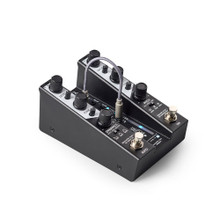
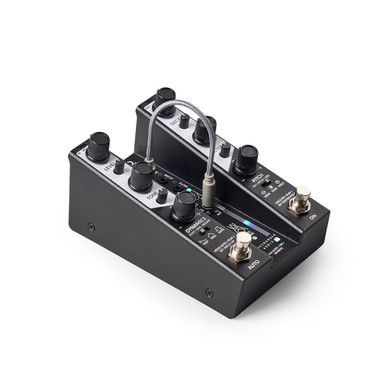
Gamechanger Audio has reimagined how you can use pedals. Manually alter the way your sound is expressed to create and embellish your soundscapes for a very hands-on experience!
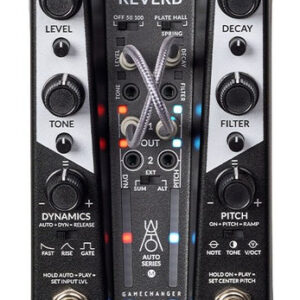
The AUTO series Reverb pedal reacts to every touch, dynamics, style, and note choice to shape your tone by adding responsive textures to your performance and evolving as you play. The Gamechanger Audio AUTO Series Chorus pedal features three emotional algorithms, Plate, Spring, and Hall, giving you distinct and expressive soundscapes.
Key Features
- Three Reverb Modes – Plate, Spring, and Hall gives you access to classic and familiar reverb effects.
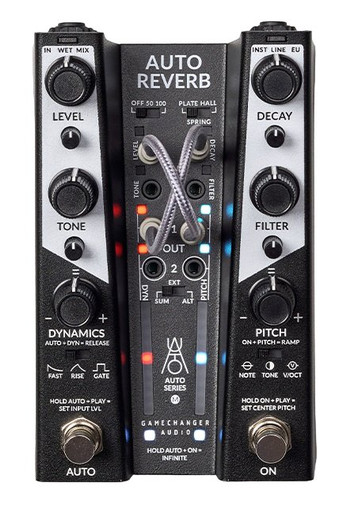
- Shape Your Tone Your Way – Using Level, Decay, Tone, and Drive knobs, you can control the rate and shape of reverb, allowing the pedal to naturally react to your playing and boost a bright and airy sound.
- Three Stereo Spread Settings – Select from 0%, 50%, or 100% to control the spread of reverb produced.
Customise Delay & Modulation
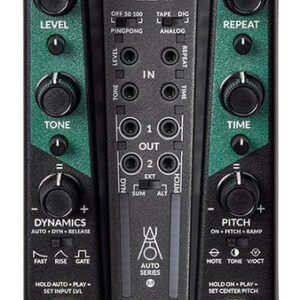
Like the other pedals in the range, the AUTO Series Reverb pedal uses two modulation sources, Dynamics and Pitch. Dynamics tracks the nuances in your playing, capturing your unique playing and the picking loudness of your instrument. Pitch, on the other hand, registers each note, bend, and vibrato. Each source can be applied to any of the 4 controls, Level, Decay, Tone, and Drive to create and embellish your soundscapes.
Dynamic Modulation and Secondary Transformation
Each primary mode effect is partnered with a corresponding attenuverter that allows you to be precise when dialling in the amount of modulation and the direction of each effect independently. Here’s where it gets interesting. A single, loud strum dynamically and subtly nudges the secondary attenuverter in the other direction to produce sweet and gentle sweeping parameter shifts.
Specifications
- Stereo and mono signal processing
- Switchable input level: INSTRUMENT, LINE or EURORACK
- Switchable LEVEL knob functionality: INPUT LEVEL + DRY SOUND, INPUT LEVEL + KILLDRY or DRY/WET MIX
- TRACK input for routing an auxiliary signal for controlling the modulation
- TRACK output for passing the TRACK input further or for dry signal output
- MIDI/CLK input for MIDI clock or analog trigger sync for time base effects
- 9V DC center negative power inlet, power supply of at least 250 mA is required
- USB-C input for MIDI and future updates
- 4 Patch Cables included in the package
- Pedal Weight 450 g / 1 lbs
- Pedal Dimensions LWH 15.2 x 10.2 x 7.5 cm / 6 x 4 x 3 in