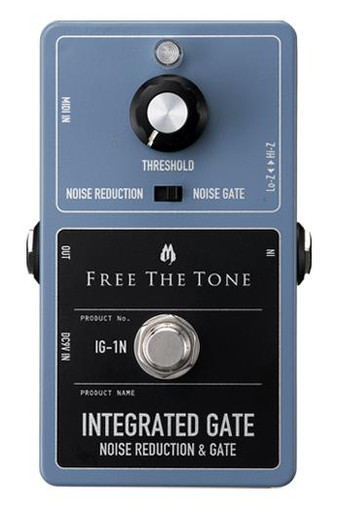
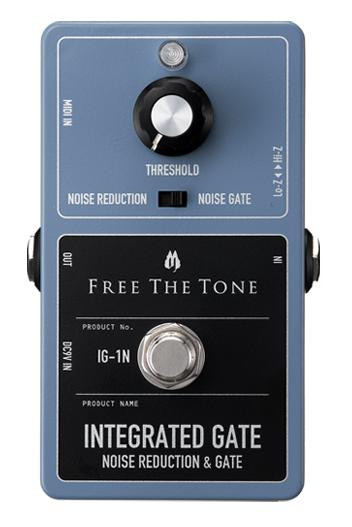



The Free The Tone IG-1N Integrated Gate is a next-generation noise reduction pedal designed to tame modern stage and studio noise without sacrificing your core tone. By combining a fully analogue audio path with ultra-fast digital control, it delivers incredibly natural note decay while keeping hum, buzz and interference firmly under control. Whether you want transparent noise reduction or a tight, percussive gate, the IG-1N lets you focus on playing, not fighting noise. Traditional gates can chop off your sustain, dull your sound or feel unpredictable under the fingers. The IG-1N tackles these issues head-on with a unique signal monitoring system that constantly analyses your playing and adjusts the output level in real time. The result is smooth, musical attenuation that follows the natural rise and fall of your notes, even with high-gain rigs or in noisy venues filled with computers, LED lighting and wireless devices. At the heart of the IG-1N is Free The Tone’s digitally controlled analogue circuit design. Your guitar or bass signal never leaves the analogue domain, preserving dynamics, touch sensitivity and harmonic detail. The digital side simply controls the level with pinpoint accuracy and speed, so you get the best of both worlds: pristine sound quality and highly intelligent noise management. With switchable Noise Reduction and Noise Gate modes, an input impedance selector to match different instruments and pickups, and MIDI control for effect on/off, the IG-1N integrates seamlessly into modern pedalboards and complex switching systems. Free The Tone’s original HTS buffer circuit further ensures that your signal remains clear and consistent, even when the effect is bypassed. Natural, Intelligent Noise Reduction The IG-1N’s signal monitoring system constantly tracks your input signal via a dedicated CPU, analysing its waveform and level in real time. Instead of using a crude threshold that simply slams the gate shut, it adjusts the output level smoothly and musically as your notes decay. This preserves the natural swell and fade of string vibrations, avoiding the abrupt cut-offs and unnatural tails that plague conventional noise gates. Dual Operating Modes for Any Rig Two distinct modes let you tailor the IG-1N to your playing style. In Noise Reduction mode, the pedal gradually reduces volume as your signal falls below the Threshold setting, making background noise far less noticeable while keeping your sustain intact. In Noise Gate mode, the signal is muted immediately once it drops below the Threshold, delivering a crisp, tight gate effect that is ideal for staccato riffs, stop-start rhythms and ultra-precise high-gain work. Analogue Signal Path with Digital Precision To preserve the true character of your guitar or bass, the IG-1N keeps the entire audio path in the analogue domain. The digital circuitry is used only for high-speed level control, not for audio conversion. This digitally controlled analogue approach, also found in Free The Tone’s PA-1Q and TRI AVATAR units, ensures minimal tonal coloration while providing extremely accurate, responsive noise reduction that feels completely connected to your playing. Pedalboard and MIDI Friendly The IG-1N is built to slot into modern setups with ease. An input impedance select switch (Hi-Z/Lo-Z) optimises the pedal for different instruments and pickup types, while Free The Tone’s HTS circuit delivers high sound quality and low noise even when the effect is off, protecting your tone across long signal chains. A dedicated MIDI IN jack allows remote effect on/off control via Control Change messages, making it simple to integrate the IG-1N with MIDI-enabled loop switchers and controllers. Key Features Advanced Signal Monitoring System – A dedicated CPU constantly monitors and analyses the input waveform, allowing the IG-1N to apply noise reduction in a way that follows the natural decay of your notes. This results in smooth, musical attenuation instead of the choppy,…



Free The Tone IG-1N Integrated Gate Pedal
This is a New Free The Tone IG-1N Integrated Gate Pedal from Free The Tone its found in our Specialist Effects Pedals on the Just Pedals menu. Read More below.
As an affiliate partner, we may earn a small commission when you buy through our links — at no extra cost to you.
Brand
Free The Tone
In the current JustPedals catalogue, Free The Tone is represented by Delay Pedals, Overdrive Pedals and Chorus Pedals. Current listings include IG-1N Integrated Gate, CC-1B Crunchy Chime Booster and ODL-1 Overdriveland Overdrive. That makes the range relevant to players looking for drive, gain and clipping, plus time-based effects and ambience. Check each model for its exact circuit or processing platform, controls, power requirements and connections, particularly where the catalogue includes both pedals and supporting gear.
Category
Specialist Effects Pedals
Specialist effects alter the signal in ways that do not sit cleanly inside one established family. They may use granular processing, frequency shifting, resonators, freeze or sustain, bit reduction, ring modulation, feedback networks or combinations of several techniques. The relevant distinction is the underlying process, its tracking or latency, and how completely the dry signal can be blended or replaced.
Tags
Analogue
The signal is shaped by continuously varying electronic circuitry rather than being converted into a digital effect algorithm. Component choice, operating voltage and circuit tolerances influence headroom, noise, clipping texture and the small variations in response between designs.
Bass
Voiced or equipped to retain low-frequency fundamentals and the higher headroom of a bass signal. Clean blends, crossovers and bass-specific filter ranges can preserve weight and articulation while the effected portion adds harmonics, movement or ambience.
Digital
Converts the signal or control process into numerical data for algorithmic processing. Digital designs can provide precise timing, long memory, complex routing and repeatable presets; sample rate, conversion, internal resolution and latency influence fidelity and response.
Others Just Ordered :
- I Love A Happy Accident… – Animals Pedal

- Animals Pedal Vintage Van Driving is Very Fun Overdrive
- Animals Pedal Sunday Afternoon Is Infinity Bender

- Ninevolt Pedals | Bath Time Reverb (Animals Pedal)
- This Fuzz Pedal Makes No Sense… But It Sounds Incredible

- ANIME Pedals | Animals Pedal Custom Illustrated Series