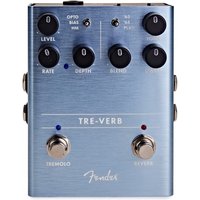
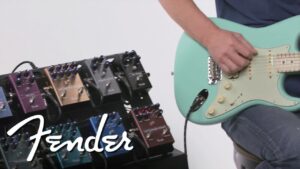
Original Fender circuit. Lush effects that set the tone for whole genres of music. The Fender Tre-Verb Digital Reverb/Tremolo features an unmistakable Fender amp Tremolo and Reverb sound. Both Tremolo and Reverb effects work independently at your feet in one easy-to-use compact design. Featuring classic reverb effects from Fenders renowned spring reverb units from 1963 and 1965; with multiple Tremolo modes to choose from you can create the exact sound you want for your music. Complete with stereo inputs and outputs to ensure easy connection to any pedalboard or amp.
Fender Tre-Verb Digital Reverb & Tremolo
£219.00
This is a New Fender Tre-Verb Digital Reverb & Tremolo from Fender its found in our Tremolo & Vibrato Pedals on the Just Pedals menu. Read More below.
View Just Fender
As an affiliate partner, we may earn a small commission when you buy through our links — at no extra cost to you.
Related videos


Brand
Fender
Fender’s effects line draws on the company’s Southern California instrument-and-amplifier history. The all-original pedal range Fender introduced in the late 2010s was designed in Southern California with input from gigging and studio musicians. JustPedals listings include The Bends compressor, Marine Layer reverb, Pugilist distortion, Tre-Verb and Smolder Acoustic Overdrive. That range connects familiar Fender amplifier sounds with dedicated stompboxes, while also covering bass and acoustic applications. The brand name does not indicate where every model was manufactured; compare each pedal’s controls, routing and model-specific specifications.
Category
Tremolo & Vibrato Pedals
Tremolo varies amplitude, making volume rise and fall; vibrato varies pitch, making the note move sharp and flat. Some circuits combine both or derive them from modulation systems that blur the boundary. Rate, depth, waveform and stereo phase determine whether the motion is smooth, pulsing, choppy, seasick or spatial, while tap tempo can lock the cycle to a rhythm.
Tags
Digital
Converts the signal or control process into numerical data for algorithmic processing. Digital designs can provide precise timing, long memory, complex routing and repeatable presets; sample rate, conversion, internal resolution and latency influence fidelity and response.
Reverb
Builds a dense tail of reflections around the original sound. Early reflections establish apparent distance and size, while decay, diffusion, damping and modulation shape the density, brightness and movement of the later field. Pre-delay separates the dry attack from the ambience, and mix controls their relative level.
Stereo
Processes, creates or passes two audio channels. True stereo preserves separate left and right inputs, while mono-to-stereo effects generate spatial differences internally; routing, phase behaviour and whether trails remain stereo determine the resulting image. Some outputs sum to mono when only one socket is connected, which can change level or modulation depth.
Others Just Ordered :
- I Love A Happy Accident… – Animals Pedal

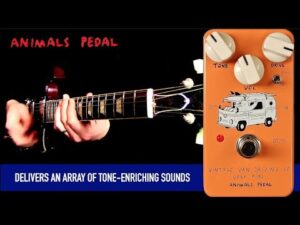
- Animals Pedal Vintage Van Driving is Very Fun Overdrive
- Animals Pedal Sunday Afternoon Is Infinity Bender

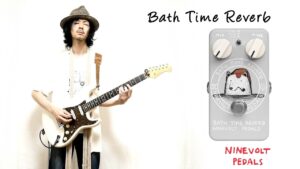
- Ninevolt Pedals | Bath Time Reverb (Animals Pedal)
- This Fuzz Pedal Makes No Sense… But It Sounds Incredible

- ANIME Pedals | Animals Pedal Custom Illustrated Series