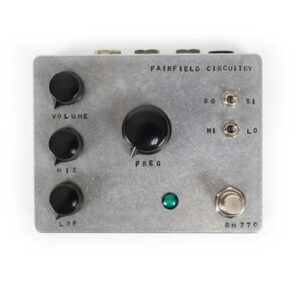
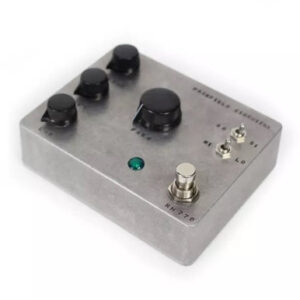
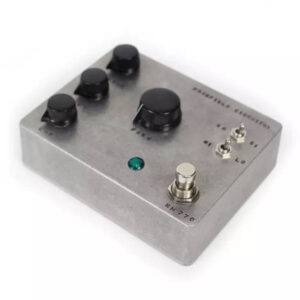
Fairfield Circuits Randys Revenge Ring Modulator Pedal

£299.00

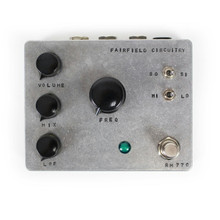
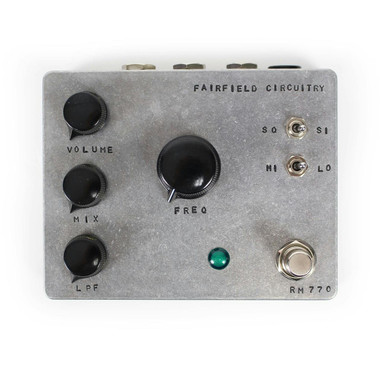
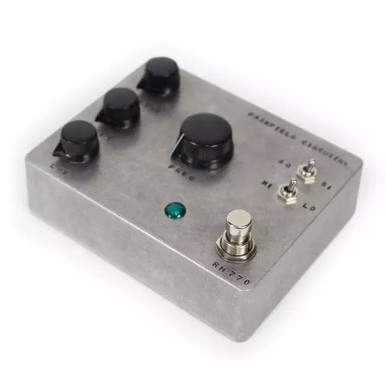
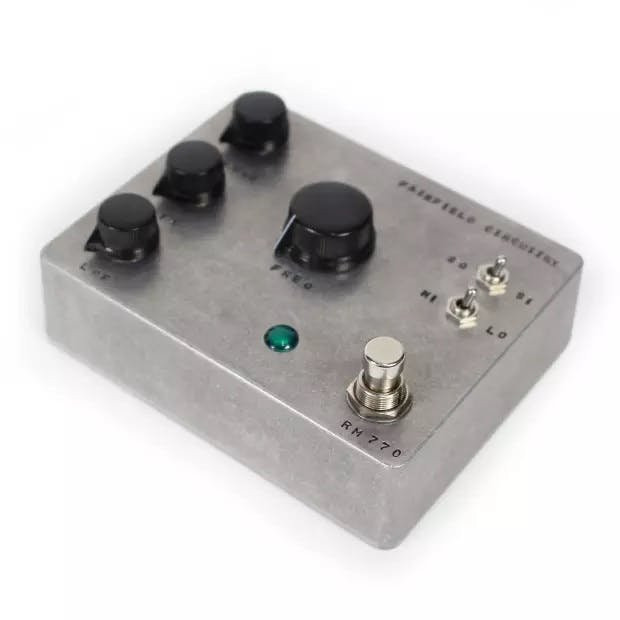
This is the Fairfield Circuits Randys Revenge Ring Modulator Pedal from Fairfield Circuitry, listed in Modulation Pedals on Just Pedals. Read More below.

View Just
more
and ,

Fairfield Curcuits make great sounding, simply designed pedals and the Randys Revenge is a stunning Ring Modulator. At its finest, in a considerably small package, powered by your typical 9V power supply, all analogue, hand stamped, pure sine wave oscillator, low-pass filtered with a touch of class and apparently musical. These are the requirements of warp speed space travel; a regular occurrence when dealing with Randy’s hardware.

The lower oscillator frequencies create rich trem/vibe effects, excruciatingly slow or chopped up rhythmic flavours. As the frequency goes up, thick bells, tuned intervals, low-fidelity synth-like effects are only the beginning. Experimenting with the low-pass filter cutoff frequency and the dry/wet mix will yield tones as strange or subtle as desired.

Featuring expanded control voltage (CV) capabilities that allow for interactions beyond the simple stacking of effects, Randy can be used to control and be controlled by other CV capable devices. The stereo CV is switch-programmable for use with an expression pedal or as a 2-channel CV port. Both the oscillator and low-pass filter frequency are voltage-controllable. The internal oscillator is also available as an output, turning Randy into a stand-alone voltage-controlled oscillator (VCO).

NOTES ON POWERING

Randy’s Revenge was designed to operate using your typical centre negative, regulated 9-9.6 VDC power supply. The pedal is protected against reversed polarity and overvoltage conditions. Always check your power supply for proper voltage and polarity before connecting. There is no battery connection inside the pedal.

Specifications

TECHNICALS

  • input impedance 1 M
  • output impedance 1 k
  • power supply 9 to 9.6 VDC
  • current draw 85 mA

PHYSICALS

  • true true bypass
  • 1/4” mono input/output jacks
  • 1/4” stereo CV jack
  • 2.1mm DC connector
  • 4.7” x 3.8” enclosure dimensions

Brand

Fairfield Circuitry

Fairfield Circuitry is a boutique pedal company based in Hull, Quebec, Canada, known for its unique and innovative effects pedals designed for guitarists and bassists. Founded by Guillaume Fairfield, the company has gained recognition for its commitment to craftsmanship, creativity, and sonic excellence.

Fairfield Circuitry pedals are revered for their distinctive designs, offering musicians a wide range of effects to explore and incorporate into their music. Each pedal is meticulously handcrafted using high-quality components and features intuitive controls, allowing musicians to easily dial in their desired tones.

One of Fairfield Circuitry’s most acclaimed pedals is the Shallow Water, a dynamic tremolo pedal that simulates the unpredictable behaviour of vintage magnetic tape machines and tube amplifiers. The Shallow Water offers a unique and organic tremolo effect with a touch of modulation, creating lush, swirling textures reminiscent of ocean waves.

Category

Modulation Pedals

Modulation changes a signal through a continuously moving control source. This broad category covers effects that alter delay time, phase, pitch, amplitude or filtering to create rotation, movement and evolving texture when no narrower effect family is dominant. Waveform, rate, depth, stereo phase and control routing determine the shape and spatial behaviour of that movement.

Tags

Analogue

The signal is shaped by continuously varying electronic circuitry rather than being converted into a digital effect algorithm. Component choice, operating voltage and circuit tolerances influence headroom, noise, clipping texture and the small variations in response between designs.

Stereo

Processes, creates or passes two audio channels. True stereo preserves separate left and right inputs, while mono-to-stereo effects generate spatial differences internally; routing, phase behaviour and whether trails remain stereo determine the resulting image. Some outputs sum to mono when only one socket is connected, which can change level or modulation depth.