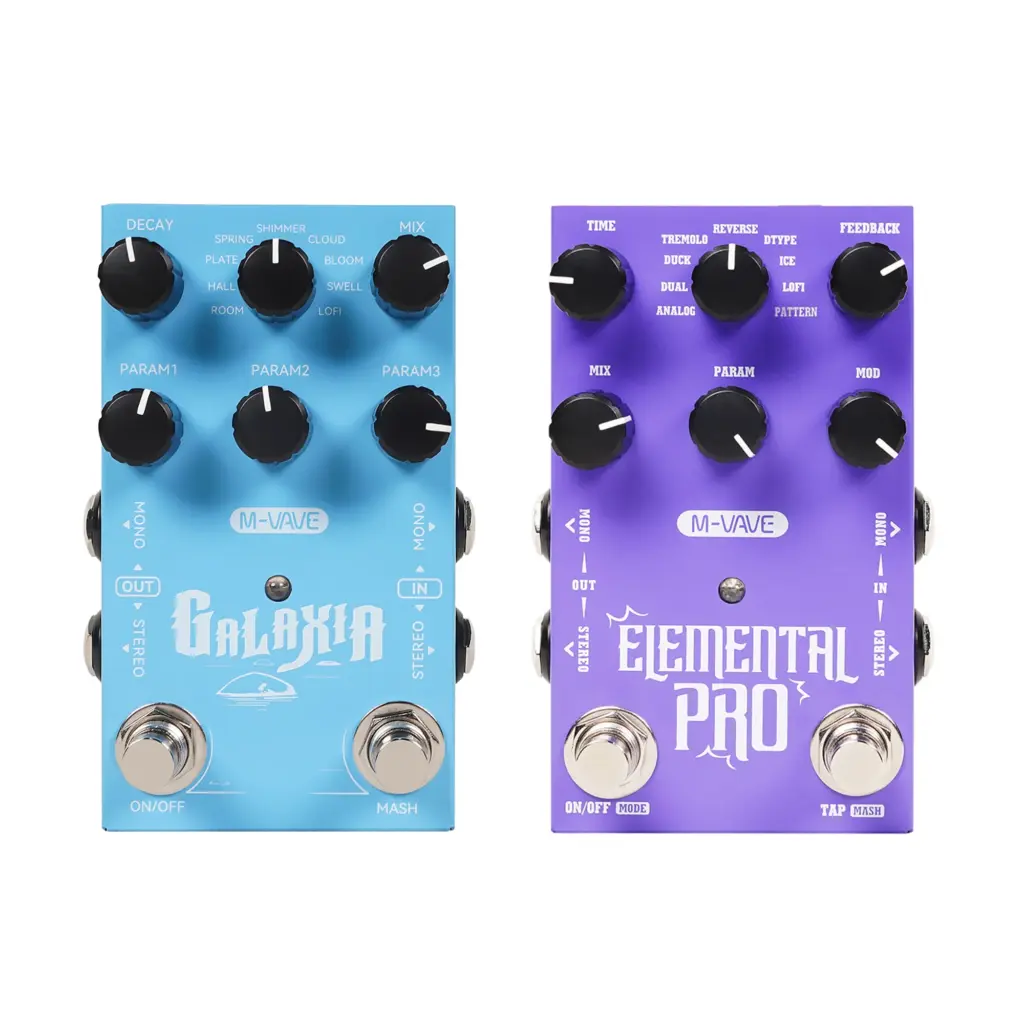
Here at JustPedals we think you can rely on Electric to make great Guitar Pedals. Check out the Electric Pedal Mini Single Type Crunch Distortion Classic Chorus Delay Digital Delay on JustPedals now. Electric Guitar Effects Pedal Mini Single Type Crunch Distortion Classic Chorus Delay Digital Delay
Electric Pedal Mini Single Type Crunch Distortion Classic Chorus Delay Digital Delay
The Electric Pedal Mini Single Type Crunch Distortion Classic Chorus Delay Digital Delay is new on JustPedals, and instock direct. Electric Guitar Effects Pedal Mini Single Type Crunch Distortion Classic Chorus Delay Digital Delay
As an affiliate partner, we may earn a small commission when you buy through our links — at no extra cost to you.
Category
Chorus Pedals
Chorus pedals mix the dry signal with one or more short, modulated delays to create movement, width and gentle pitch variation. Rate controls the speed of the modulation; depth controls its excursion; blend, tone and stereo routing determine how prominent the effect becomes. Slower, shallow settings can add width without obscuring the note, while deeper settings move towards a seasick or synthetic wobble. Analogue bucket-brigade and digital designs can behave differently, so check mono compatibility, headroom and the placement of the pedal after drives or before a mixer.
Delay Pedals
Delay pedals repeat the input after a set time, from a short slapback to long ambient trails. Feedback controls how many repeats continue; filtering, modulation, saturation and mix shape their tone and prominence. Tap tempo can keep rhythmic delays aligned with a song, while presets and MIDI help when several timings are needed. Analogue, tape-style and digital designs respond differently to transients and overload. Check maximum delay time, spillover, stereo routing, trails and headroom before choosing a model for the rest of the board.
Distortion Pedals
Distortion pedals use stronger or more deliberate clipping than a typical overdrive, adding harmonics, compression and sustain. Some are voiced for amp-like crunch, others for high-gain rhythm or a deliberately abrasive texture. Gain, tone, presence, resonance and output controls determine how the pedal interacts with the amplifier and pickups; a blend or noise gate can preserve clarity in heavier settings. Placement changes the result, so check whether the design is intended to push an amp, run into a clean platform or feed a direct cabinet simulation.
Guitar Pedals
Guitar pedals are compact devices placed in the signal path to change level, tone, dynamics, pitch, time, modulation or routing. This broad category includes simple analogue effects, digital processors, switching and utility products, so the most important differences are the circuit function and connection method. Check whether a model expects instrument or line level, how it is powered, whether it preserves bass or stereo information, and how its bypass behaves with the rest of the board.
Tags
Chorus
Chorus mixes the dry signal with one or more short, modulated delays to create movement, width and gentle pitch variation. Rate sets the speed; depth sets the excursion; blend, tone and stereo routing control how prominent the effect becomes. Shallow settings can widen a clean part without obscuring the note, while deeper settings create a pronounced wobble. Check mono compatibility, headroom and the position after drives or before a mixer.
Delay
Delay repeats the input after a set time. Feedback controls how long the repeats continue, while filtering, modulation, saturation and mix shape their character and prominence. Tap tempo can set rhythmic timing hands-free, and presets or MIDI can recall several timings. Check maximum delay time, spillover, trails, stereo routing, headroom and whether the pedal is analogue, tape-style or digital when the repeat response is important.
Digital
Digital products use conversion and processing to create, store or control the effect. This can provide presets, complex routing, repeatable algorithms, USB, MIDI and firmware features, but conversion, latency, power requirements and clocking depend on the design. Check the input and output levels, sample or impulse-response support, bypass behaviour and current draw when combining a digital unit with analogue pedals or a direct recording setup.
Distortion
Distortion uses deliberate clipping to add harmonics, compression and sustain. Some circuits are voiced for amp-like crunch, others for high-gain rhythm or an abrasive texture. Gain, tone, presence, resonance, blend and noise-control features determine how the pedal interacts with pickups and the next stage. Before choosing, decide whether it will push an amplifier, run into a clean platform or feed a cabinet simulation, because the same control settings can behave very differently in each route.
Electric
Electric is an instrument-compatibility label for products intended for electric guitars, basses or other amplified sources. It does not identify one effect circuit, so the useful questions are input impedance, frequency range, headroom, pickup response and output format. Check the individual listing for the intended instrument, tuning, power requirement and whether the product is meant for an amplifier, interface, PA or another pedal.
Mini Pedal
Mini pedals use a reduced-width enclosure to conserve pedalboard space. Their smaller format may limit battery access, footswitch spacing and the number or size of controls, while side-mounted sockets and power placement determine how much space is saved once connected. Check dimensions, power draw, control reach and output headroom, particularly if several mini pedals will be placed close together or controlled in low light.
- Mooer Meta FX – Review
- MOOER META FX Review: 3 Effects in 1—but Here’s the Problem
- I Wasn’t Expecting To Be Impressed – But What Is The Mooer Meta FX?
- Mooer // META FX Stereo Multi-Effect Platform (Demo)
- A NEW GENERATION OF PEDALS IS HERE – Mooer Meta FX Reverb Review
- Mooer META FX | All the REVERBS from subtle to WILD!