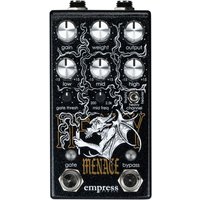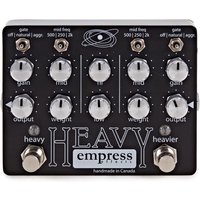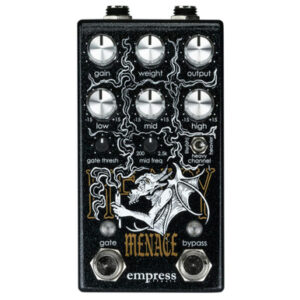
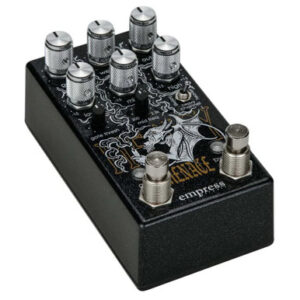

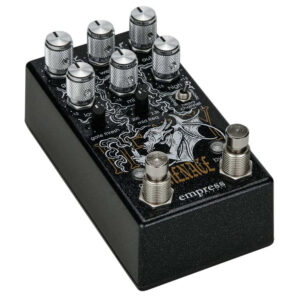
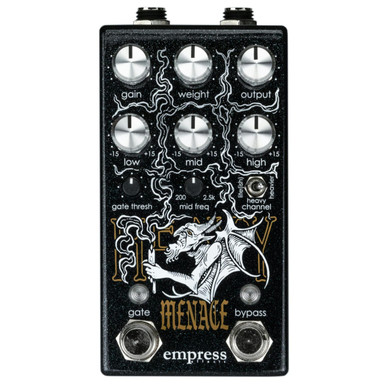
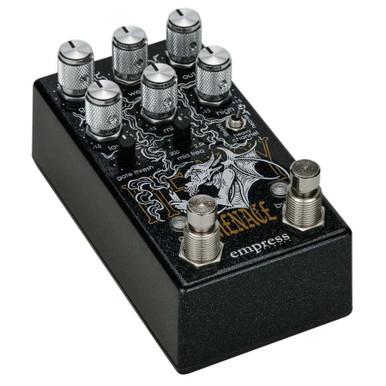
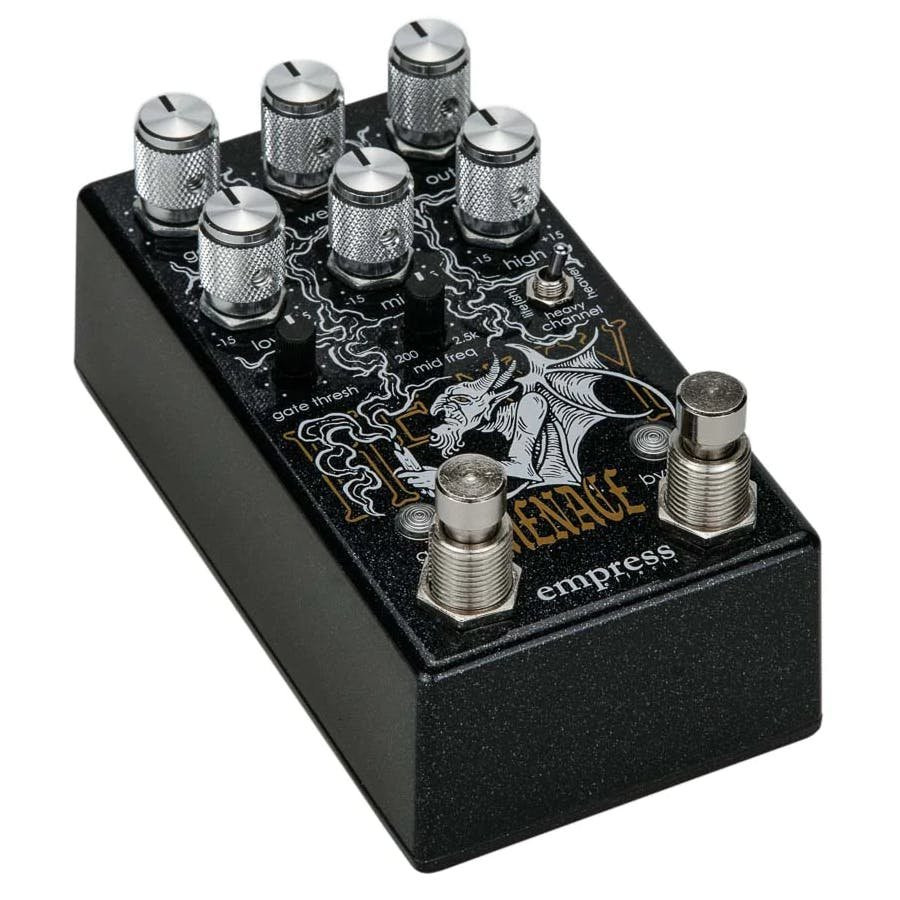
The Heavy Menace is "the most versatile distortion pedal" Empress has ever created, in their own words. It's an evolution of their original Heavy pedal but with new features and a more compact enclosure. In addition to the original 'Heavy' and 'Heavier' modes, the Heavy Menace adds a new 'Lite(ish)' mode — covering any high-gain sound from classic hard rock to searing modern metal.
Key Features
- Three versatile distortion modes — Light(ish), Heavy, and Heavier.
- Footswitchable noise gate.
- 3-band EQ with sweepable mid frequency.
- Weight control to sculpt low frequency response.
- Linked or independent switching of the distortion and gate.
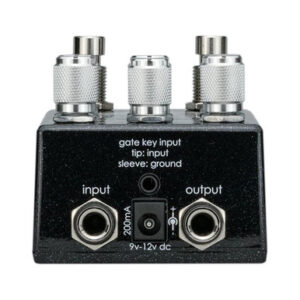
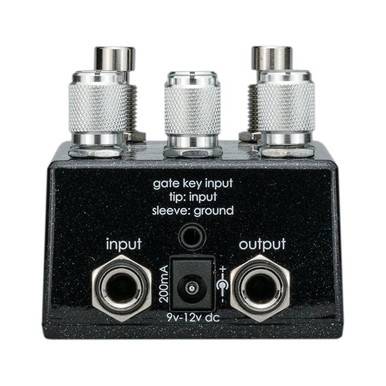
- Gate key input (1/8" TS or TRS).
- True bypass or buffered bypass.
Enhanced EQ
Empress are obsessed with EQ, and the 3-band circuit on the Heavy Menace is one of their best. The 'Weight' control adjusts a high-pass filter in the distortion circuit to shape low-end character. Turn it up for a thick, full sound, or turn counter-clockwise for a tight response that's perfect for palm muting and extended-range guitars.
Midrange is a key element of a great distorted sound, so the mid frequency is sweepable from 200 Hz to 2.5 kHz to dial in the sweet spot for your guitar and amp. Scoop for a tight, aggressive sound, or push to add definition and cut through a mix.
Adaptive Gate
Players loved the gate on the original Heavy. Envelope followers in the circuit respond to your playing, letting sustained notes decay naturally but clamping down quickly during fast stops.
On the Heavy Menace, this gate is now footswitchable, with two available modes of operation. In normal bypass mode, the gate doesn’t affect the signal if the distortion is off, while independent bypass mode is like having separate distortion and gate pedals.
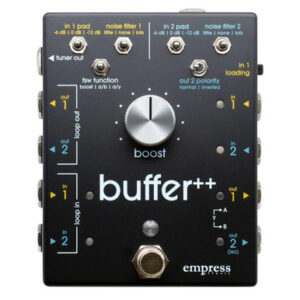
We’ve also added a key input so you can optionally trigger the gate with an external signal. This is particularly useful if you have additional pedals before the Heavy Menace in your signal chain, such as a low-gain pedal for stacking. Split a clean signal with a pedal like our Buffer+ and connect it to the Gate Key Input, and the gate will behave consistently regardless of changes at the main input.
Specifications
- Input Impedance: 1MΩ
- Output Impedance: 100Ω
- Frequency Response (-3dB): 35Hz – 17kHz
- Input Voltage: 9-12V DC
- Required Current: 250mA
- Power Input Connector: 2.1mm Barrel Connector
- Dimensions (H x L x W): 2.5" x 4.8" x 2.6"
- Weight: 1 lb