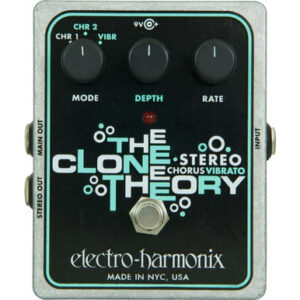
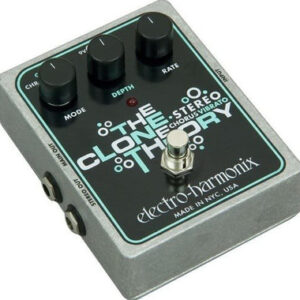
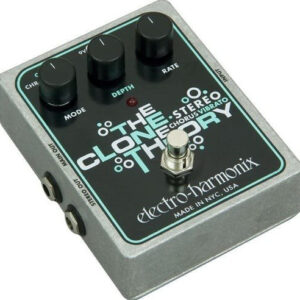
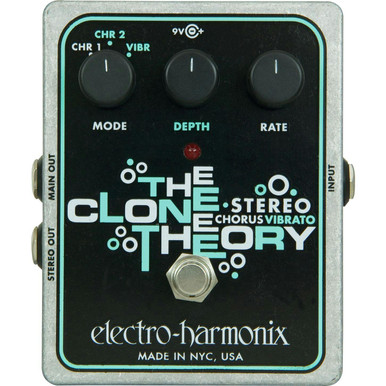
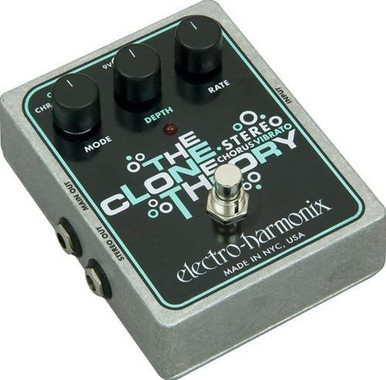
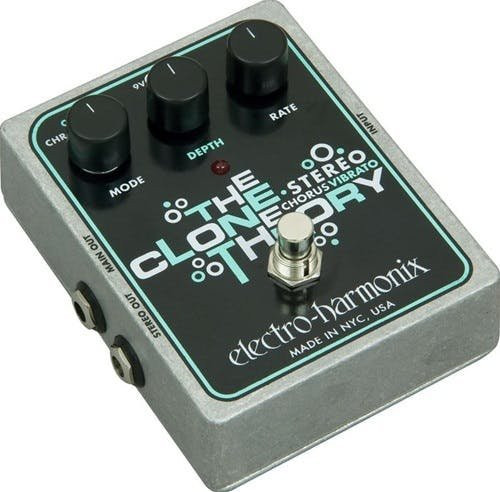
Electro Harmonix Stereo Clone Theory

£109.99

This is a New Electro Harmonix Stereo Clone Theory from Electro Harmonix, listed in Specialist Effects Pedals on Just Pedals. Read More below.

View Just
more
and

Electro Harmonix Stereo Clone Theory

The ultimate chorus pedal. Lush, warm and defined chorusing and vibrato. Simple but definitive performance controls. Use the stereo outputs and be enveloped in a spatial shimmer.

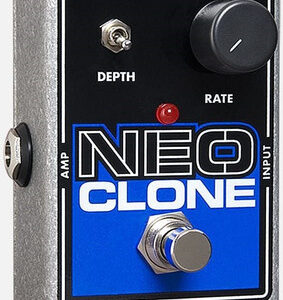
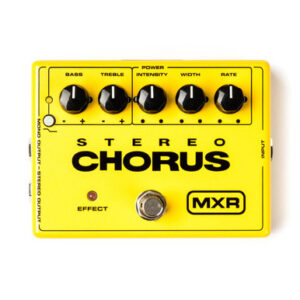
The Electro-Harmonix Micro Clone Theory Stereo Chorus Effects Pedal resurrects the popular Clone Theory Chorus/Vibrato pedal as part of the Electro-Harmonix XO die cast series. Now in stereo and a much smaller, improved housing, the Micro Clone Theory Stereo Effects Pedal features the same features and controls that so many guitarists loved and relied on to ring out lush, sparkling washes of tone from the original.

Features

Controls:
Chorus/Vibrato mix
Rate
Depth 

Battery included – power supply available
Related videos

Brand

Electro Harmonix

In the current JustPedals catalogue, Electro Harmonix is represented by Fuzz Pedals, Overdrive Pedals and Octave Pedals. Current listings include Q-Tron+, Nano Clone and V256 Vocoder. That makes the range relevant to players looking for drive, gain and clipping, plus time-based effects and ambience. Check each model for its exact circuit or processing platform, controls, power requirements and connections, particularly where the catalogue includes both pedals and supporting gear.

Category

Specialist Effects Pedals

Specialist effects alter the signal in ways that do not sit cleanly inside one established family. They may use granular processing, frequency shifting, resonators, freeze or sustain, bit reduction, ring modulation, feedback networks or combinations of several techniques. The relevant distinction is the underlying process, its tracking or latency, and how completely the dry signal can be blended or replaced.

Tags

Stereo

Processes, creates or passes two audio channels. True stereo preserves separate left and right inputs, while mono-to-stereo effects generate spatial differences internally; routing, phase behaviour and whether trails remain stereo determine the resulting image. Some outputs sum to mono when only one socket is connected, which can change level or modulation depth.