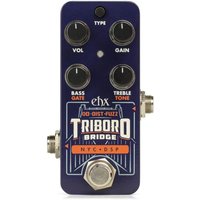
The EHX Pico Triboro Bridge is a dynamic drive pedal offering a broad tonal palette and multiple gain modes in a remarkably compact form. This tri-mode unit featuring Overdrive Distortion and Fuzz modes can effortlessly bridge any tonal gap in your rig serving as a tonal centrepiece or offering a new spin on the same old drives youre accustomed to. Featuring intuitive Treble and Bass EQ controls in addition to a Input Contouring EQ its a breeze to mould your sound to your needs – from vintage crackles to brutal modern aggression. The Pico Triboro Bridge is also incredibly versatile in terms of saturation with drive distortion and fuzz modes that cover a wide range of gain levels without sacrificing clarity or dynamics. This makes it perfect for players who want a single pedal that can handle all of their gain needs without taking up valuable space on their pedalboard.
Electro Harmonix Pico Triboro Bridge Overdrive / Fuzz / Distortion
This is a New Electro Harmonix Pico Triboro Bridge Overdrive / Fuzz / Distortion from Electro Harmonix is in our Overdrive Pedals category on Just Pedals. Read More below.
As an affiliate partner, we may earn a small commission when you buy through our links — at no extra cost to you.
Related videos

Brand
Electro Harmonix
Founded by Mike Matthews in New York City in 1968, Electro-Harmonix became known for inventive effects that brought new sounds within reach of guitarists. Its first product was the LPB-1 Linear Power Booster; the company’s long-running catalogue ranges from fuzz and overdrive to delay, modulation, octave and experimental processing. JustPedals listings include the Small Clone chorus, Small Stone phaser, Memory Boy delay, POG 2 octave generator and Micro Q-Tron envelope filter. Check the exact version and power requirements when comparing EHX models, since familiar names often span different generations and formats.
Category
Overdrive Pedals
Overdrive uses soft or moderate clipping to add harmonics and compression while retaining more of the original note shape than heavy distortion. Some circuits emphasise the midrange and trim bass before clipping; others remain broad, transparent or amplifier-like. Gain, clipping arrangement, headroom and tone filtering decide whether it supplies a light edge, a saturated drive sound or extra push into another gain stage.
Tags
Bass
Voiced or equipped to retain low-frequency fundamentals and the higher headroom of a bass signal. Clean blends, crossovers and bass-specific filter ranges can preserve weight and articulation while the effected portion adds harmonics, movement or ambience.
Distortion
Clips the waveform firmly and adds a dense series of harmonics with compression and sustain. The clipping devices, gain stages and tone filters determine whether the result is tight, smooth, mid-focused, scooped, grainy or deliberately abrasive.
Fuzz
Pushes the signal into extreme clipping, often approaching a square wave and producing dense harmonics. Transistor type, bias, input loading and filtering govern whether the texture is smooth, woolly, gated, spluttering, octave-rich or highly responsive to the instrument volume.
Others Just Ordered :
- I Love A Happy Accident… – Animals Pedal
- Animals Pedal Vintage Van Driving is Very Fun Overdrive
- Animals Pedal Sunday Afternoon Is Infinity Bender
- Ninevolt Pedals | Bath Time Reverb (Animals Pedal)
- This Fuzz Pedal Makes No Sense… But It Sounds Incredible

- ANIME Pedals | Animals Pedal Custom Illustrated Series