
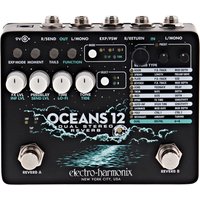
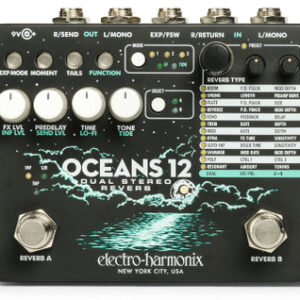
A sea of sonic potential. The Electro Harmonix Oceans 12 Dual Stereo Reverb presents players with a revolutionary addition to their pedalboard. Developed from the game-changing Oceans 11 pedal – this unit blows its competition out the water. Its packed with 12 different reverb effects and 24 presets gifting you with a myriad of ways to decorate your playing. And with two simultaneous stereo reverb engines at your disposal you can combine your favourite sounds and implement them into your live or studio rig.But its your sound after all So you need to have complete control. Which is why Electro Harmonix have loaded it with a vast array of intricate features to let you dial in your perfect tone. Whether you want long ambient trails to fill the mix or rather a subtle echo to fuel your solos – the Oceans 12 quite simply has it all. Theres even tap tempo to ensure your effects are dialled-in to perfection during performance. Because this is a pedal crafted for musicians of all abilities genres and playing styles. Ready to dive in?
Electro Harmonix Oceans 12 Dual Stereo Reverb
This is a New Electro Harmonix Oceans 12 Dual Stereo Reverb from Electro Harmonix is in our Reverb Pedals category on Just Pedals. Read More below.
As an affiliate partner, we may earn a small commission when you buy through our links — at no extra cost to you.
Related videos

Brand
Electro Harmonix
Founded by Mike Matthews in New York City in 1968, Electro-Harmonix became known for inventive effects that brought new sounds within reach of guitarists. Its first product was the LPB-1 Linear Power Booster; the company’s long-running catalogue ranges from fuzz and overdrive to delay, modulation, octave and experimental processing. JustPedals listings include the Small Clone chorus, Small Stone phaser, Memory Boy delay, POG 2 octave generator and Micro Q-Tron envelope filter. Check the exact version and power requirements when comparing EHX models, since familiar names often span different generations and formats.
Category
Reverb Pedals
Reverb creates the dense pattern of reflections heard after sound enters a physical or imagined space. Room, hall, plate and spring models differ in reflection density, frequency decay and modulation, while ambient algorithms extend or transform the tail beyond natural acoustics. Decay, pre-delay, damping, diffusion and wet/dry balance define the apparent size, surface and distance of that space.
Tags
Presets
Stores complete groups of parameter values for later recall. The number of locations, switching time, spillover behaviour and whether presets include routing, expression and MIDI assignments determine how completely one sound can change into another.
Stereo
Processes, creates or passes two audio channels. True stereo preserves separate left and right inputs, while mono-to-stereo effects generate spatial differences internally; routing, phase behaviour and whether trails remain stereo determine the resulting image. Some outputs sum to mono when only one socket is connected, which can change level or modulation depth.
Tap Tempo
Measures repeated foot taps and converts their interval into an effect rate or delay time. Subdivisions translate that pulse into dotted, triplet or other rhythmic values, while averaging and range limits influence how quickly and accurately the tempo settles.
Others Just Ordered :
- I Love A Happy Accident… – Animals Pedal

- Animals Pedal Vintage Van Driving is Very Fun Overdrive
- Animals Pedal Sunday Afternoon Is Infinity Bender

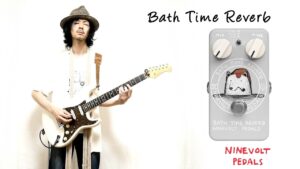
- Ninevolt Pedals | Bath Time Reverb (Animals Pedal)
- This Fuzz Pedal Makes No Sense… But It Sounds Incredible

- ANIME Pedals | Animals Pedal Custom Illustrated Series