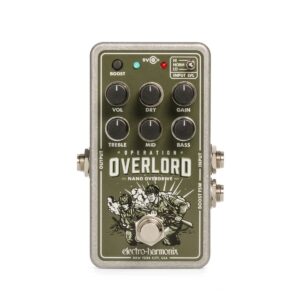
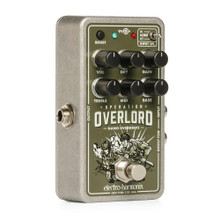
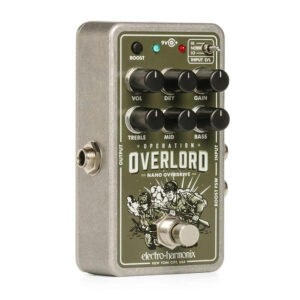
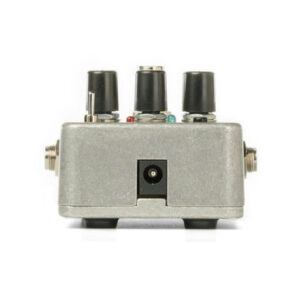
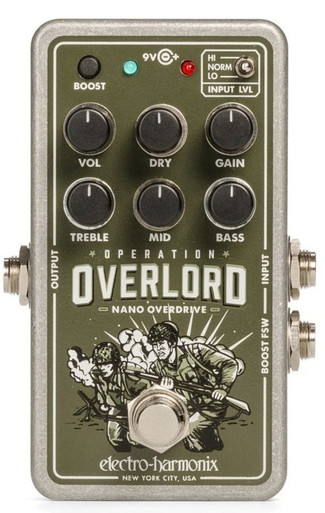
Electro Harmonix Nano Operation Overlord drive

£99.99

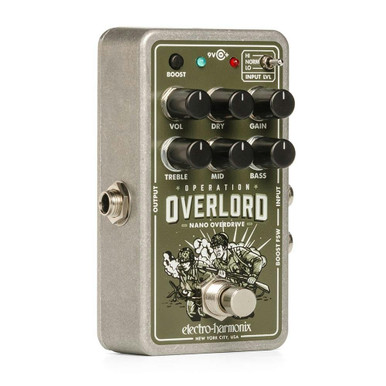
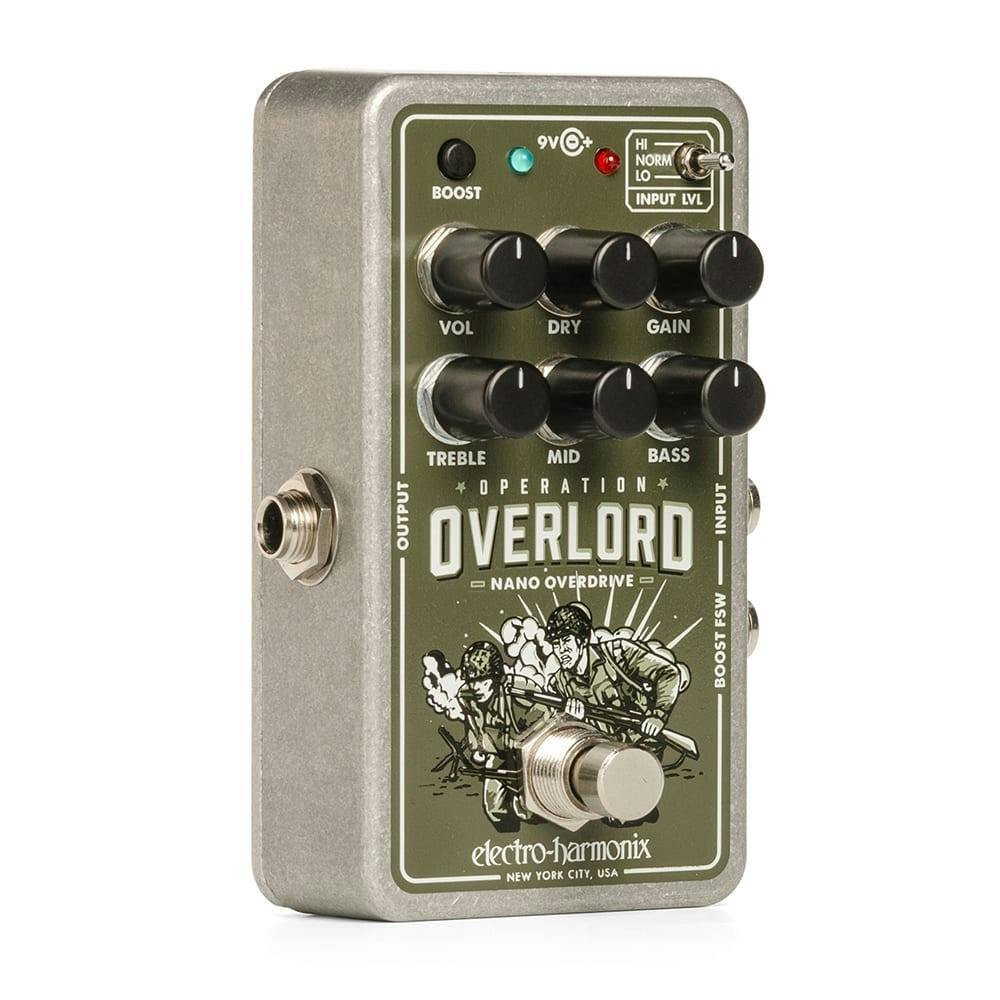
This is the Electro Harmonix Nano Operation Overlord drive from Electro Harmonix, listed in Specialist Effects Pedals on Just Pedals. Read More below.

View Just
more
and ,

Here's what Electro Harmonix say about the Nano Operation Overlord Allied Overdrive:

A nano-sized version of the Operation Overlord with the same great overdrive and distortion tones, but in mono for those who don’t require stereo ins/outs. It’s super versatile and ready for your axe be it guitar, bass or keys.

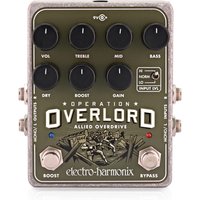
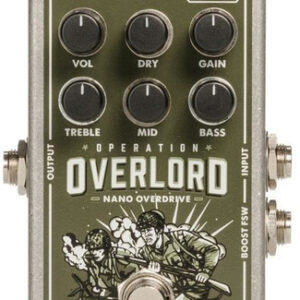
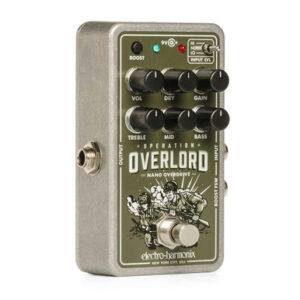
The EHX Nano Overlord is switchable between two modes: Normal and Boost. Normal mode provides low to medium gain sounds and relies on three amp-like JFET gain stages. When Boost mode is engaged it’s like adding a pedal-type OD circuit in front of the JFET stages to really increase overall distortion. The pedal also features a Dry blend control which is invaluable for bass and keyboards, a 3-position input level selector switch and an active 3-band EQ.

“The Overlord will likely strike many as a bounteous, ultra-affordable one-stop option for adding dirt and/or dBs to both guitar and bass.” – Premier Guitar

Key Features

  • Compact, yet feature laden overdrive and distortion pedal
  • Create sounds ranging from boost without the grit and sweet crunch all the way to intensely saturated overdrive and thick distortion
  • 3-position input level switch lets you set the initial input gain level for a variety of instruments including guitar, bass and keyboards
  • Active 3-band EQ for superlative tone shaping
  • In Normal Mode three amp-like JFET gain stages provide low to medium gain sounds
  • In the switchable Boost Mode a classic pedal-style overdrive circuit is added before the JFET stages to increase overall distortion
  • The pedal’s Dry blend control is especially useful for bass and keyboards because it lets you retain your instrument’s articulation, harmonic content and bottom end
  • Power adapter included

Related videos

Brand

Electro Harmonix

Electro-Harmonix (EHX) is a legendary manufacturer of guitar pedals and audio electronics, renowned for their distinctive sound and pioneering designs. Established in 1968 by Mike Matthews, EHX has played a significant role in shaping the landscape of effects pedals. The company’s pedals are celebrated for their innovative circuits and unique tones, earning them a dedicated following among musicians across genres. From classics like the Big Muff Pi fuzz to modern favorites like the POG octave generator, Electro-Harmonix pedals are known for their versatility and sonic character.

EHX’s product lineup spans a wide range of effects categories, including distortion, modulation, delay, and reverb, among others. Their pedals often feature intuitive controls and rugged construction, making them suitable for both stage and studio use. In addition to their iconic standalone pedals, Electro-Harmonix has also produced notable units such as the Memory Man delay/echo and the Holy Grail reverb, which have become staples in many guitarist’s rigs. With a legacy of innovation and a commitment to quality, Electro-Harmonix continues to be a leading force in the world of guitar effects, inspiring musicians to explore new sonic possibilities.

Category

Specialist Effects Pedals

Specialist effects alter the signal in ways that do not sit cleanly inside one established family. They may use granular processing, frequency shifting, resonators, freeze or sustain, bit reduction, ring modulation, feedback networks or combinations of several techniques. The relevant distinction is the underlying process, its tracking or latency, and how completely the dry signal can be blended or replaced.

Tags

Bass

Voiced or equipped to retain low-frequency fundamentals and the higher headroom of a bass signal. Clean blends, crossovers and bass-specific filter ranges can preserve weight and articulation while the effected portion adds harmonics, movement or ambience.

Stereo

Processes, creates or passes two audio channels. True stereo preserves separate left and right inputs, while mono-to-stereo effects generate spatial differences internally; routing, phase behaviour and whether trails remain stereo determine the resulting image. Some outputs sum to mono when only one socket is connected, which can change level or modulation depth.