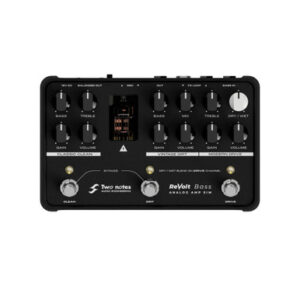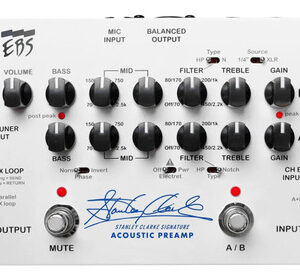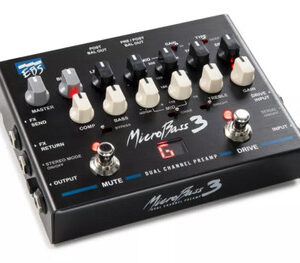
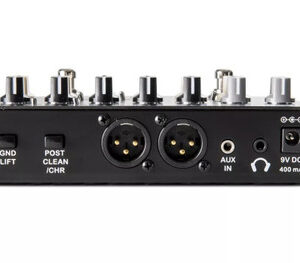
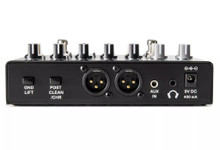

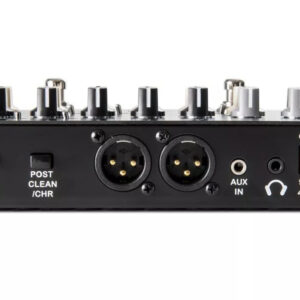
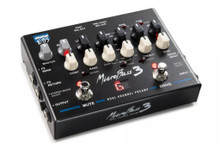
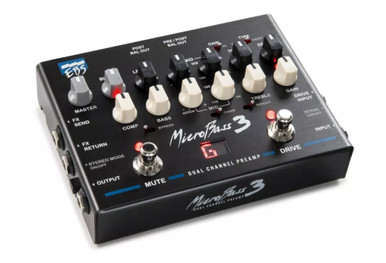
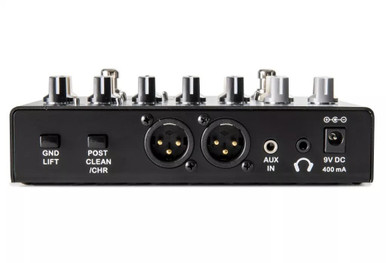
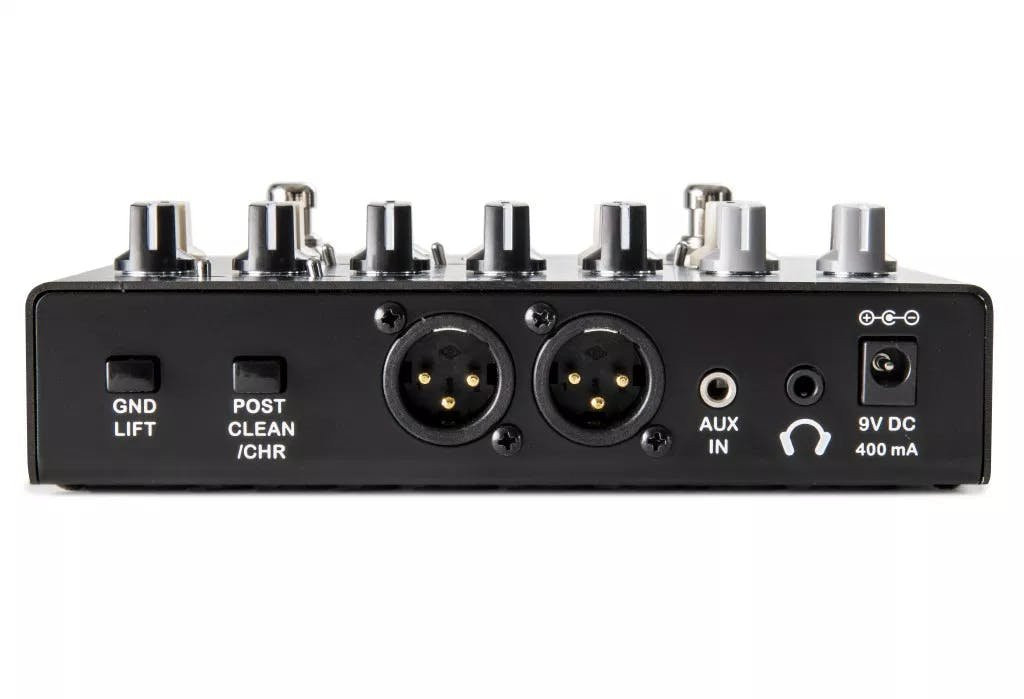
The EBS-MB3 is a preamp with two channels, produced using high-end materials and parts. You’ll have plenty of headroom to play with as the preamp works at a signal level that is equal to a pro mixing console. This higher signal means you can use it as a preamp alongside any type of standard power amp.
Useful Built-In Tools
A number of in-built features separate the EBS-MB3 from the rest. The two contrasting channels (drive and clean) can be used either parallel or in series. The dual balanced XLR-Outputs can tap the signal post and pre-EQ simultaneously, while 10 M Ohms of Input Impedance let it handle absolutely any kind of bass. An onboard tuner means you can tune without needing another device. This is a seriously versatile piece of kit!
Features
- Professional, Analogue Preamp
- Dual Channels (Overdrive & Clean)
- Blend Control (for Drive)
- Run Either in Parallel or Series
- Dual Balanced XLR-Out (Pre & Post EQ or Stereo)
- Effects Loop (Mono or Stereo) – Running in Stereo Mode the Balanced Outputs Become Left & Right Output
- Character and Bright Filters (Clean Channel)
- HI or LO Gain Drive Engines
- Thin or Deep Type (Drive Channel)
- Onboard Compressor
- Tuner, Aux Input
- Headphones Out
- 10 M Ohms Input Impedance
- 9V DC, 450 mA Required (Power Supply is Included)
Specifications
General:
- Weight: 660g (1.5lbs)
- Dimensions (W x D x H): 6.6" x 4.9" x 2.1"
Aux Info:
- Power Requirements: Idle 450mA @9V. Max 750mA @ 9V (with Headphones at Max Output Level
Balanced Outputs:
- Options: Pre/Post EQ, L/R Channel in Stereo Mode
- XLR Connections: 1-GND, 2-Hot, 3-Cold
- Output Level: Nominal -20dBv
Output:
- Output Impedance: <1 k Ohms
- Signal Level: Nominal 0 dBv
Aux Input:
- Input Impedance: 20 k Ohms
- Nominal Level: -10 dBv
Phones Out:
- Recommended Impedance: 32 – 200 Ohms
Effects Loop:
- Input Impedance: > 200 k Ohms // 22 pF
- Output Impedance: < 100 Ohms
- Gain: Unity (1:1)
- Loop Signal Level: Nominal -10 dBv
Drive Channel:
- Input: Input Impedance 1.8 M Ohms // 22 pF
- Drive: Gain Range 40 dB
- Engines: Lo: Type 2nd Harmonics Soft, Hi: Type Symmetrical 2-Stage with +18 dB Gain
- Type: Thin/Normal/Deep Pre-Drive EQ
- Filter Section: Tone Filter: Type 6 dB/Oct. Low Pass. Frequency Range 700-20k Hz. Middle Filter: Type Bandpass Filter. Frequency Range 100 – 4.500 Hz. Q 1.2, Gain Range +/- 15 dB
Clean Channel:
- Input Impedance: Parallel Mode 1.5 M Ohms // 44 pF, Serial Mode 10 M Ohms // 22 pF
- Gain: Gain Range min/max -00/ +30 dB, Gain Peak LED +10 dBv, Frequency Response +0 / -3 dB 20 – 20.000 Hz
Character:
- Filter Type: Shelving High/Low Pass
- Gain: Lo +6 dB @ 80 Hz, Mid -2 dB @ 900 Hz, Hi +3 dB @ 7.5 kHz
Bright:
- Filter Type Shelving: Gain +10 dB @ 10 kHz
Filter Section:
- Bass Filter: Type 12 dB/oct. Shelving. Gain Range +/- 18 dB @ 60 Hz
- Middle Filter: Type Bandpass Filter. Freq Range 50 – 5.000 Hz. Q -Boost 0.5 – 1.3, Q – Cut 0.5 >5. Gain Range +/- 12-15 dB
- Treble Filter: Type Shelving. Gain Range +/- 18 dB @ 8 kHz
- Comp/Limit: Comp Gain 0 Db. Attenuation Max 24 dB, Compression Ratio Max 3:1, Attack (80%) typ <10 ms, Release (80%) typ 100 ms