
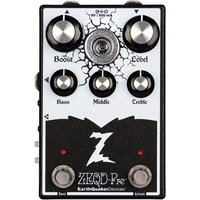
The EarthQuaker Devices ZEQD-Pre Tube Preamp is an all-analog amplifier solution designed to deliver genuine tube character in a compact pedalboard-friendly format. Created in collaboration with Dr. Z Amplification it combines EarthQuaker Devices forward-thinking design with decades of tube amp expertise. At its core is an EF86 pentode tube known for its hi-fi clarity dynamic response and expressive feel. Built to live at the end of your signal chain the ZEQD-Pre adds warmth depth and harmonic richness to anything you run through it. A passive three-band EQ integrated analog cabinet simulation balanced XLR output and professional headphone out make it equally suited to recording silent practice and live performance. With no menus IRs or digital processing its a simple musical all-analog alternative to modern amp modelling.
EarthQuaker Devices ZEQD-Pre Tube Preamp
This is a New EarthQuaker Devices ZEQD-Pre Tube Preamp from EarthQuaker Devices its found in our Preamp & DI Pedals on the Just Pedals menu. Read More below.
As an affiliate partner, we may earn a small commission when you buy through our links — at no extra cost to you.
Related videos

Brand
EarthQuaker Devices
Musician Jamie Stillman founded EarthQuaker Devices in 2004 after moving from pedal repair into circuit design. The first full-production release was the Hoof fuzz in 2007. The company develops its pedals in-house in Akron, Ohio, where it hand-builds and hand-tests them and backs them with a lifetime guarantee. Current JustPedals examples show the range’s practical and exploratory sides: Ghost Echo reverb, Data Corrupter harmonizer, Avalanche Run delay and reverb, and Rainbow Machine pitch shifting. EarthQuaker’s own design philosophy pairs usable controls with sounds that can move well beyond conventional effects.
Category
Preamp & DI Pedals
A preamp brings an instrument signal to a controlled level and shapes its impedance, gain and frequency balance before amplification or recording. A DI converts the signal for a balanced, low-impedance connection and may include ground lift, pad and transformer isolation. Combined units can add drive, cabinet filtering, effects loops and parallel outputs while keeping the direct path stable.
Tags
Analogue
The signal is shaped by continuously varying electronic circuitry rather than being converted into a digital effect algorithm. Component choice, operating voltage and circuit tolerances influence headroom, noise, clipping texture and the small variations in response between designs.
Digital
Converts the signal or control process into numerical data for algorithmic processing. Digital designs can provide precise timing, long memory, complex routing and repeatable presets; sample rate, conversion, internal resolution and latency influence fidelity and response.
Others Just Ordered :
- I Love A Happy Accident… – Animals Pedal

- Animals Pedal Vintage Van Driving is Very Fun Overdrive
- Animals Pedal Sunday Afternoon Is Infinity Bender
- Ninevolt Pedals | Bath Time Reverb (Animals Pedal)
- This Fuzz Pedal Makes No Sense… But It Sounds Incredible

- ANIME Pedals | Animals Pedal Custom Illustrated Series