
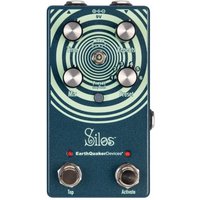
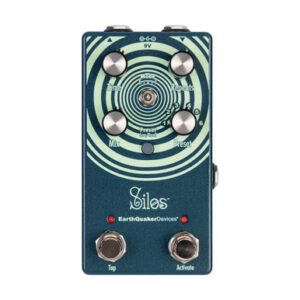
The Earthquaker Devices Silos Multi-Generational Time Reflection Device is perfect for musicians seeking a versatile delay pedal with digital analog and tape delay modes. Each mode offers unique sonic characteristics ranging from bright clear digital repeats to murky analog delays and vintage-style tape echoes. With the ability to save six custom presets and assign expression control to any key parameter the Silos provides endless flexibility. Its tap tempo and up to one second of delay time make it an excellent tool for adding rhythmic textures or atmospheric depth to your sound. Designed for both live and studio use the Silos responds exceptionally well to distortion and saturation.
Earthquaker Devices Silos Multi-Generational Time Reflection Device
£199.00
This is a New Earthquaker Devices Silos Multi-Generational Time Reflection Device from EarthQuaker Devices its found in our Specialist Effects Pedals on the Just Pedals menu. Read More below.
View Just EarthQuaker Devices
As an affiliate partner, we may earn a small commission when you buy through our links — at no extra cost to you.
Related videos

Brand
EarthQuaker Devices
Musician Jamie Stillman founded EarthQuaker Devices in 2004 after moving from pedal repair into circuit design. The first full-production release was the Hoof fuzz in 2007. The company develops its pedals in-house in Akron, Ohio, where it hand-builds and hand-tests them and backs them with a lifetime guarantee. Current JustPedals examples show the range’s practical and exploratory sides: Ghost Echo reverb, Data Corrupter harmonizer, Avalanche Run delay and reverb, and Rainbow Machine pitch shifting. EarthQuaker’s own design philosophy pairs usable controls with sounds that can move well beyond conventional effects.
Category
Specialist Effects Pedals
Specialist effects alter the signal in ways that do not sit cleanly inside one established family. They may use granular processing, frequency shifting, resonators, freeze or sustain, bit reduction, ring modulation, feedback networks or combinations of several techniques. The relevant distinction is the underlying process, its tracking or latency, and how completely the dry signal can be blended or replaced.
Tags
Analogue
The signal is shaped by continuously varying electronic circuitry rather than being converted into a digital effect algorithm. Component choice, operating voltage and circuit tolerances influence headroom, noise, clipping texture and the small variations in response between designs.
Digital
Converts the signal or control process into numerical data for algorithmic processing. Digital designs can provide precise timing, long memory, complex routing and repeatable presets; sample rate, conversion, internal resolution and latency influence fidelity and response.
Presets
Stores complete groups of parameter values for later recall. The number of locations, switching time, spillover behaviour and whether presets include routing, expression and MIDI assignments determine how completely one sound can change into another.
Tap Tempo
Measures repeated foot taps and converts their interval into an effect rate or delay time. Subdivisions translate that pulse into dotted, triplet or other rhythmic values, while averaging and range limits influence how quickly and accurately the tempo settles.
Others Just Ordered :
- I Love A Happy Accident… – Animals Pedal

- Animals Pedal Vintage Van Driving is Very Fun Overdrive
- Animals Pedal Sunday Afternoon Is Infinity Bender
- Ninevolt Pedals | Bath Time Reverb (Animals Pedal)
- This Fuzz Pedal Makes No Sense… But It Sounds Incredible

- ANIME Pedals | Animals Pedal Custom Illustrated Series