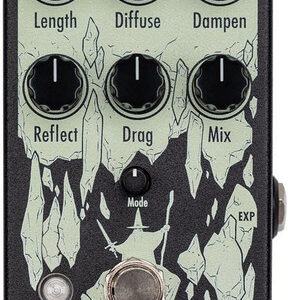
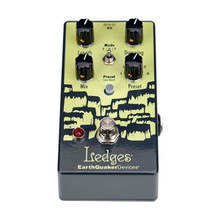
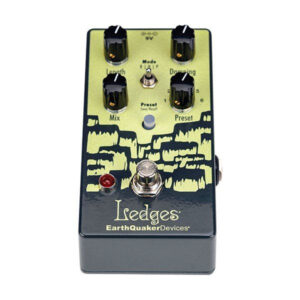
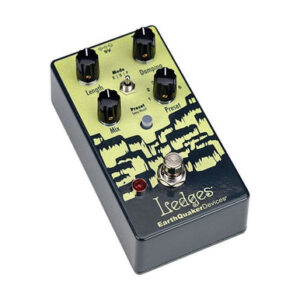
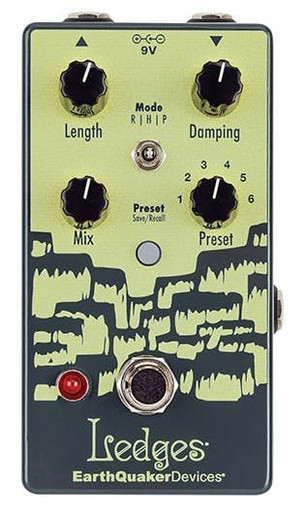
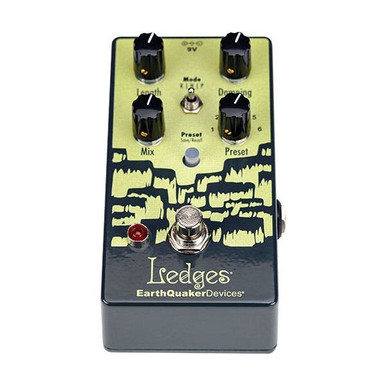
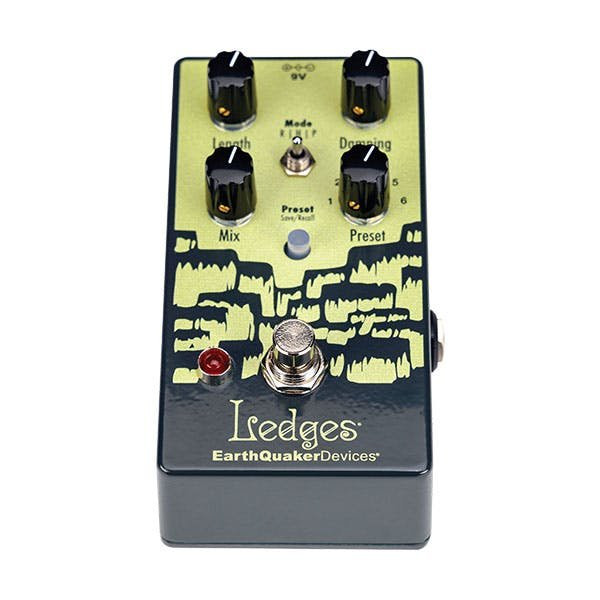
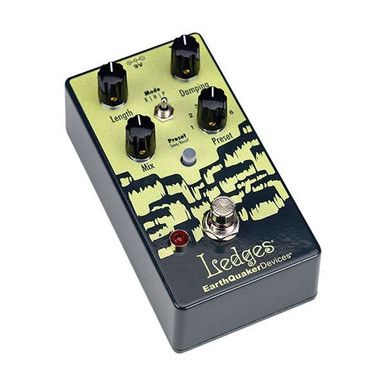
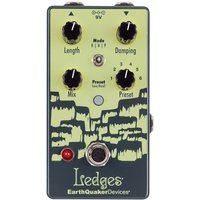
Earthquaker Devices Ledges Tri-Dimensional Reverberation Machine Reverb Pedal

£194.99

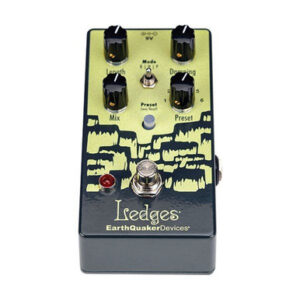
This is a New Earthquaker Devices Ledges Tri-Dimensional Reverberation Machine Reverb Pedal from EarthQuaker Devices, listed in Reverb Pedals on Just Pedals. Read More below.

View Just
more
and , , ,

From classic, standard reverb tones to undiscovered sonic reaches, it’s everything you’ve ever wanted and needed out of a reverb.

The three switchable modes each deliver a unique blend of reverb but are connected through a spectrum. The Room setting at its shortest achieves a small, boxy room sound that gradually gets bigger as you turn it up. As you increase the Hall setting, it morphs into a Cathedral-style reverb that becomes really big, boomy and echoey with distant reflections. Turn up the Plate setting to get bouncy reflections that recycle and reverberate forever.

The pedal features Silent Soft-Touch Relais-Based switching with buffered bypass and trails, and has an all-analogue dry signal path and digital effect signal path.

Key Features

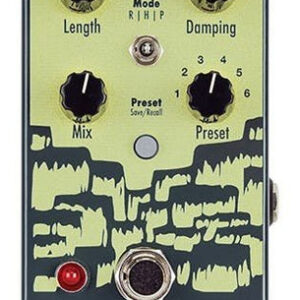
  • 6 Easily User-Editable and Accessible Preset Slots – Makes it simple to save your favourite settings, for on-the-fly changes.
  • 6 Reverb Presets – Simply select a number with the switchable knob and then engage the Save on the center button and dial in your perfect sound.
  • EXP Jack with User-Assignable Expression Pedal or Voltage Control – Pedal control over any parameter.

3 Effects Modes

  • Mode R: The Room setting at its shortest achieves a small, boxy room sound that gradually gets bigger as you turn it up.
  • Mode H: The Hall setting becomes big, boomy, and echoey with distant reflections.
  • Mode P: The Plate setting creates bouncy reflections that recycle and reverberate forever.

Modes of Operation

  • Live Mode – Green LED- pedal will operate exactly where the controls are set, any changes will have no effect on the presets unless saved.
  • Preset Mode – Red LED – recalls stored settings for each control, actual control settings will be ignored.
Related videos

Brand

EarthQuaker Devices

Musician Jamie Stillman founded EarthQuaker Devices in 2004 after moving from pedal repair into circuit design. The first full-production release was the Hoof fuzz in 2007. The company develops its pedals in-house in Akron, Ohio, where it hand-builds and hand-tests them and backs them with a lifetime guarantee. Current JustPedals examples show the range’s practical and exploratory sides: Ghost Echo reverb, Data Corrupter harmonizer, Avalanche Run delay and reverb, and Rainbow Machine pitch shifting. EarthQuaker’s own design philosophy pairs usable controls with sounds that can move well beyond conventional effects.

Category

Reverb Pedals

Reverb creates the dense pattern of reflections heard after sound enters a physical or imagined space. Room, hall, plate and spring models differ in reflection density, frequency decay and modulation, while ambient algorithms extend or transform the tail beyond natural acoustics. Decay, pre-delay, damping, diffusion and wet/dry balance define the apparent size, surface and distance of that space.

Tags

Analogue

The signal is shaped by continuously varying electronic circuitry rather than being converted into a digital effect algorithm. Component choice, operating voltage and circuit tolerances influence headroom, noise, clipping texture and the small variations in response between designs.

Buffered Bypass

Keeps an active buffer in the signal path when the effect is bypassed. The buffer converts a high-impedance input to a lower-impedance output, helping long cables and multiple pedals retain level and high frequencies, although its headroom and noise remain part of the path.

Digital

Converts the signal or control process into numerical data for algorithmic processing. Digital designs can provide precise timing, long memory, complex routing and repeatable presets; sample rate, conversion, internal resolution and latency influence fidelity and response.

Presets

Stores complete groups of parameter values for later recall. The number of locations, switching time, spillover behaviour and whether presets include routing, expression and MIDI assignments determine how completely one sound can change into another.