
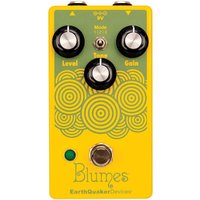
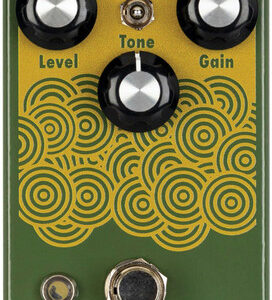
The EarthQuaker Devices Blumes Low Signal Shredder Overdrive is an innovative bass overdrive effects pedal that redefines the boundaries of sonic exploration. Designed for the modern bassist it takes a unique approach to overdrive with a modified Plumes circuit that delivers twice the gain and a deeper bass response. This pedal offers three unique clipping options: symmetrical LED asymmetrical silicon and a no diode OpAmp drive giving musicians the freedom to sculpt their sound with precision. Not just feature-packed the Blumes Low Signal Shredder Overdrive is crafted with a commitment to quality and durability. It boasts of an all-analogue signal path and internal bipolar power operation which ensures integrity of signal and enriches the tonal output. The inclusion of Flexi-Switch Technology makes it a versatile choice for both momentary and traditional latching footswitch operation. Handcrafted in Akron Ohio and backed by a lifetime warranty this pedal is a testament to superior craftsmanship and reliability. Despite its powerful capabilities the pedals compact design and low current draw of 25 mA make it an efficient and space-saving addition to any musicians kit.
EarthQuaker Devices Blumes Low Signal Shredder Overdrive
This is a New EarthQuaker Devices Blumes Low Signal Shredder Overdrive from EarthQuaker Devices is in our Overdrive Pedals category on Just Pedals. Read More below.
As an affiliate partner, we may earn a small commission when you buy through our links — at no extra cost to you.
Related videos

Brand
EarthQuaker Devices
Musician Jamie Stillman founded EarthQuaker Devices in 2004 after moving from pedal repair into circuit design. The first full-production release was the Hoof fuzz in 2007. The company develops its pedals in-house in Akron, Ohio, where it hand-builds and hand-tests them and backs them with a lifetime guarantee. Current JustPedals examples show the range’s practical and exploratory sides: Ghost Echo reverb, Data Corrupter harmonizer, Avalanche Run delay and reverb, and Rainbow Machine pitch shifting. EarthQuaker’s own design philosophy pairs usable controls with sounds that can move well beyond conventional effects.
Category
Overdrive Pedals
Overdrive uses soft or moderate clipping to add harmonics and compression while retaining more of the original note shape than heavy distortion. Some circuits emphasise the midrange and trim bass before clipping; others remain broad, transparent or amplifier-like. Gain, clipping arrangement, headroom and tone filtering decide whether it supplies a light edge, a saturated drive sound or extra push into another gain stage.
Tags
Analogue
The signal is shaped by continuously varying electronic circuitry rather than being converted into a digital effect algorithm. Component choice, operating voltage and circuit tolerances influence headroom, noise, clipping texture and the small variations in response between designs.
Bass
Voiced or equipped to retain low-frequency fundamentals and the higher headroom of a bass signal. Clean blends, crossovers and bass-specific filter ranges can preserve weight and articulation while the effected portion adds harmonics, movement or ambience.
DIY Kit
Supplied as components and hardware to be assembled into a working pedal. Circuit complexity, board layout, enclosure preparation and off-board wiring set the difficulty, while accurate component values, polarity and solder joints determine the final noise, reliability and sound.
Others Just Ordered :
- I Love A Happy Accident… – Animals Pedal

- Animals Pedal Vintage Van Driving is Very Fun Overdrive

- Animals Pedal Sunday Afternoon Is Infinity Bender

- Ninevolt Pedals | Bath Time Reverb (Animals Pedal)

- This Fuzz Pedal Makes No Sense… But It Sounds Incredible

- ANIME Pedals | Animals Pedal Custom Illustrated Series