
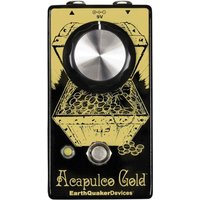
The EarthQuaker Devices Acapulco V2 Gold Distortion is a roaring one-knob pedal that captures the explosive sound of a cranked vintage Model T amplifier. It delivers raw open distortion with massive character letting you summon searing crunch raunchy overdrive or spanky cleans simply by adjusting your guitars controls.Built with true bypass relay switching and designed for pure simplicity the Acapulco V2 gives you huge amp-like tones without the size maintenance or cost of the real thing. Its single giant volume knob and touch-sensitive response make it a powerful and versatile addition to any pedalboard.
EarthQuaker Devices Acapulco V2 Gold Distortion
£134.99
This is a New EarthQuaker Devices Acapulco V2 Gold Distortion from EarthQuaker Devices is in our Distortion Pedals category on Just Pedals. Read More below.
View Just EarthQuaker Devices
As an affiliate partner, we may earn a small commission when you buy through our links — at no extra cost to you.
Related videos

Brand
EarthQuaker Devices
Musician Jamie Stillman founded EarthQuaker Devices in 2004 after moving from pedal repair into circuit design. The first full-production release was the Hoof fuzz in 2007. The company develops its pedals in-house in Akron, Ohio, where it hand-builds and hand-tests them and backs them with a lifetime guarantee. Current JustPedals examples show the range’s practical and exploratory sides: Ghost Echo reverb, Data Corrupter harmonizer, Avalanche Run delay and reverb, and Rainbow Machine pitch shifting. EarthQuaker’s own design philosophy pairs usable controls with sounds that can move well beyond conventional effects.
Category
Distortion Pedals
Distortion clips the waveform more firmly than overdrive, generating dense upper harmonics, longer sustain and a more compressed response. Circuit topology and filtering decide whether the sound is tight and focused, broad and aggressive, smooth or deliberately abrasive. Gain sets the amount of clipping, while pre- and post-distortion tone controls strongly influence low-end definition, midrange presence and high-frequency texture.
Tags
True Bypass
Connects input directly to output through mechanical or relay switching when the effect is off, removing the active circuit from the audio path. It avoids buffer colour but leaves cable capacitance and switching design to influence high-frequency loss and possible switching noise.
Others Just Ordered :
- I Love A Happy Accident… – Animals Pedal

- Animals Pedal Vintage Van Driving is Very Fun Overdrive

- Animals Pedal Sunday Afternoon Is Infinity Bender

- Ninevolt Pedals | Bath Time Reverb (Animals Pedal)

- This Fuzz Pedal Makes No Sense… But It Sounds Incredible

- ANIME Pedals | Animals Pedal Custom Illustrated Series