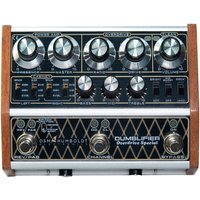
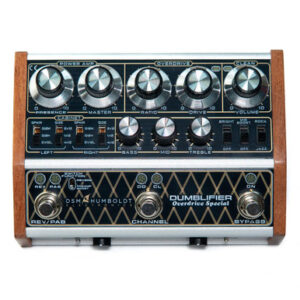
The Dumblifier Overdrive Special is DSM & Humboldt?s fully analogue take on the mythical Dumble ODS a sound players have chased for decades. Instead of relying on digital processing this pedal recreates the amps natural compression bloom and dynamic feel using authentic analogue amplifier-modelling circuitry. Every nuance of your playing translates through the Dumblifier from touch-sensitive cleans to harmonically rich overdrive that sings sustains and reacts just like the real thing. Designed as both a two-channel overdrive pedal and a complete amp-replacement solution the Dumblifier packs in stereo cabinet simulation stereo reverb TRS outputs with cab bypass a stereo FX loop and DI outs for stage or studio use. With flexible tone-shaping switches intuitive controls and a rugged custom-machined aluminium chassis with wooden side panels it delivers the legendary Dumble experience in a portable reliable and gig-ready format.
DSM & Humboldt Dumblifier Overdrive Special
This is a New DSM & Humboldt Dumblifier Overdrive Special from DSM & Humboldt its found in our Overdrive Pedals on the Just Pedals menu. Read More below.
As an affiliate partner, we may earn a small commission when you buy through our links — at no extra cost to you.
Brand
DSM & Humboldt
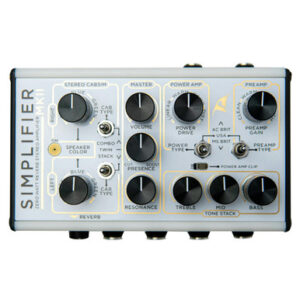
In the current JustPedals catalogue, DSM & Humboldt is represented by Amp & Cab Simulator Pedals, Preamp & DI Pedals and Overdrive Pedals. Current listings include DSM/Humboldt Sub-Atomic, DSM/Humboldt Simplifier X and DSM/Humboldt Simplifier Mk II. That makes the range relevant to players looking for drive, gain and clipping, plus modelling, direct rigs and multi-effects. Check each model for its exact circuit or processing platform, controls, power requirements and connections, particularly where the catalogue includes both pedals and supporting gear.
Category
Overdrive Pedals
Overdrive uses soft or moderate clipping to add harmonics and compression while retaining more of the original note shape than heavy distortion. Some circuits emphasise the midrange and trim bass before clipping; others remain broad, transparent or amplifier-like. Gain, clipping arrangement, headroom and tone filtering decide whether it supplies a light edge, a saturated drive sound or extra push into another gain stage.
Tags
Analogue
The signal is shaped by continuously varying electronic circuitry rather than being converted into a digital effect algorithm. Component choice, operating voltage and circuit tolerances influence headroom, noise, clipping texture and the small variations in response between designs.
Digital
Converts the signal or control process into numerical data for algorithmic processing. Digital designs can provide precise timing, long memory, complex routing and repeatable presets; sample rate, conversion, internal resolution and latency influence fidelity and response.
Stereo
Processes, creates or passes two audio channels. True stereo preserves separate left and right inputs, while mono-to-stereo effects generate spatial differences internally; routing, phase behaviour and whether trails remain stereo determine the resulting image. Some outputs sum to mono when only one socket is connected, which can change level or modulation depth.
Others Just Ordered :
- I Love A Happy Accident… – Animals Pedal
- Animals Pedal Vintage Van Driving is Very Fun Overdrive
- Animals Pedal Sunday Afternoon Is Infinity Bender
- Ninevolt Pedals | Bath Time Reverb (Animals Pedal)
- This Fuzz Pedal Makes No Sense… But It Sounds Incredible
- ANIME Pedals | Animals Pedal Custom Illustrated Series