
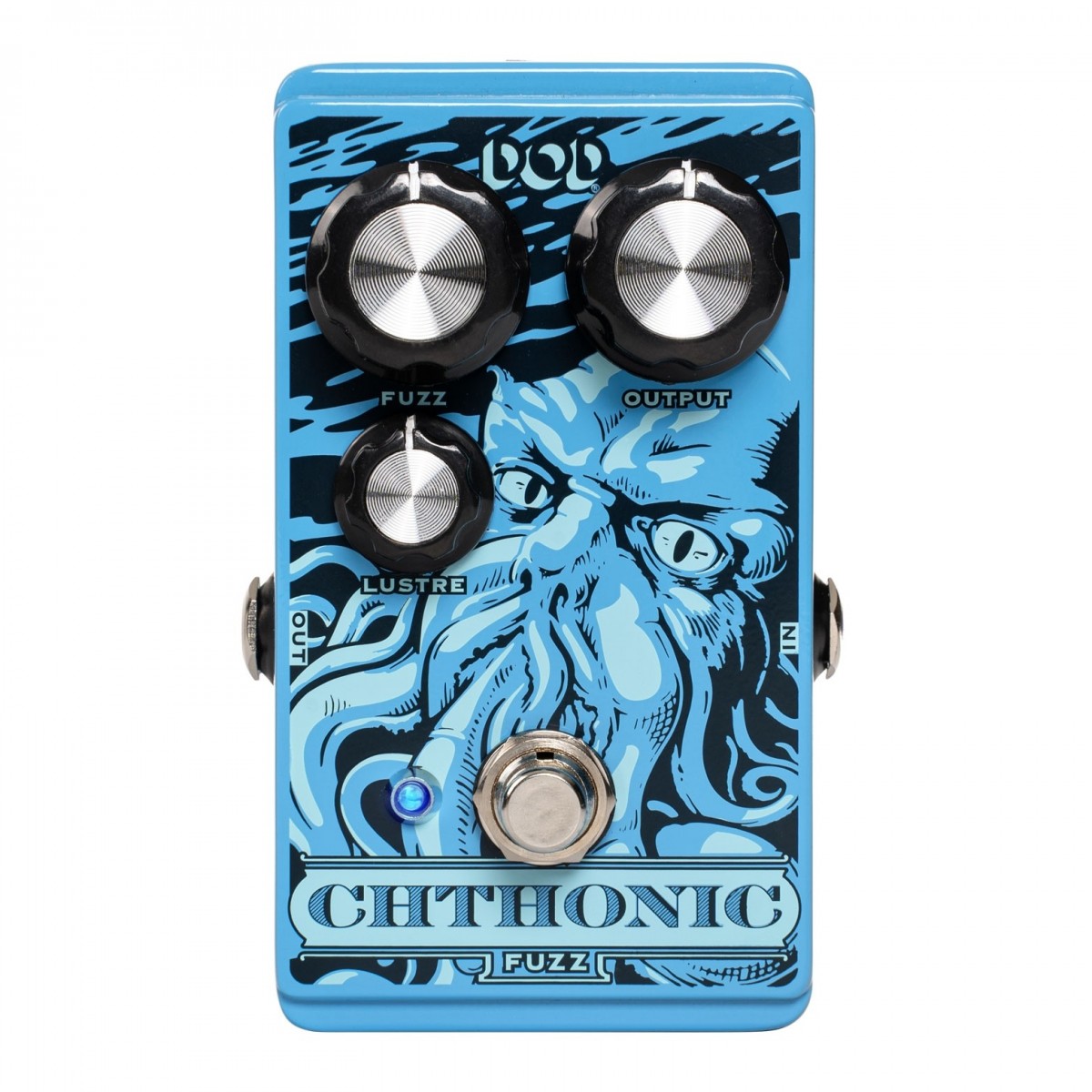
The DOD Chthonic Fuzz pedal is a blast of thick tone designed specifically for clean amps and brighter sounding guitars. This pedal delivers a hefty fudgy and sludgy fuzz tone that harmonizes flawlessly with single-coil P90 gold-foil and DeArmond style pickups. With an emphasis on brighter guitars and clean bright amps the Chthonic Fuzz Pedal is derived from a single-knob 70s fuzz circuit featuring a subtle tone control (Lustre) and a separate gain control (Fuzz) to create a powerful fuzz with an earthly dark flavour. The Chthonic Fuzz Pedal uses transistor clipping with a pair of 2N2222 transistors enabling outstanding clean-up similar to other notable fuzz pedals when using the guitar volume knob. Hailing from an alternate universe this pedal is a uniquely versatile choice that not only works wonders with PAF-style humbuckers but also stands as a dark companion to the Carcosa Fuzz. The Chthonics Kraken/Cthulhu graphics courtesy of the artist behind the Carcosa Fuzz artwork further enhance its cryptic allure. In essence the Chthonic is a darker fuzz pedal designed specifically for brighter guitars and amps that retains pick attack throughout its range while offering impeccable clean-up capabilities.
DOD Chthonic Fuzz Pedal
This is a New DOD Chthonic Fuzz Pedal from DOD, listed in Fuzz Pedals on Just Pedals. Read More below.
As an affiliate partner, we may earn a small commission when you buy through our links — at no extra cost to you.
Related videos
Brand
DOD
In the current JustPedals catalogue, DOD is represented by Delay Pedals, Wah & Filter Pedals and Preamp & DI Pedals. Current listings include Mini Volume, Bifet Boost 410 and Mini Expression. That makes the range relevant to players looking for drive, gain and clipping, plus time-based effects and ambience. Check each model for its exact circuit or processing platform, controls, power requirements and connections, particularly where the catalogue includes both pedals and supporting gear.
Category
Fuzz Pedals
Fuzz drives the signal into extreme clipping, often flattening the waveform and generating a thick spectrum of harmonics. Transistor type, bias, input loading and tone filtering create markedly different responses, from loose and velvety to gated, spluttering or octave-rich. Some circuits interact strongly with pickup impedance and guitar volume, while others include buffers or blends for a more consistent response.
Others Just Ordered :
- I Love A Happy Accident… – Animals Pedal

- Animals Pedal Vintage Van Driving is Very Fun Overdrive
- Animals Pedal Sunday Afternoon Is Infinity Bender
- Ninevolt Pedals | Bath Time Reverb (Animals Pedal)

- This Fuzz Pedal Makes No Sense… But It Sounds Incredible

- ANIME Pedals | Animals Pedal Custom Illustrated Series