
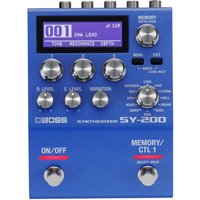
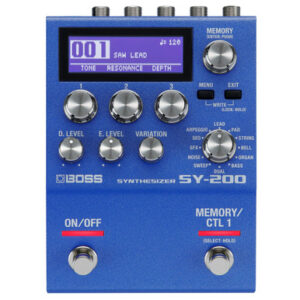
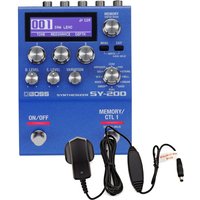
The Boss SY-200 Guitar/Bass synthesizer pedal opens up a whole new sonic landscape to explore. Ever wished that you could turn your guitar or bass into a synth? Well good news now you can. With 171 analogue-style tones you arent short of synth goodness – all are fully customisable thanks to three dials controlling the tone resonance and depth allowing you to discover without limits. In addition to the 171 total sounds you have 128 memory slots for storing your crazy creations. Effortlessly blend the synth sound with your normal sound thanks to independent level control dials. Versatile and vastly customisable Boss have created a fantastic synth that is compact portable and easily playable its a must have for any guitarist looking at delving into the world of synths.
Boss SY-200 Guitar/Bass Synthesizer Pedal
This is a New Boss SY-200 Guitar/Bass Synthesizer Pedal from Boss its found in our Synth Pedals on the Just Pedals menu. Read More below.
As an affiliate partner, we may earn a small commission when you buy through our links — at no extra cost to you.
Related videos

Brand
Boss
BOSS began in Osaka in 1973 as MEG Electronics, a company dedicated to effects. Its first BOSS-branded effect was the CE-1 Chorus Ensemble in 1976; the OD-1, SP-1 and PH-1 launched the compact-effects series in 1977. The JustPedals catalogue includes familiar overdrives and distortions such as the OD-3, SD-1, BD-2, DS-1 and MT-2 Metal Zone, as well as utility items such as the PCS-20A cable. BOSS now spans compact pedals, multi-effects, loopers, tuners and controllers. Manufacturing origin should be checked by model rather than inferred from the brand’s Japanese history.
Category
Synth Pedals
A synth pedal analyses an instrument signal and uses it to control generated oscillators, filters and envelopes. Unlike ordinary distortion, the output may replace the original waveform with a distinctly electronic voice. Tracking mode, pitch range, envelope response, filter movement, polyphony and dry blend determine how accurately the synthesis follows playing dynamics and whether the result behaves as bass, lead, pad or texture.
Tags
Analogue
The signal is shaped by continuously varying electronic circuitry rather than being converted into a digital effect algorithm. Component choice, operating voltage and circuit tolerances influence headroom, noise, clipping texture and the small variations in response between designs.
Bass
Voiced or equipped to retain low-frequency fundamentals and the higher headroom of a bass signal. Clean blends, crossovers and bass-specific filter ranges can preserve weight and articulation while the effected portion adds harmonics, movement or ambience.
Others Just Ordered :
- I Love A Happy Accident… – Animals Pedal

- Animals Pedal Vintage Van Driving is Very Fun Overdrive
- Animals Pedal Sunday Afternoon Is Infinity Bender

- Ninevolt Pedals | Bath Time Reverb (Animals Pedal)
- This Fuzz Pedal Makes No Sense… But It Sounds Incredible

- ANIME Pedals | Animals Pedal Custom Illustrated Series