
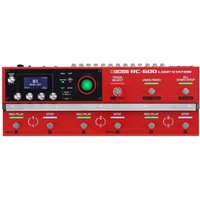
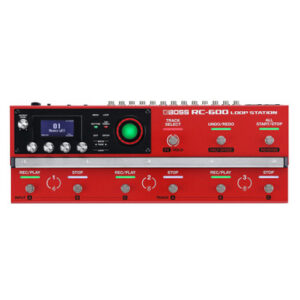
The Boss RC-600 6 Track Loop Station delivers the next-generation of floor-based loopers. Able to utilise six stereo tracks the RC-600 offers outstanding sound quality a multitude of onboard effects and unrivalled real-time controls all contributing to its position as the most advanced looper on the planet. Influence your music with brand new creative power this pedal will breathe a new lease of life into your music no matter what instrument you play. Packed with 49 input FX and 53 track FX with the ability to use four at once in each section you can fully sculpt your loops to create completely unique sounds to give you that cutting edge. Easy to control this pedal comes with nine freely assignable footswitches and external control support. A liberating experience pedal will take your loops to the next level.
Boss RC-600 6 Track Loop Station
This is a New Boss RC-600 6 Track Loop Station from Boss its found in our Looper Pedals on the Just Pedals menu. Read More below.
As an affiliate partner, we may earn a small commission when you buy through our links — at no extra cost to you.
Related videos

Brand
Boss
BOSS began in Osaka in 1973 as MEG Electronics, a company dedicated to effects. Its first BOSS-branded effect was the CE-1 Chorus Ensemble in 1976; the OD-1, SP-1 and PH-1 launched the compact-effects series in 1977. The JustPedals catalogue includes familiar overdrives and distortions such as the OD-3, SD-1, BD-2, DS-1 and MT-2 Metal Zone, as well as utility items such as the PCS-20A cable. BOSS now spans compact pedals, multi-effects, loopers, tuners and controllers. Manufacturing origin should be checked by model rather than inferred from the brand’s Japanese history.
Category
Looper Pedals
A looper records a passage and plays it back repeatedly so additional parts can be overdubbed over the cycle. Loop length, audio quality, storage and the number of independent tracks define the basic capability. Undo, quantisation, synchronisation, rhythm guides, reverse and half-speed functions determine how recordings can be corrected, transformed and aligned with other equipment.
Tags
Stereo
Processes, creates or passes two audio channels. True stereo preserves separate left and right inputs, while mono-to-stereo effects generate spatial differences internally; routing, phase behaviour and whether trails remain stereo determine the resulting image. Some outputs sum to mono when only one socket is connected, which can change level or modulation depth.
Others Just Ordered :
- I Love A Happy Accident… – Animals Pedal

- Animals Pedal Vintage Van Driving is Very Fun Overdrive

- Animals Pedal Sunday Afternoon Is Infinity Bender

- Ninevolt Pedals | Bath Time Reverb (Animals Pedal)

- This Fuzz Pedal Makes No Sense… But It Sounds Incredible

- ANIME Pedals | Animals Pedal Custom Illustrated Series
