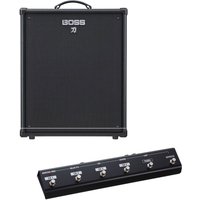
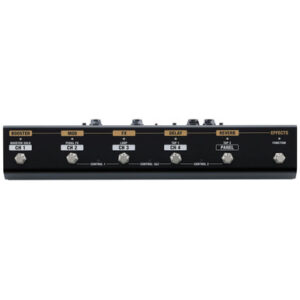
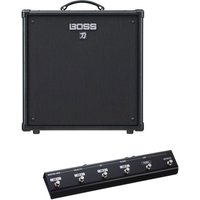
The Boss Katana-210 Bass Amplifier Combo with GA-FC Foot Controller is a high-performance amp designed for the comfort and creativity of any musician in the studio or on stage. Perfect for established bassists this amp delivers a supreme tonal performance and features all the perks of modern technological effects. There are three selectable voicings; mid scoop bright and extended range which enable you to choose from a mix of sounds that are suited to multiple styles and genres – so that you can find and re-find your perfect voice. With the Katana-210 youll never have to worry about being heard. Manufactured with an industry standard speaker system based around two 10-inch woofers this amp is packed with a massive 160 watts of class AB stage power. Also featured are four independent effect sections and with the GA-FC footswitch youll have a world of sounds beneath your feet. You can also edit the effects and settings of the amp from your phone through the optional BOSS Bluetooth Audio MIDI Dual Adapter. Experience complete control of your performance at all times.
Boss Katana-210 Bass Amplifier Combo with GA-FC Foot Controller
This is a New Boss Katana-210 Bass Amplifier Combo with GA-FC Foot Controller from Boss its found in our Pedal Switchers on the Just Pedals menu. Read More below.
As an affiliate partner, we may earn a small commission when you buy through our links — at no extra cost to you.

Related videos

Brand
Boss
BOSS began in Osaka in 1973 as MEG Electronics, a company dedicated to effects. Its first BOSS-branded effect was the CE-1 Chorus Ensemble in 1976; the OD-1, SP-1 and PH-1 launched the compact-effects series in 1977. The JustPedals catalogue includes familiar overdrives and distortions such as the OD-3, SD-1, BD-2, DS-1 and MT-2 Metal Zone, as well as utility items such as the PCS-20A cable. BOSS now spans compact pedals, multi-effects, loopers, tuners and controllers. Manufacturing origin should be checked by model rather than inferred from the brand’s Japanese history.
Category
Pedal Switchers
A pedal switcher routes effects through independently controlled loops so several pedals can be engaged, bypassed or reordered from one set of footswitches. Simple loop strips shorten the live signal path; programmable systems store combinations as presets and may send MIDI commands or change amplifier channels. Loop count, buffer placement, stereo support, spillover and routing flexibility define the system.
Tags
Bass
Voiced or equipped to retain low-frequency fundamentals and the higher headroom of a bass signal. Clean blends, crossovers and bass-specific filter ranges can preserve weight and articulation while the effected portion adds harmonics, movement or ambience.
Bluetooth
Provides a short-range wireless data or audio connection. Depending on the design it may carry backing audio, editing commands, preset management or MIDI rather than the live instrument signal; codec delay and supported Bluetooth profiles determine what the connection can do.
MIDI
Sends, receives or responds to Musical Instrument Digital Interface messages rather than carrying the instrument audio itself. Program changes recall presets, continuous controllers move parameters, and MIDI clock or transport messages synchronise timing between devices.
Vocal
Designed for microphone-level signals and the frequency, dynamics and feedback behaviour of the human voice. Input gain, balanced connections, phantom power and pitch tracking may be provided so effects respond correctly before the signal reaches a mixer or PA.
Others Just Ordered :
- I Love A Happy Accident… – Animals Pedal

- Animals Pedal Vintage Van Driving is Very Fun Overdrive

- Animals Pedal Sunday Afternoon Is Infinity Bender

- Ninevolt Pedals | Bath Time Reverb (Animals Pedal)
- This Fuzz Pedal Makes No Sense… But It Sounds Incredible

- ANIME Pedals | Animals Pedal Custom Illustrated Series