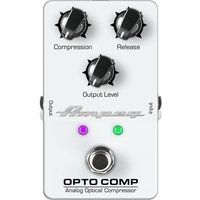
The Ampeg Opto Comp Analogue Bass Compressor is the perfect way to take control over your tone offering a smooth vintage-style compression to help reduce volume spikes and maximise sustain. It also provides you with compression release and output letting you dial in variety of compressions to help beef up your tone or create punchier sounds. With this model you can also dial in a fast subtle compression to help control peaks or crank it up all the way to give your voicing a unique character. Its addition of a true bypass switch retains your original signal when the pedal is switched off the Ampeg Opto Comp Bass Compressor is the perfect companion for bassists wanting the ultimate tone.
Ampeg Opto Comp Analogue Bass Compressor
£100.00
This is a New Ampeg Opto Comp Analogue Bass Compressor from Ampeg is in our Compressor Pedals category on Just Pedals. Read More below.
View Just Ampeg
As an affiliate partner, we may earn a small commission when you buy through our links — at no extra cost to you.
Brand
Ampeg
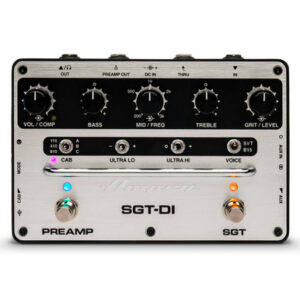
In the current JustPedals catalogue, Ampeg is represented by Preamp & DI Pedals, Overdrive Pedals and Chorus Pedals. Current listings include Scrambler, Classic Analog and Opto Comp Analogue. That makes the range relevant to players looking for drive, gain and clipping, plus modulation and movement. Check each model for its exact circuit or processing platform, controls, power requirements and connections, particularly where the catalogue includes both pedals and supporting gear.
Category
Compressor Pedals
Compression reduces the difference between louder and quieter parts of the signal. It can restrain peaks, lift decaying notes and make picking feel more even, but strong settings also change the attack and add audible sustain or pumping. Threshold, ratio, attack, release and blend determine when gain reduction begins, how firmly it acts and how much natural transient detail remains.
Tags
Analogue
The signal is shaped by continuously varying electronic circuitry rather than being converted into a digital effect algorithm. Component choice, operating voltage and circuit tolerances influence headroom, noise, clipping texture and the small variations in response between designs.
Bass
Voiced or equipped to retain low-frequency fundamentals and the higher headroom of a bass signal. Clean blends, crossovers and bass-specific filter ranges can preserve weight and articulation while the effected portion adds harmonics, movement or ambience.
True Bypass
Connects input directly to output through mechanical or relay switching when the effect is off, removing the active circuit from the audio path. It avoids buffer colour but leaves cable capacitance and switching design to influence high-frequency loss and possible switching noise.
Others Just Ordered :
- I Love A Happy Accident… – Animals Pedal

- Animals Pedal Vintage Van Driving is Very Fun Overdrive

- Animals Pedal Sunday Afternoon Is Infinity Bender

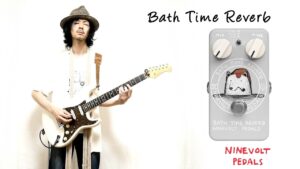
- Ninevolt Pedals | Bath Time Reverb (Animals Pedal)
- This Fuzz Pedal Makes No Sense… But It Sounds Incredible

- ANIME Pedals | Animals Pedal Custom Illustrated Series