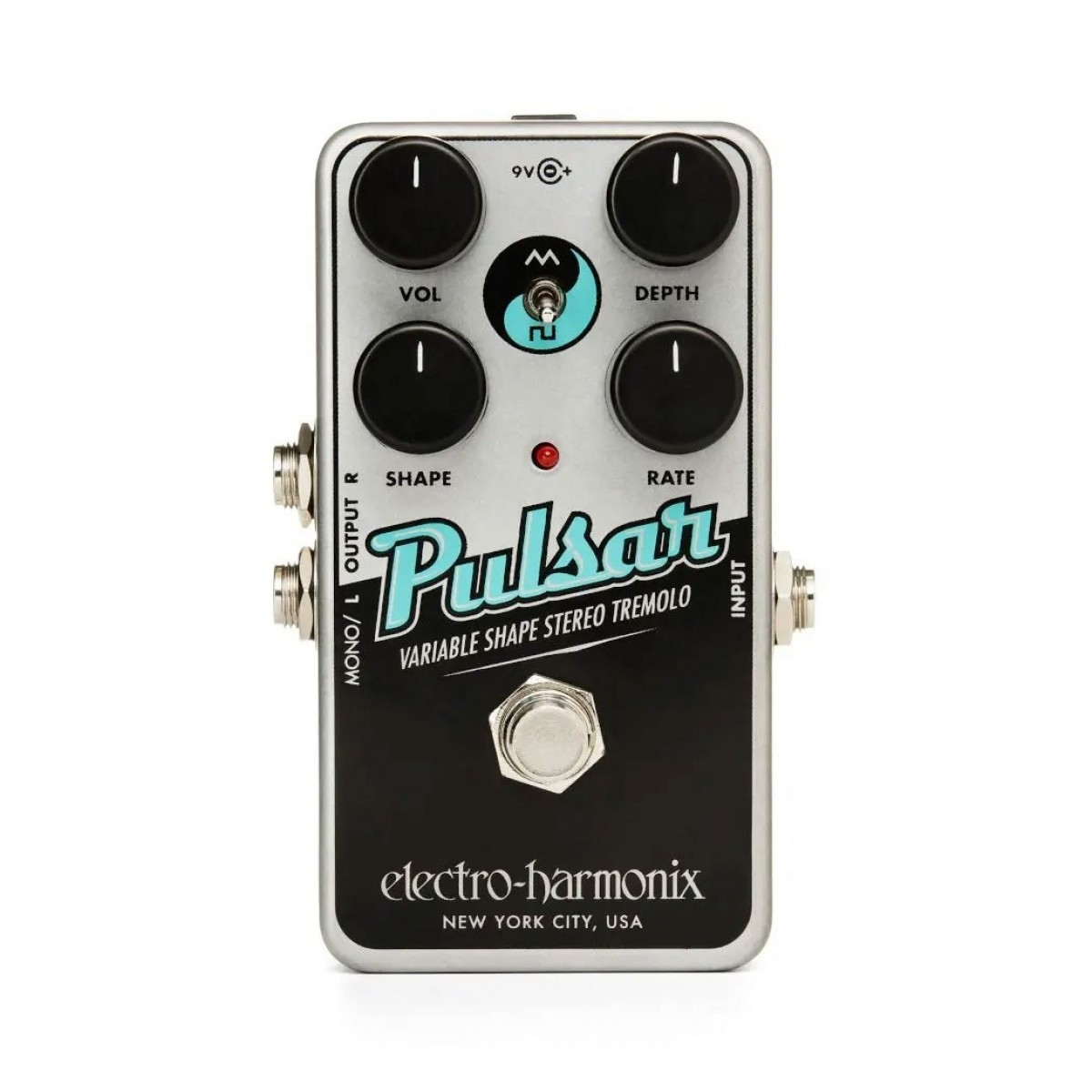
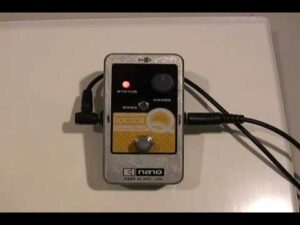
The Electro Harmonix Nano Pulsar Variable Shape Stereo Tremolo is a compact yet powerful pedal packed with a wide range of effects. With its collection of tremolo-modulating waveforms and the option to operate in Triangle or Square Wave modes the Nano Pulsar takes tremolo beyond the ordinary. Whether used in mono or stereo this pedal creates shifting waves of sound that surround you and fill your space with weaving pulsating energy. With intuitive controls including a Volume control to address any perceived volume drop a Depth knob to adjust the amount of tremolo and a Rate knob to control the speed of the effect the Nano Pulsar offers advanced sound shaping and control. From sublimely beautiful to downright shocking the Nano Pulsar is your go-to pedal for all things tremolo and panning.
Electro Harmonix Nano Pulsar Variable Shape Stereo Tremolo
This is a New Electro Harmonix Nano Pulsar Variable Shape Stereo Tremolo from Electro Harmonix, listed in Tremolo & Vibrato Pedals on Just Pedals. Read More below.
As an affiliate partner, we may earn a small commission when you buy through our links — at no extra cost to you.
Related videos


Brand
Electro Harmonix
In the current JustPedals catalogue, Electro Harmonix is represented by Fuzz Pedals, Overdrive Pedals and Octave Pedals. Current listings include Q-Tron+, Nano Clone and V256 Vocoder. That makes the range relevant to players looking for drive, gain and clipping, plus time-based effects and ambience. Check each model for its exact circuit or processing platform, controls, power requirements and connections, particularly where the catalogue includes both pedals and supporting gear.
Category
Tremolo & Vibrato Pedals
Tremolo varies amplitude, making volume rise and fall; vibrato varies pitch, making the note move sharp and flat. Some circuits combine both or derive them from modulation systems that blur the boundary. Rate, depth, waveform and stereo phase determine whether the motion is smooth, pulsing, choppy, seasick or spatial, while tap tempo can lock the cycle to a rhythm.
Tags
Stereo
Processes, creates or passes two audio channels. True stereo preserves separate left and right inputs, while mono-to-stereo effects generate spatial differences internally; routing, phase behaviour and whether trails remain stereo determine the resulting image. Some outputs sum to mono when only one socket is connected, which can change level or modulation depth.
Others Just Ordered :
- Mooer Meta FX – Review

- MOOER META FX Review: 3 Effects in 1—but Here’s the Problem

- I Wasn’t Expecting To Be Impressed – But What Is The Mooer Meta FX?

- Mooer // META FX Stereo Multi-Effect Platform (Demo)

- A NEW GENERATION OF PEDALS IS HERE – Mooer Meta FX Reverb Review

- Mooer META FX | All the REVERBS from subtle to WILD!