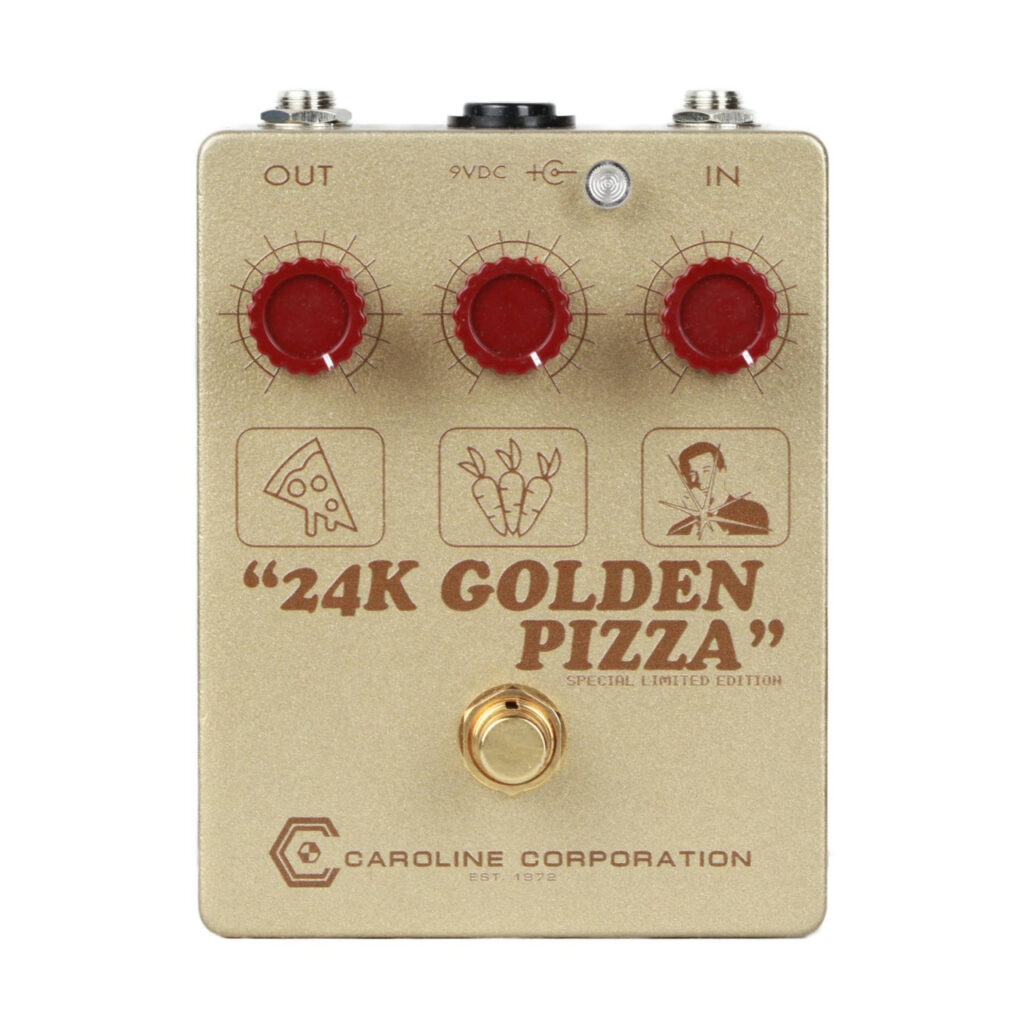



The Caroline Guitar Company Limited Edition 24K Golden Pizza Fuzz is a gloriously unhinged take on their cult Hawaiian Pizza pedal, dressed up in suitably decadent gold. Built around two NOS Motorola 5089 transistors, it delivers monstrously dirty fuzz and distortion tones with extra gain on tap and impressively low noise, all in a compact, pedalboard friendly box. From sputtering, voltage-starved chaos to thick, crunchy sustain, the 24K Golden Pizza is far more versatile than its tongue-in-cheek looks suggest. Simple input gain, output gain and voltage controls let you move effortlessly between ragged garage rock grind, spitty broken amp textures and roaring, harmonically rich fuzz that still responds dynamically to your playing. Under the hood, a fully analogue signal path keeps your tone immediate and touch sensitive, reacting to your pick attack and guitar volume like a wild, slightly broken vintage box. With standard mono in and out and 9V DC centre negative power, it drops straight onto your board without fuss, ready to add character, attitude and a healthy dose of wrong to any rig. Limited Edition Golden Take on a Cult Classic This 24K Golden Pizza is a special, limited-edition spin on Caroline’s much loved Hawaiian Pizza fuzz. You get the same irreverent, inspiring circuit, now in a striking gold finish that looks as outrageous as it sounds. It is a perfect choice if you want a fuzz that stands out visually as much as it does sonically. Monstrously Dirty, Characterful Fuzz Designed for players who like their dirt unapologetically filthy, the 24K Golden Pizza dishes out thick, crunchy fuzz and distortion with bags of midrange character. Whether you are chugging power chords, bashing out garage rock riffs or tearing into noisy leads, it delivers a raw, aggressive voice that slices through a mix. Deceptively Versatile Controls With just input gain, output gain and voltage controls, dialling in great sounds is quick and intuitive. Crank the input for saturated, compressed filth, or back it off for more open, overdrive like textures. The voltage control lets you starve or feed the circuit to change its feel and response, from tight and punchy to saggy, spitty and unpredictable. Premium NOS Transistors and Analogue Circuit At the heart of the 24K Golden Pizza are two NOS Motorola 5089 transistors, chosen for their increased gain and reduced noise. Combined with a fully analogue signal path, they give the pedal a responsive, dynamic feel that reacts to your touch and guitar volume, keeping the playing experience lively and expressive even at extreme gain settings. Key Features Limited Edition 24K Golden Finish – A special run of Caroline’s Hawaiian Pizza fuzz in a bold gold aesthetic that looks as wild as it sounds, making it a standout centrepiece on any pedalboard. NOS Motorola 5089 Transistors – Two carefully selected NOS Motorola 5089 transistors provide higher gain with lower noise, giving you brutal saturation while keeping hiss and unwanted artefacts under control. Input, Output and Voltage Controls – Simple but powerful controls let you shape everything from output level to the internal headroom and sag of the circuit, unlocking a wide range of fuzz and distortion textures without menu diving. Fully Analogue, Pedalboard Friendly Design – A pure analogue signal path, mono 1/4″ in and out, and standard 9V DC centre negative power make it easy to integrate into any rig while preserving an immediate, dynamic playing feel. SpecificationsGeneral Product: Caroline Guitar Company Limited Edition 24K Golden Pizza Fuzz Pedal Pedal Type: Fuzz Analogue / Digital: Analogue Stereo / Mono: Mono Country of Manufacture: USA (Columbia, South Carolina) Controls Input Gain Output Gain Voltage Electronics Transistors: 2 x NOS Motorola 5089 Signal Path: Fully analogue Connectivity Inputs: 1 x 1/4″ Outputs: 1 x 1/4″ Expression: None Power Power Supply: 9V DC centre negative Power Supply Included:…



Caroline Guitar Company Limited Edition 24K Golden Pizza Fuzz Pedal
This is a New Caroline Guitar Company Limited Edition 24K Golden Pizza Fuzz Pedal from Caroline Guitar Company its found in our Fuzz Pedals on the Just Pedals menu. Read More below.
As an affiliate partner, we may earn a small commission when you buy through our links — at no extra cost to you.
Brand
Caroline Guitar Company
In the current JustPedals catalogue, Caroline Guitar Company is represented by Fuzz Pedals, Chorus Pedals and Octave Pedals. Current listings include Meteore, Kilobyte and Somersault Chorus. That makes the range relevant to players looking for drive, gain and clipping, plus time-based effects and ambience. Check each model for its exact circuit or processing platform, controls, power requirements and connections, particularly where the catalogue includes both pedals and supporting gear.
Category
Fuzz Pedals
Fuzz drives the signal into extreme clipping, often flattening the waveform and generating a thick spectrum of harmonics. Transistor type, bias, input loading and tone filtering create markedly different responses, from loose and velvety to gated, spluttering or octave-rich. Some circuits interact strongly with pickup impedance and guitar volume, while others include buffers or blends for a more consistent response.
Tags
Analogue
The signal is shaped by continuously varying electronic circuitry rather than being converted into a digital effect algorithm. Component choice, operating voltage and circuit tolerances influence headroom, noise, clipping texture and the small variations in response between designs.
Others Just Ordered :
- I Love A Happy Accident… – Animals Pedal

- Animals Pedal Vintage Van Driving is Very Fun Overdrive

- Animals Pedal Sunday Afternoon Is Infinity Bender

- Ninevolt Pedals | Bath Time Reverb (Animals Pedal)

- This Fuzz Pedal Makes No Sense… But It Sounds Incredible

- ANIME Pedals | Animals Pedal Custom Illustrated Series