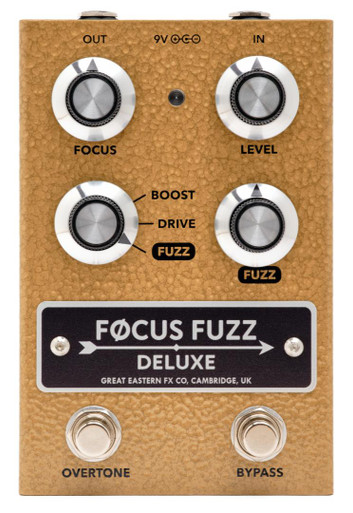
Great Eastern FX Co. Obsolete Devices Distortion Filter D312A Pedal

£249.00

On the menu for January 2026 are the Guitar Pedals, freshly added and carefully selected. These New units are available to order online with fast, secure delivery from trusted UK retailers. Read on for full details, specifications, demos, videos, reviews, and the best places to buy the Guitar Pedals today.


Spread the love

Description

Spread the love

On the menu for January 2026 are the Guitar Pedals, freshly added and carefully selected. These New units are available to order online with fast, secure delivery from trusted UK retailers. Read on for full details, specifications, demos, videos, reviews, and the best places to buy the Guitar Pedals today.

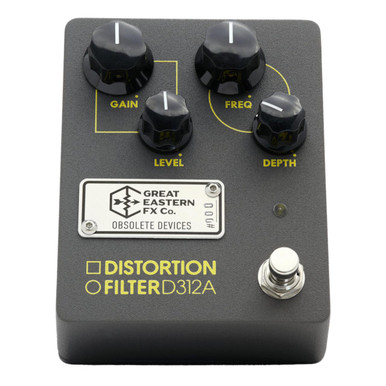
The Distortion Filter D312A is part of the quirky Obsolete Devices series, where Great Eastern FX Co. dig into their stash of weird and wonderful vintage components and let their imaginations run wild!

It combines classic hard-clipping distortion with a powerful band-pass filter, unlocking a range of hard-hitting tones that are both strange and sublime.

Unique parts for unique sounds

At the heart of the pedal are three Soviet-era germanium pulse diodes (D312A, if you’re into part numbers). Set up for asymmetrical clipping, these unusual NOS diodes deliver complex, dynamic breakup with an expressive, almost vocal mid-range quality.

More than your average EQ…

To push the sound even further, Great Eastern FX added an analogue band-pass filter. With controls for Frequency and Depth, you can add subtle tone-shaping emphasis or pulverise a specific frequency into submission. Think classic cocked wah vibes, QOTSA-style filtered distortion, or just raw and organic dirt — it’s all in there.

Key Features

  • Gain & Level controls: Shape your distortion from gritty breakup to full-blown saturation with the Gain knob. Then use Level to match your clean signal’s volume, or crank it for extra punch.
  • Analogue band-pass filter: Sculpt your tone with pinpoint precision using the Frequency and Depth knobs. Go from subtle mid-range drive to aggressive, frequency-focused distortion.
  • Limited to just 165 units: Once they’re gone, they’re gone! This is a rare chance to add something truly unique to your board.
  • Designed & handbuilt in the UK: This pedal’s crafted with care by the Great Eastern FX Co. team using rare, vintage components.

Specifications

  • Power Requirements: 9V DC mains adaptor only (not included)
  • Current draw: ~10mA
  • Size: 125 x 94 x 55 mm (4.9” x 3.7” x 2.2”)
  • Weight: 390 g (0.9 lb)

Additional information

Weight 0.5 kg

Category

Guitar Pedals

Tags

Distortion

Distortion pedals take your clean guitar signal and transform it into something bigger, bolder, and full of attitude. By clipping the waveform, they add sustain, bite, and aggression, creating that thick, compressed tone that’s powered rock music for decades. From the growling crunch of classic hard rock to the tight, saturated roar of modern metal, distortion is all about energy and presence. It gives every note weight and authority, pushing your amp to its limits and beyond.

There are countless flavours of distortion, each with its own texture and edge. Some sound smooth and creamy, others raw and gnarly like tearing fabric. It’s the sonic equivalent of turning up the heat until the sound cooks — rich, sizzling, and perfectly seasoned to taste. Whether used for rhythm muscle or soaring leads, a good distortion pedal doesn’t just add volume; it adds personality, grit, and that unmistakable sense of power under your fingers.

EQ

While Ed Sheeran primarily relies on the natural sound of his acoustic guitar and vocals, he occasionally uses EQ (Equalization) to shape and enhance his tone during live performances or in the studio. EQ pedals or onboard preamps can allow him to adjust the frequency response of his guitar signal to suit the acoustics of different venues or to achieve specific tonal characteristics. Here’s how EQ might be utilized in Ed Sheeran’s setup:

1. **Tonal Shaping**: EQ can be used to adjust the balance of frequencies in the guitar signal, allowing Ed Sheeran to shape his tone to his liking. For example, he might boost the midrange frequencies to bring out the warmth and presence of his acoustic guitar, or cut certain frequencies to reduce any harshness or mud in the sound.

2. **Feedback Control**: In a live setting, EQ can help control feedback by notching out problematic frequencies that might cause the guitar signal to feed back through the amplification system. This can be particularly useful when performing in venues with challenging acoustics or high volume levels.

3. **Room Correction**: In situations where the venue’s acoustics are less than ideal, EQ can be used to compensate for any deficiencies in the sound. By adjusting the EQ settings, Ed Sheeran can tailor the guitar tone to sound more balanced and natural, regardless of the room’s acoustic properties.

4. **Matching Gear**: EQ can also be used to match the tone of Ed Sheeran’s guitar to the sound of other instruments or equipment in his setup. For example, he might adjust the EQ to complement the tonal characteristics of his vocal microphone or to blend seamlessly with backing tracks or other instruments.

Overall, while EQ may not be a central component of Ed Sheeran’s guitar effects setup, it can still play a valuable role in shaping his tone and ensuring that he achieves the desired sound in different performance environments. Whether used subtly for tonal shaping or more aggressively for feedback control, EQ allows Ed Sheeran to tailor his guitar tone to suit his musical vision and performance needs.

Filter

New

This is brand new, fresh in, and a UK warranty is included. New Gear always comes from trusted UK music retailers.

Volume

Volume pedals control the output level of a guitar signal using a foot-operated treadle. They allow smooth volume swells, dynamic control during playing, and easy muting between songs. Volume pedals can be placed at different points in the signal chain to either control overall loudness or adjust gain and drive behaviour when positioned before distortion or overdrive pedals.

Wah

Wah refers to an expressive filter effect that sweeps through a range of frequencies, creating a vocal-like “wah” sound. Controlled in real time with a foot-operated treadle, it allows players to emphasise different parts of the frequency spectrum as they play. Wah pedals are commonly used for lead guitar, funk rhythm work, and expressive solos, responding closely to picking dynamics and foot movement.