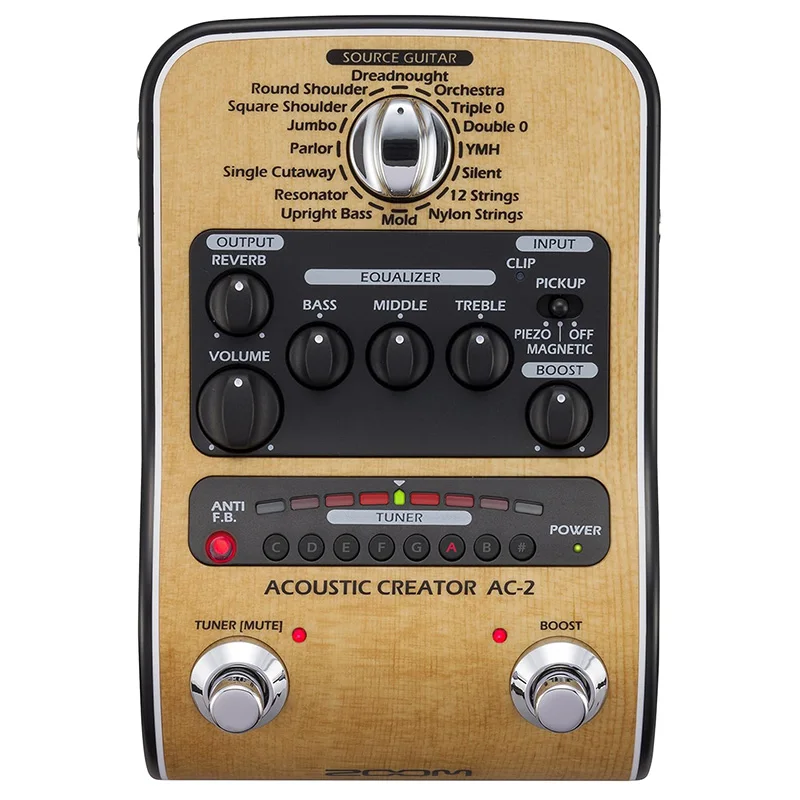
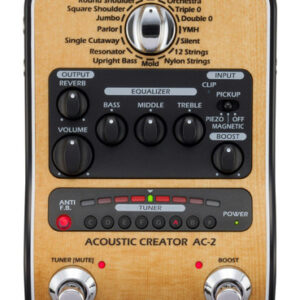
Here at JustPedals we think you can rely on Zoom to make great Guitar Pedals. Check out the Zoom AC-2 Acoustic Creator Acoustic DI Tone Restoration Tuner Reverb EQ Anti-Feedback on JustPedals now. Zoom AC-2 Acoustic Creator, Acoustic DI with Tone Restoration, Tuner, Reverb, EQ, and Anti-Feedback
Zoom AC-2 Acoustic Creator Acoustic DI Tone Restoration Tuner Reverb EQ Anti-Feedback
£123.39
The Zoom AC-2 Acoustic Creator Acoustic DI Tone Restoration Tuner Reverb EQ Anti-Feedback is new on JustPedals, and instock direct. Zoom AC-2 Acoustic Creator, Acoustic DI with Tone Restoration, Tuner, Reverb, EQ, and Anti-Feedback
View Just Zoom
As an affiliate partner, we may earn a small commission when you buy through our links — at no extra cost to you.
Related videos
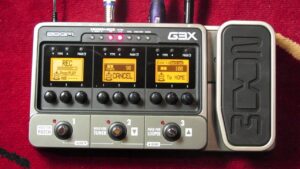
Brand
Zoom
ZOOM CORPORATION is a Tokyo-based Japanese maker founded in 1983. After developing audio components and rhythm equipment, it released the compact 9002 multi-effects processor in 1990 and later the popular 505 Guitar. Today its guitar, bass and acoustic processors range from small practice units to larger floorboards. JustPedals listings include the G1X FOUR and B1 FOUR, plus the A1 FOUR for acoustic instruments and its expression-pedal version. Compare each model’s instrument focus and expression controls: similarly sized Zoom units can be built around different effects and playing needs.
Category
Distortion Pedals
Distortion clips the waveform more firmly than overdrive, generating dense upper harmonics, longer sustain and a more compressed response. Circuit topology and filtering decide whether the sound is tight and focused, broad and aggressive, smooth or deliberately abrasive. Gain sets the amount of clipping, while pre- and post-distortion tone controls strongly influence low-end definition, midrange presence and high-frequency texture.
EQ Pedals
Equalisation changes the level of selected frequency regions without intentionally adding modulation or time-based effects. Graphic EQ divides the spectrum into fixed bands, parametric EQ allows frequency and bandwidth to move, and simpler designs provide broad bass, middle and treble shaping. Available boost or cut, centre frequencies, filter width and overall output level determine whether the pedal makes corrective, tonal or gain-driving changes.
Guitar Pedals
Guitar pedals are compact devices placed in the signal path to change level, tone, dynamics, pitch, time, modulation or routing. This broad category includes simple analogue effects, digital processors, switching and utility products, so the most important differences are the circuit function and connection method. Check whether a model expects instrument or line level, how it is powered, whether it preserves bass or stereo information, and how its bypass behaves with the rest of the board.
Reverb Pedals
Reverb creates the dense pattern of reflections heard after sound enters a physical or imagined space. Room, hall, plate and spring models differ in reflection density, frequency decay and modulation, while ambient algorithms extend or transform the tail beyond natural acoustics. Decay, pre-delay, damping, diffusion and wet/dry balance define the apparent size, surface and distance of that space.
Tags
Acoustic
Voiced for the wider dynamics, strong transient detail and pickup characteristics of acoustic instruments. High input impedance, phase reversal, notch filtering and restrained processing help preserve body resonance while controlling piezo harshness and feedback. Balanced outputs may also carry the corrected signal directly to a mixer or interface.
Reverb
Builds a dense tail of reflections around the original sound. Early reflections establish apparent distance and size, while decay, diffusion, damping and modulation shape the density, brightness and movement of the later field. Pre-delay separates the dry attack from the ambience, and mix controls their relative level.
Tuner
Tuner products provide a visible or silent way to check pitch at the start of a signal chain. Accuracy, calibration range, detection speed, display visibility, mute switching and bypass type affect how well they suit a live board. Polyphonic tuners can show several strings at once, while chromatic designs may offer more detailed single-note feedback. Check the input and output arrangement, power draw and display readability under the intended stage lighting.
Others Just Ordered :
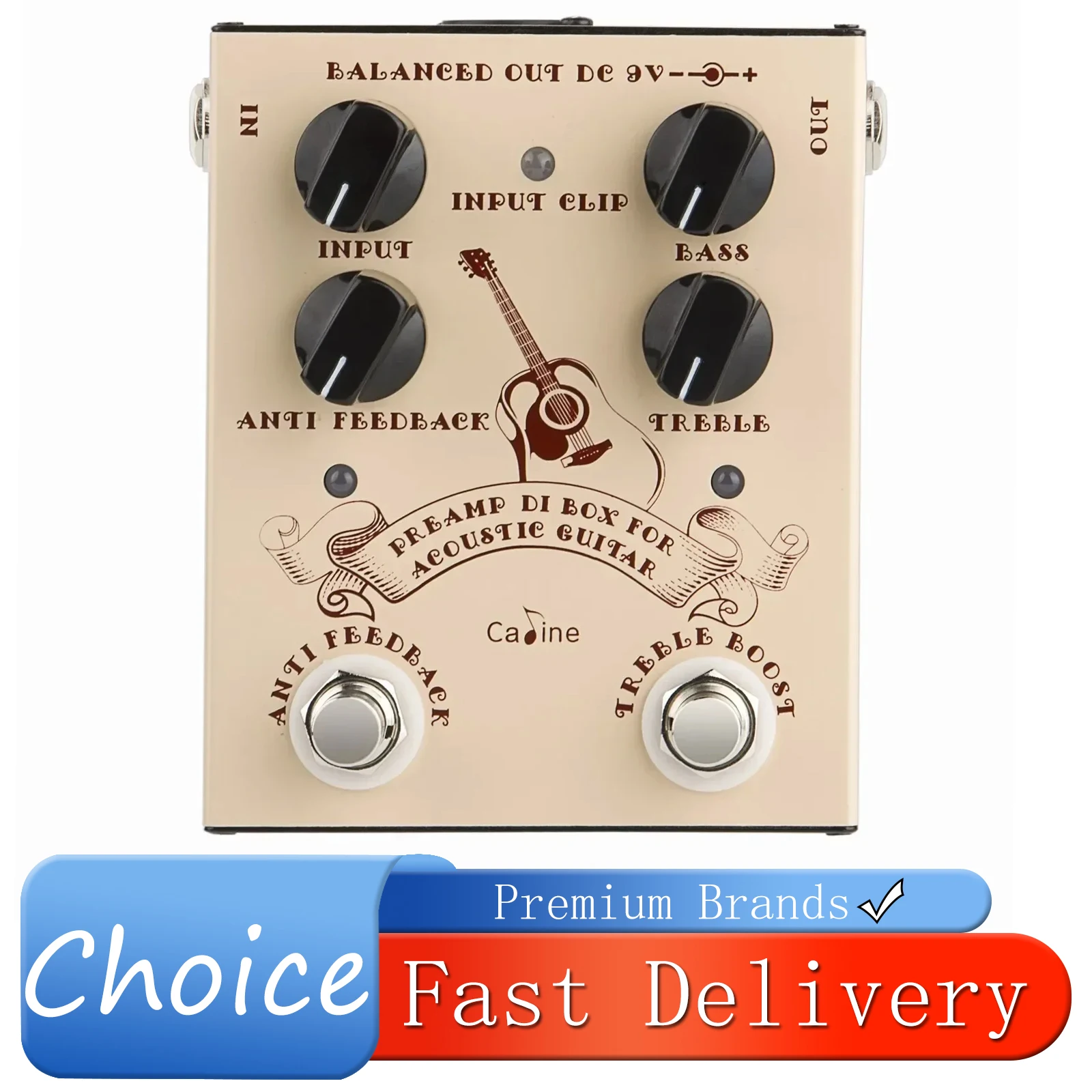
- Mooer Meta FX – Review
- MOOER META FX Review: 3 Effects in 1—but Here’s the Problem

- I Wasn’t Expecting To Be Impressed – But What Is The Mooer Meta FX?

- Mooer // META FX Stereo Multi-Effect Platform (Demo)

- A NEW GENERATION OF PEDALS IS HERE – Mooer Meta FX Reverb Review

- Mooer META FX | All the REVERBS from subtle to WILD!