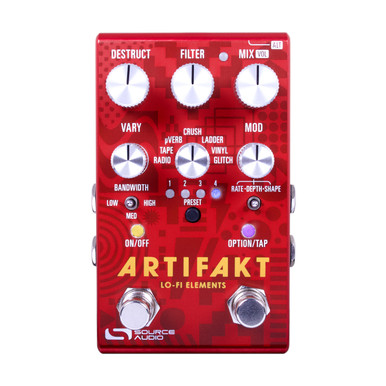

Here’s what Source Audio say about the Source Audio ARTIFAKT Lo-Fi Elements Modulation, Reverb Bit Reduction and Filter Pedal:
The ARTIFAKT Lo-fi Elements is the first pedal of its kind, a comprehensive collection of all the hazy, scratchy, wobbly, and broken tones that epitomize the term ‘lo-fi’.”
Like a mega-delay or mega-reverb, ARTIFAKT is a “one-stop shop” for all the most sought-after lo-fi effects including old vinyl replications, tape modulation and saturation, bit crushing, sample rate reduction, dark reverb and echo, filtering, compression, glitch, and more.
Source Audio has dedicated much of the past three years to meticulously honing each of these sounds as well as engineering an entirely new hardware design with an easy-to-use interface that places the pedal’s full capabilities at your fingertips.
Key Features
- Lo-Fi Modulation / Reverb / Delay / Bitrate Reduction Effects Pedal
- Updated platform with imporoved interface and additional controls and foots witches – for easier access to more parameters, presets, tap tempo and a variety of other engine specific functions
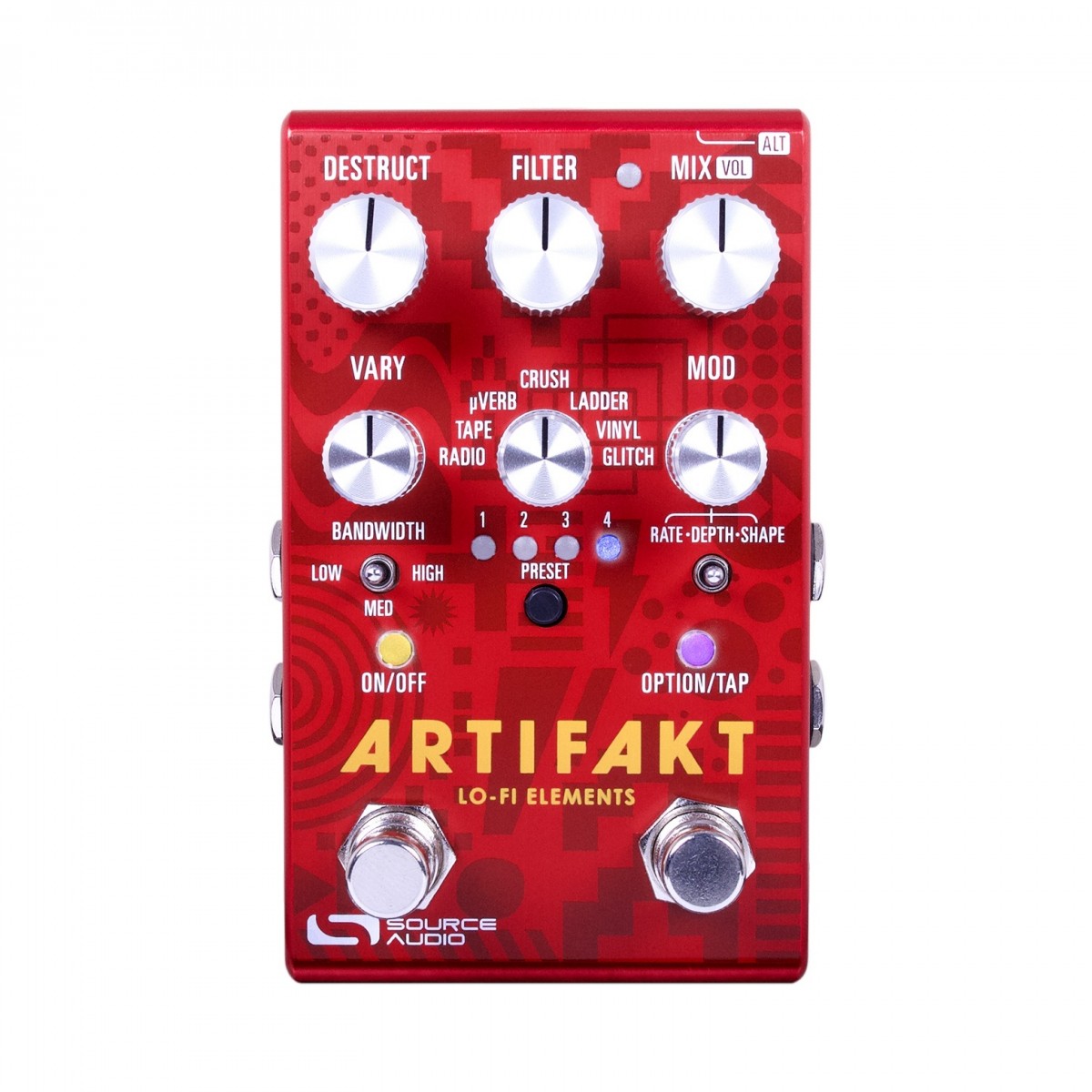
- 7 different effect engines on the face of the pedal
o Radio – crackling nostalgic tones of a vintage radio struggling to dial in a signal
o Tape – conjures the sound of vintage tape machines with subtle compression, tape saturation, flutter and pitch modulation
o μVerb – a primitive reverb effect with bouncing echoes similar to the reverb on 8-bit gaming systems
o Crush – bit-depth quantizing and sample rate reduction, finely sculpted with the resonance of a Moog-style ladder filter
o Ladder – filter effect inspired by the revered R-2R ladder filter
o Vinyl – faithfully emulates the crackle and pop of vintage records
o Glitch – adds an unpredictable edge with random speeds and pitches
- 16 presets accessible via the pedal controls (128 presets available via MIDI)
- Full MIDI control via 3.5 mm TRS MIDI In and Thru jacks
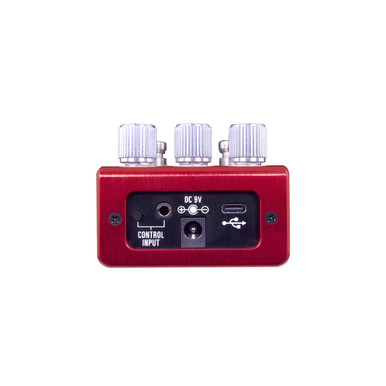
- USB-C port for connecting to Neuro 3.0, Source Audio’s preset downloading and effect editing software
- Stereo Inputs and Outputs
- External expression control over any parameter using the Neuro 3.0 editor
- Switchable Active Analog or True Bypass
- Powered by (opt.) 9V DC power supply
(2,1 mm plug, center -, 200 mA current draw
Navigating through the seven positions of ARTIFAKT’s effect selector knob unleashes a symphony of sonic transformations, each akin to engaging a new pedal with its own unique brand of lo-fi.
- The first effect on the dial is Radio, tune into its crackling nostalgic tones where static frequency filtering and noise generation evoke the charm of a vintage radio struggling to dial in a signal.
- The Tape engine conjures the sound of vintage tape machines by blending subtle compression, overdrive, tape flutter, and pitch modulation to invoke effects like slapback, chorus, doubling, and tape saturation.
- μVerb is a primitive reverb effect with bouncing echoes similar to the reverb on 8-bit gaming systems.
- The Crush effect voyages the realm of bit-depth quantizing and sample rate reduction, all finely sculpted with the resonance of a MoogTM-style ladder filter.
- Ladder, inspired by the revered R-2R ladder filter, offers both envelope and LFO modulation control for classic and dramatic filter sweep effects.
- Vinyl faithfully emulates the crackle and pop of vintage records, from pristine 180-gram vinyl to well-loved gramophone platters.
- Glitch adds an unpredictable edge, capturing fragments of your performance and hurling them back at random speeds and pitches.
Pairing the ARTIFAKT Lo-fi Elements with Source Audio’s completely reimagined and reengineered Neuro 3.0 software elevates an already great pedal to new heights. Access free, stage-ready presets from Neuro’s expanding library of factory and Neuro Community presets.
Explore Neuro’s extensive editing capabilities to blend and experiment with the various lo-fi elements mentioned earlier—it’s a limitless effects palette for crafting unique lo-fi sounds. ARTIFAKT also boasts stereo inputs and outputs, full MIDI control via the 3.5mm TRS in and thru jacks, dual footswitches, 128 presets, and more.