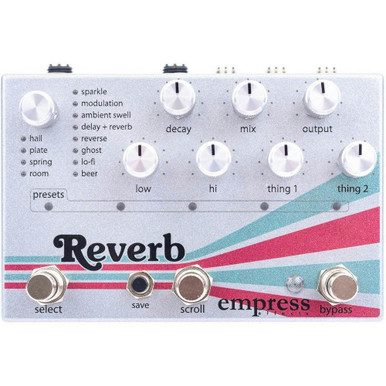

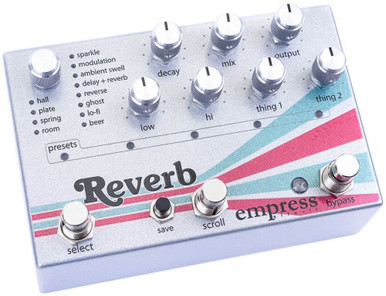
The Reverb by Empress is an absolute beast of a Reverb pedal with the option to get every Reverb sound under the sun. With incredible sound quality and the option to really tweak your reverb sound.
For each preset you can edit the decay, mix and total output as well as fine-tune the EQ. It also has a ‘thing 1’ and ‘thing 2’ knob to alter different parameters depending on the preset.
You can store up to 35 presets and scroll through your favourites whether they be hall, plate, spring or ambient. Importantly, it’s all easy to tweak on the top end of the pedal without scrolling through thousands of digital screens and menus.
Here’s what Empress say about the Reverb
Realistic simulations of spaces, as well as never-before-heard surreal ambiances are represented with stunning sound quality. Sporting stereo ins and outs, a small footprint and all the controls at your finger-tips, it strikes the perfect balance of control and ease of use, avoiding laborious menus. Presets, the versatile control port, and MIDI open up a world of possibilities for live performances. Whether you’re looking for a classic spring, realistic room or new sonic flavors to expand your creativity, this pedal delivers. And….it’s got a beer mode!
Features
- 24 studio quality algorithms and counting – The pedal has 12 algorithm types, some include multiple variations. For example, vintage and studio plate, dark and bright springs. Also, as more algorithms get added you can update your pedal via the SD Card. It’s the pedal that keeps on giving.
- Pristine Classic Sounds – pristine sounding classic hall, plate, spring and room sounds that rival or surpass studio units costing many times more.
- Ambient Sounds – A complete palette of tweak-able ambient sounds that offer the creative player so much territory to explore and make their own.
- Easy to use and fast to dial in – All the algorithm controls are sitting on a knob in front of you, no fiddling through laborious menus.
- Tap Functions – many algorithms have infinite hold settings or the ability to tap in delay time.
- Low Noise signal path – Features a signal to noise ratio of >104dB and maintains an analog dry path.
- Up to 35 Presets – Settings can be saved to 35 presets. With three stomp switches, accessing the presets is easy.
- 2 Preset Modes – Bank style or scrolling style preset modes.
- True Bypass and Buffered Bypass – It can be configured to run with true bypass or buffered bypass if you want to hear trails.
- Cabinet Simulator – 3 variations to choose from, perfect for recording, practicing or for gigs without an amp.
- Output Transformer – Get hum-free operation when operating in stereo with two amps. Output 2 is isolated with a transformer to eliminate nasty ground loops.
- High Quality Audio – 48kHz sampling, with 24 bit conversion and 32 bit internal processing.
- Analog Dry Path – Dry signal is left untouched, and blended with the wet signal using VCA. (no zipper noise, hooray!)
- Unsurpassed Connectivity – The Universal Control Port allows you to connect an expression pedal, external tap switch, control voltage, external audio input and MIDI – all using a standard 1/4″ jack!
- Advanced Configuration Menu – The Advanced configuration menu lets you configure how your reverb works. Select from true or buffered bypass, 0-35 presets, MIDI configuration, Control port control(expression pedal, external tap, control voltage and MIDI) as well as which style of preset system to use, input signal pad, output transformer enable and more!
- Small Size – The enclosure measures approximately 5.7″ by 3.75″ by 1.75″, which is delightfully small when considering all the features packed into this unit.
Specifications
- Input Impedance: 1M
- Output Impedance: 100
- Output Impedance (transformer): 600
- Frequency Response (-3dB, dry): 10Hz – 50kHz
- Frequency Response (-3dB, wet): 10Hz – 23.4kHz
- Total Harmonic Distortion (dry): 0.09%
- Total Harmonic Distortion (wet): 0.22%
- Dynamic Range (dry): 106.9 dBA
- Dynamic Range (wet): 105.5 dBA
- Input Headroom (dry): +10.0 dBu
- Input Headroom (wet, no pad): +0.5 dBu
- Input Headroom (wet, 6dB pad): +5.7 dBu
- Input Headroom (wet, 12dB pad): +10.8 dBu
- Output Headroom: +16.2dBu
- Power Input Connector: 2.1mm Barrel Connector
- Required Current: 300mA
- Height (enclosure only): 1.75″
- Height (including controls): 2.25″
- Length: 5.7″
- Width: 3.75″
- Weight: 1.5lbs