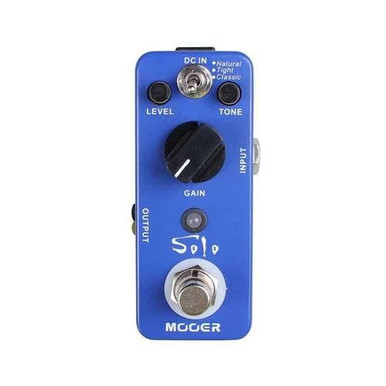
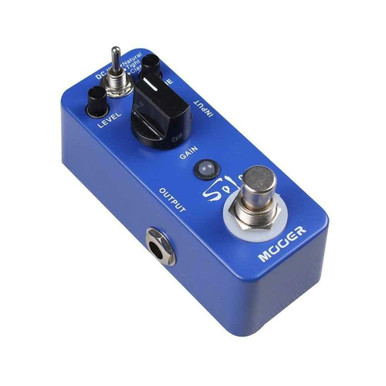
Mooer Solo Distortion Pedal

£49.00

This is a New Mooer Solo Distortion Pedal from Mooer, listed in Distortion Pedals on Just Pedals. Read More below.

View Just
more
and

The Mooer Solo Distortion has three modes: ‘Natural’ is an organic gain sound that’s useable for just about anything, ‘Tight’ is a more modern gain sound as you would expect from a high gain amplifier and ‘classic’ is a vintage gain tone that’s warm and cries out for classic rock riffs! A really versatile pedal that cover’s a lot of different distortion tones.

True bypass ensures you tone remains unchanged when the Mooer pedal is disabled and the rugged metal construction is tour worthy!

The compact form factor makes it super easy to add this to any pedalboard but please note it’s too small for fit a battery in so it needs to be supplied with standard 9v DC power

Specification

  • All-sided high-gain distortion with excellent dynamic response and definition, especially suit for solo playing
  • 3 Working Modes: Natural/Tight/Classic
  • Full metal shell
  • Very small and exquisite
  • True bypass
  • Working Mode: 3 (Piezo/Standard/Jumbo)
  • Input: 1/4” monaural jack (impedance: 1M Ohms)
  • Output: 1/4” monaural jack (impedance: 1k Ohms)
  • Power Requirements: AC adapter 9V DC (center minus plug)
  • Current Draw: 17 mA
  • Dimensions: 93.5mm (D) × 42mm (W) × 52mm (H)
  • Weight:160g

Related videos

Brand

Mooer

MOOER entered the music-gear market in 2010 with miniature guitar effects pedals, conceived by four music-and-technology enthusiasts in Shenzhen, China. The company later expanded into preamp pedals, amp modelling, impulse-response loaders and multi-effects, including the GE200 and RADAR IR Loader. JustPedals listings show the compact effects side of the range: Reecho digital delay, Green Mile overdrive, Liquid Phaser, Triangolo tremolo and Pure Boost. MOOER’s small enclosures are a design choice, not a guide to how much control a model offers; check its modes, switching and power needs individually.

Category

Distortion Pedals

Distortion clips the waveform more firmly than overdrive, generating dense upper harmonics, longer sustain and a more compressed response. Circuit topology and filtering decide whether the sound is tight and focused, broad and aggressive, smooth or deliberately abrasive. Gain sets the amount of clipping, while pre- and post-distortion tone controls strongly influence low-end definition, midrange presence and high-frequency texture.

Tags

True Bypass

Connects input directly to output through mechanical or relay switching when the effect is off, removing the active circuit from the audio path. It avoids buffer colour but leaves cable capacitance and switching design to influence high-frequency loss and possible switching noise.