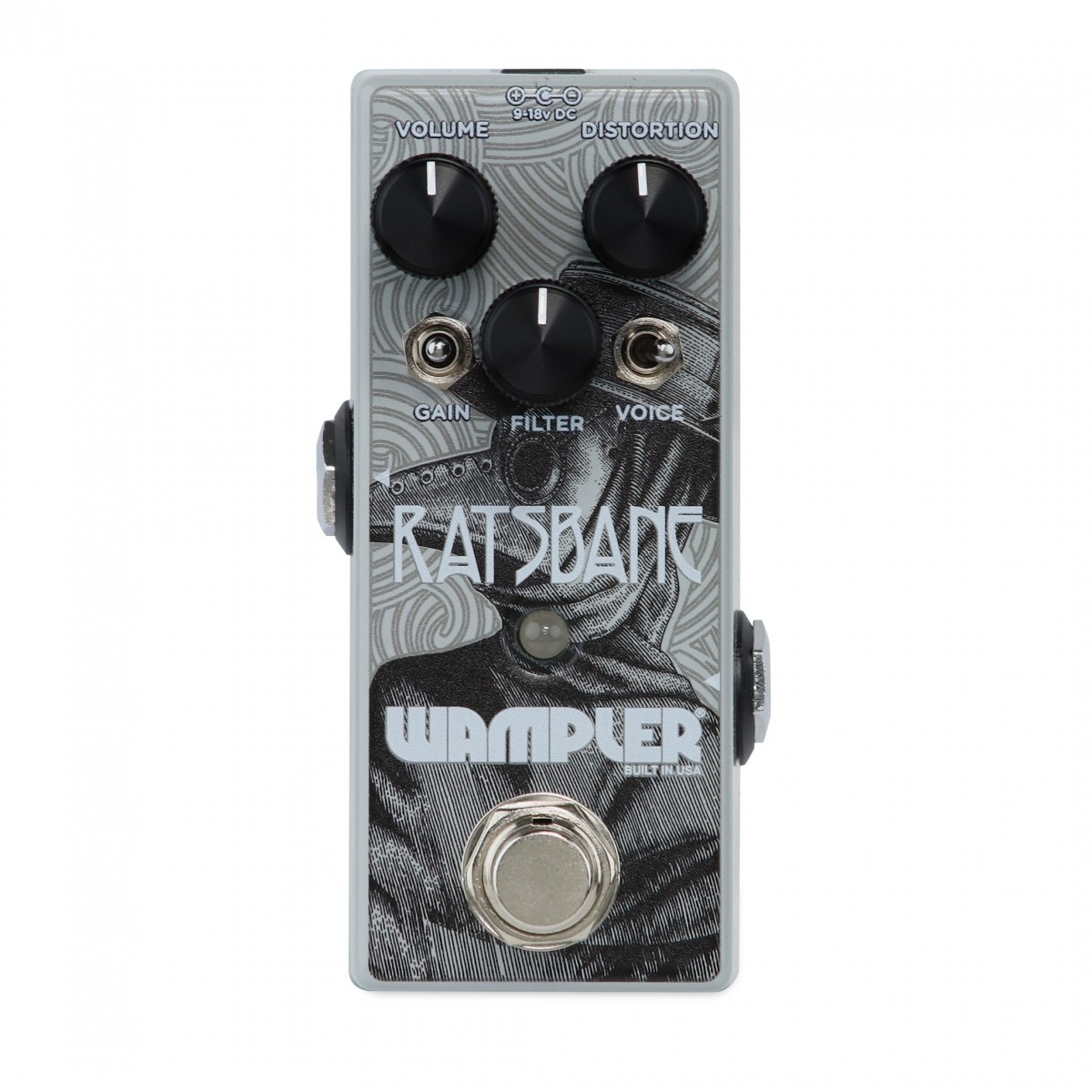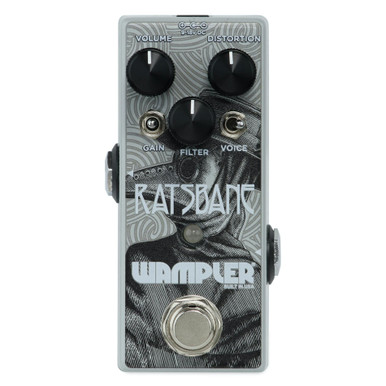

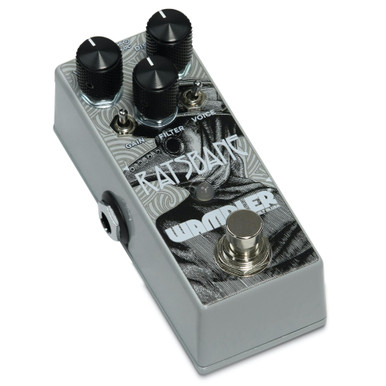
Wampler's Ratsbane is based on the iconic "rodent" distortion pedal — a hard rock and metal staple since the early '80s. Paying tribute to this legendary circuit, the Wampler Ratsbane promises more versatility than the original unit with its expanded control-set — while modern, mini-sized proportions make it much easier to fit to your pedalboard!
Much More Than A Mouse!
The "rodent" distortion sound is a sonic benchmark for many guitarists. The wide dynamic range and sheer force of this circuit is what makes it a true king among distortion pedals; versatile qualities that the Ratsbane can accurately recreate thanks to its high-grade components picked for their superior sound and response.
Gain To Cover All Of The Bases
If you're looking for a flexible distortion pedal that can cover lots of musical territory — Ratsbane is the answer. A powerful boost tone can be attained by turning the dedicated 'Distortion' control all the way down, while a throaty, fuzz-like high-gain sound with rich harmonic overtones is achievable by turning the knob up to max. Set it to 12 o'clock for a gutsy overdrive with plenty of mid-range punch.
Fan-Favourite 'Filter' Control
The 'Filter' dial was always regarded as the "secret sauce" for original '80s "rodent" units — a useful feature that Wampler has carried over for its Ratsbane. Turn it counter-clockwise to cut straight through the mix with precision and high-frequency attack, or roll it up to tame the top-end for a warm and buttery tone that remains clear.
2 Tone-Tailoring Switches
In typical Wampler fashion, the American brand has improved the usability of this classic circuit by fitting two additional tone-shaping switches. 'Gain' offers three distinct voices, affecting the amount of distortion on tap. Keep it centered for the "stock" setting, or flick it left for a firm yet smooth boost in gain. The right position provides a turbocharged, creamy distortion bordering on insane!
The 'Voice' switch subtly alters the compression and clipping of the Ratsbane. Tightening the distortion in order to be more manageable with greater levels of gain, this setting also rolls back some of the fuzziness to deliver a modern, saturated sound.
Controls
- Distortion: Affects the total amount of distortion.
- Volume: Controls the total output volume of the pedal.
- Filter: Influences the high-end roll off. Counter-clockwise is maximum treble, clockwise is minimum.
- Gain: 3-stage gain control. Middle is stock, left and right turbocharge the gain stages.
- Voice: Two voicing options that subtly alter the compression and clipping of the signal.
Key Features
- Built in the U.S.A.
- High grade components picked for their superior sound and response
- True bypass
- 9v – 18v power jack (no battery connector inside)
- Power draw: between 2.5mA (9v) and 3.2mA (18v)
- Five controls – Volume, Distortion, Filter rotary, plus 3 way Gain switch and 2 way Voice switch
- Includes Wampler’s limited 5-year warranty
- 1.5″ x 3.5″ x 1.5″ (38.1mm x 88.9mm x 38.1mm) – height excludes knobs and switches