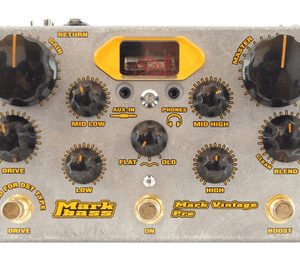

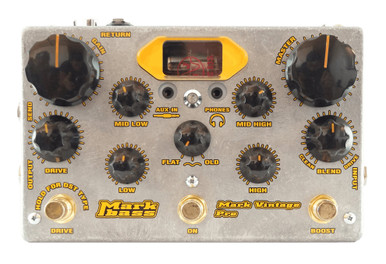
The Markbass Mark Vintage Pre tube preamp pedal is designed not only to give you authentic tube warmth but also act as a versatile tone shaper and a handy studio tool. With its 12AX7 tube you get some of that classic, organic tube sound but with the wide variety of controls including a four-band EQ and a 3-way EQ preset switch you can achieve tones from old-school to modern. With balanced DI and digital RCA and TOSLINK outputs, the Mark Vintage Pre has the practical functionality to be a reliable studio tool.
Tube Tone with Versatile Sound Shaping
The Mark Vintage Pre features a real 12AX7 tube in the pedal. This gives you some of that beloved tube warmth and harmonic character. This is great for achieving that vintage bass tone but it's not limited to that. The Mark Vintage Pre features a 4-band EQ for shaping your tone with a three-way preset switch featuring Flat, Cut (mid scoop), and Old (high scoop) for quick access.
For distortion you get two types which can be switched via footswitch. The Mark Vintage Pre can go from a crunchy overdriven tone through to seriously aggressive distortion with the amount controlled by the Drive knob. There's also a Blend control which allows you to control the mix between your clean and distorted signals. Go for all-out distortion or blend just a little bit into your clean tone to give it a little edge – it's up to you!
Additionally, there's a boost switch giving you an extra +6 dB to increase your volume and headroom when you need it.
Versatile Outputs
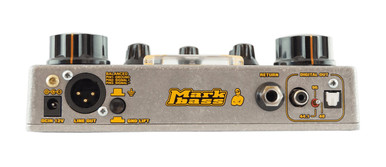
The Mark Vintage Pre features an onboard FX loop if you prefer to place certain effects in the loop, as well as a balanced DI output for hooking straight up to a mixer, PA, or audio interface. There's also RCA and TOSLINK digital outputs with a three-way sampling rate switch making it a very useful pedal to have in studio situations. In addition, there's an aux in for hooking up a device to play external audio and a headphone out for quiet practice.
Specifications
- Tube: 12AX7 (ECC 83)
- Input: Impedance 1MΩ, max. voltage 6 Vpp
- Output: Balanced DI Out with transformer (GND switch)
- Output: Digital Outputs: RCA (with transformer) and TOSLINK with sampling rate switch 44.1/48/96KHz
- Gain Range: -46 ÷ +23 dB
- FX Loop
- Controls: GAIN | MASTER | DRIVE | BLEND
- Switches: ON/OFF | DRIVE | BOOST
- Power Requirement: 12VDC | 300mA (power supply included)
- Dimensions (W/D/H): 7.6” x 5” x 2.32” | 19.3cm x 12.7cm x 5.9cm
- Weight: 1.9 lbs | 840gr
EQ
- Low: Level ±16 dB (Freq. 70Hz)
- Mid Low: Level ±16 dB (Freq. 400 Hz)
- Mid High : Level ±16 dB (Freq. 2.5 KHz)
- High: Level ±16 dB (Freq. 10 KHz)
- 3-Way switch (FLAT / CUT / OLD)