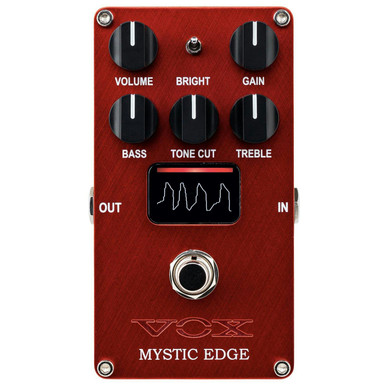

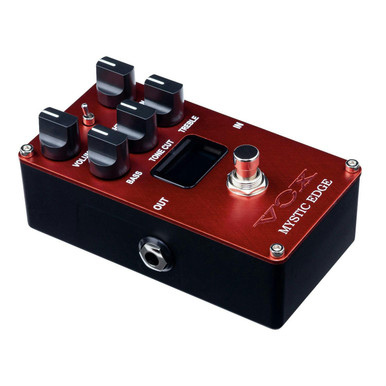
The Valvenergy Mystic Edge pedal offers the glistening chime and mid-range sweetness of Vox's legendary AC30 amplifier. Powered by Korg's innovative Nutube technology, this stompbox accurately captures the warmth, feel and dynamic touch-sensitivity of its real-life counterpart – all from a compact unit that can easily be mounted onto a pedalboard!
Classic AC30 Sound
Inspired by the bright British bark of Vox's AC30 amplifier, the Mystic Edge pedal goes beyond the typical amp-in-a-box formula to offer a truly flexible valve-like distortion. Its all-analogue signal path and Nutube circuitry provides a natural valve amp response, while the internally-boosted voltage ensures greater headroom and prevents an overly-compressed sound.
OLED Display
An intuitive high-contrast OLED display shows an oscilloscope reading while the pedal is active or bypassed. This allows you to understand exactly how your signal is affected, but perhaps more importantly – it just looks super-cool! This display also shows which mode you are currently using.
3 Output Modes
Speaking of which, three output modes make the Vox Mystic Edge very adaptable and easy to integrate into any guitar rig. You can use it as a standard pedal, a line-level preamp or a direct amp simulator using the built-in analogue cabinet simulator.
Use 'Standard' mode with your normal setup to give your amp a completely new voice, or use the 'Preamp' or 'Cab-Sim' modes for recording directly into an audio interface. In each mode, the all-analogue design and active EQ controls make it simple and inspiring to dial-in the perfect sound.
Channel Link Feature
The Mystic Edge's 'Channel Link' feature lets you chain two or more Valvenergy pedals together. A conventional 1/8” stereo cable will link 2 stompboxes, and using a stereo 1/8” splitter will link 3 or 4 pedals. This functionality allows you to turn one pedal on while bypassing the others – just like switching between the channels on a guitar amp!
Valvenergy Series Pedals
Vox's Valvenergy series offers four Nutube-driven distortion pedals that deliver the addictive feel and harmonic-richness of genuine valve amplifiers. The lineup encompasses four distinct models, each inspired by a classic amp sound.
What is Nutube?
Nutube is a tiny vacuum tube developed by Korg and the Noritake Itron Corporation, as an application of vacuum fluorescent display technology. Like a customary vacuum tube, a Nutube has an anode grid filament structure and operates as a complete triode tube. It provides the same rich overtones and response of traditional vacuum tubes in a smaller form – just what guitarists love!
Key Features
- Valve distortion pedal with all-analogue signal path
- Iconic sound of the Vox AC30
- Powered by innovative Nutube
- Three output modes for use as a pedal or preamp
- Selectable analogue cabinet simulator
- OLED display with oscilloscope
- Active EQ to shape your signal
Specifications
- Connections: Input, output, DC 9V (power), link
- Controls: Gain, volume, tone cut, treble, bass
- Switches: Bright, mode
- Power: 9V alkaline battery or centre negative AC adaptor
- Current Draw: 95 mA
- Dimensions (W x D x H): 72 x 120 x 55 mm
- Weight: 350 g/12.35 oz.