
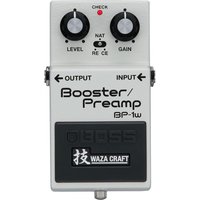
The Boss BP-1W Waza Craft Booster/Preamp Pedal is the high-end stompbox that tone purists have been waiting for. It combines the variable preamp characters of the legendary CE-1 Chorus and RE-201 Space Echo to give you those iconic baseplates without the associated effects. Along with a default “natural” voice that serves as a clean boost the BP-1W introduces extra richness depth and versatility to your guitar tone. Built to the highest standards in Japan the Waza Craft series BP-1W promises the height of premium analogue tone experiences. In CE mode the pedal reproduces the bell-like chimes and bright tones of the preamp section of the legendary CE-1 Chorus Ensemble whereas RE mode voices the chunky rounded sound of the RE-201 Space Echo Preamp. And if you want minimal sound colouration the Natural mode delivers a pure clean boost to elevate your tone without influencing it. Complete with selectable standard or vintage input buffer you can get the sonic and response profiles youre looking for on the BP-1W.
Boss BP-1W Waza Craft Booster/Preamp Pedal
This is a New Boss BP-1W Waza Craft Booster/Preamp Pedal from Boss is in our Preamp & DI Pedals category on Just Pedals. Read More below.
As an affiliate partner, we may earn a small commission when you buy through our links — at no extra cost to you.
Related videos

Brand
Boss
BOSS began in Osaka in 1973 as MEG Electronics, a company dedicated to effects. Its first BOSS-branded effect was the CE-1 Chorus Ensemble in 1976; the OD-1, SP-1 and PH-1 launched the compact-effects series in 1977. The JustPedals catalogue includes familiar overdrives and distortions such as the OD-3, SD-1, BD-2, DS-1 and MT-2 Metal Zone, as well as utility items such as the PCS-20A cable. BOSS now spans compact pedals, multi-effects, loopers, tuners and controllers. Manufacturing origin should be checked by model rather than inferred from the brand’s Japanese history.
Category
Preamp & DI Pedals
A preamp brings an instrument signal to a controlled level and shapes its impedance, gain and frequency balance before amplification or recording. A DI converts the signal for a balanced, low-impedance connection and may include ground lift, pad and transformer isolation. Combined units can add drive, cabinet filtering, effects loops and parallel outputs while keeping the direct path stable.
Tags
Analogue
The signal is shaped by continuously varying electronic circuitry rather than being converted into a digital effect algorithm. Component choice, operating voltage and circuit tolerances influence headroom, noise, clipping texture and the small variations in response between designs.
Boost
Raises signal level and may also reshape the frequency balance before the next stage. A clean boost preserves the waveform until headroom is exceeded, while coloured designs emphasise particular frequencies or add mild clipping that changes how later gain stages respond.
Vocal
Designed for microphone-level signals and the frequency, dynamics and feedback behaviour of the human voice. Input gain, balanced connections, phantom power and pitch tracking may be provided so effects respond correctly before the signal reaches a mixer or PA.
Others Just Ordered :
- I Love A Happy Accident… – Animals Pedal

- Animals Pedal Vintage Van Driving is Very Fun Overdrive

- Animals Pedal Sunday Afternoon Is Infinity Bender

- Ninevolt Pedals | Bath Time Reverb (Animals Pedal)

- This Fuzz Pedal Makes No Sense… But It Sounds Incredible

- ANIME Pedals | Animals Pedal Custom Illustrated Series
