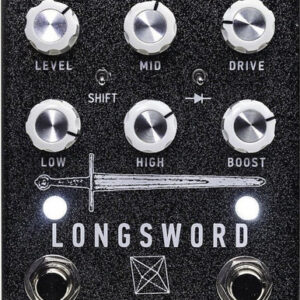
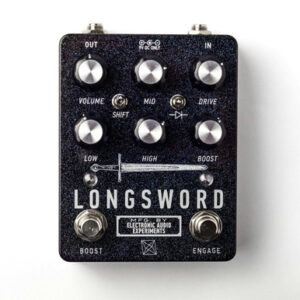

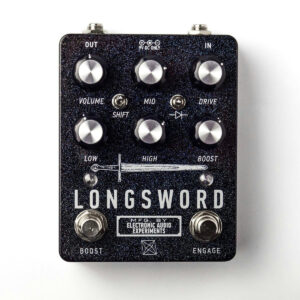
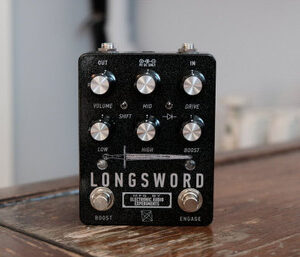
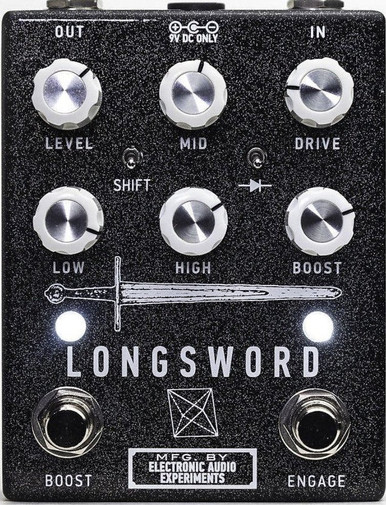
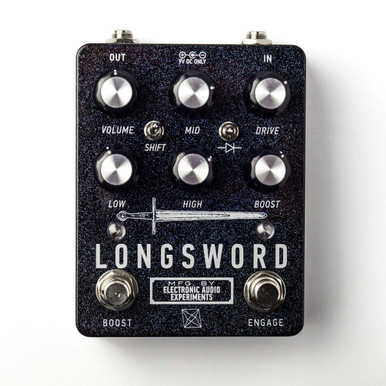
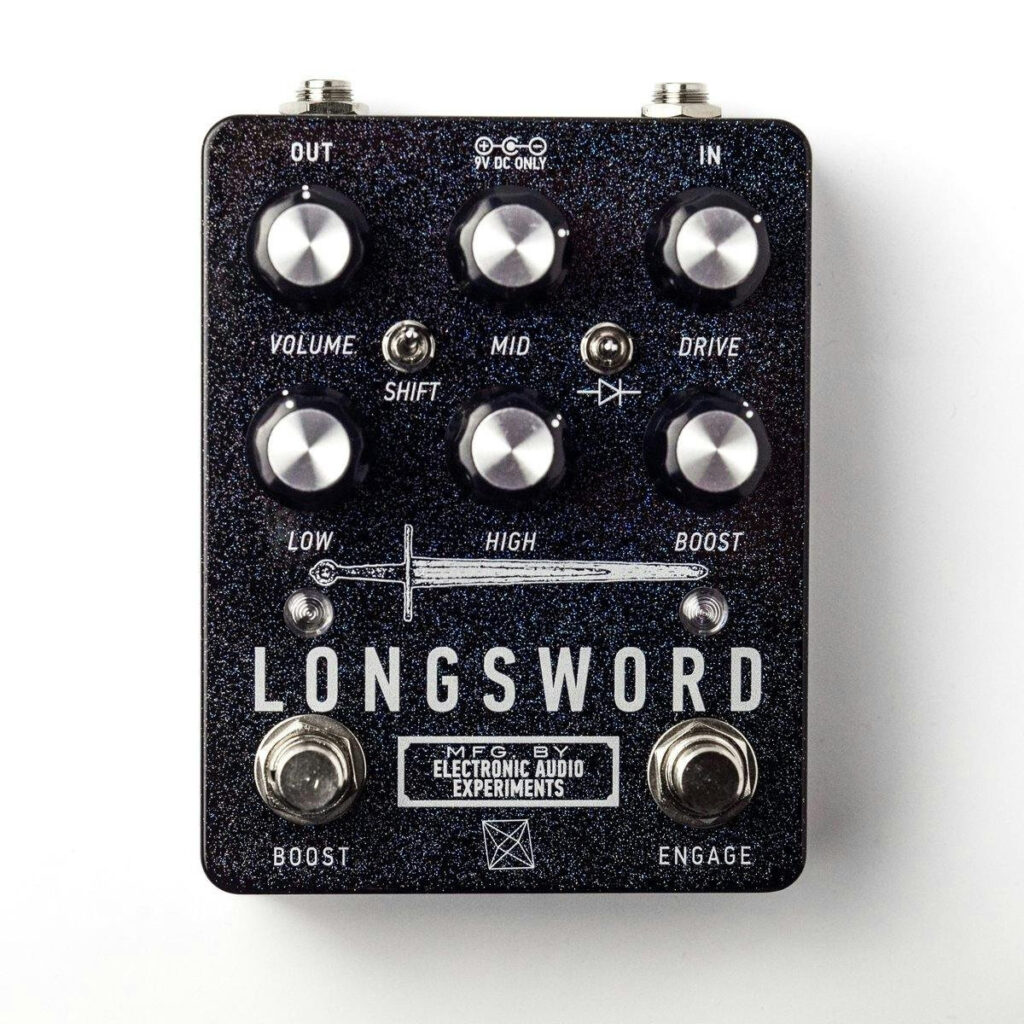
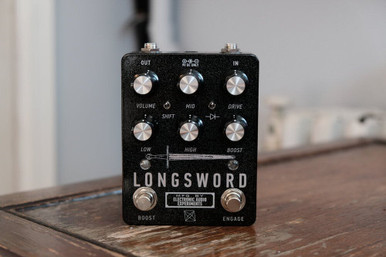
Founded in 2015 and hailing from Boston, Massachusetts, Electronic Audio Experiments are more than just a pedal manufacturer, they are "an exploration in sound and texture via electronics". The Longsword Distortion features cascaded gain stages delivering a full range of tones from a clean boost to searing, high gain distortion and everything in between. With controls for bass and treble with an active, frequency-selectable midrange boost/cut control, it's incredibly easy to sculpt a diverse array of overdrive and distortion sounds that are sure to cut through in a mix. The Longsword's broad frequency response ensures it'll work equally as well with guitar, baritone and even bass.
Controls
- Level – Output volume
- Drive – Go from light grit to heavy overdrive
- Low/High – James/Baxandall tone stack (shelving filters)
- Mid – Active midrange boost/cut
- Shift – Selects frequency controlled by Mid pot
- Diode – Selects between clipping diodes, to alter dynamics and headroom
- Up – MOSFET clipping, medium compression
- Center – No diodes, minimal compression
- Down – Silicon diode clipping, maximum compression
- Boost (Footswitch) – Engages a front end mid boost
- Boost (Knob) – Adds up to 20dB of gain when the Boost is engaged
Specifications:
- Bypass: Relay switching with true bypass
- Input impedance @ 1 Khz: 500kΩ
- Output impedance @ 1 Khz: 1kΩ
- Power: 9V DC, 2.1 mm center negative barrel. The current draw is 75 mA.
- We recommend a regulated, isolated power supply rated for 100 mA minimum. The PSU input is protected against reverse polarity and over-voltage up to 24V. Our pedals do not accept batteries.