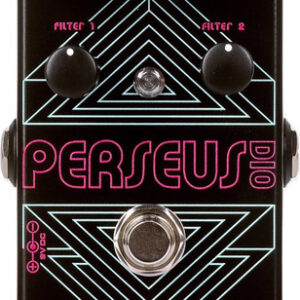
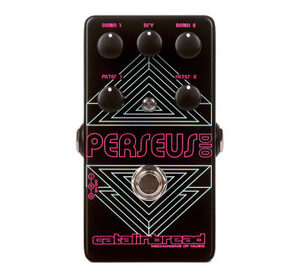

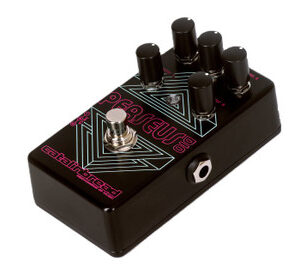
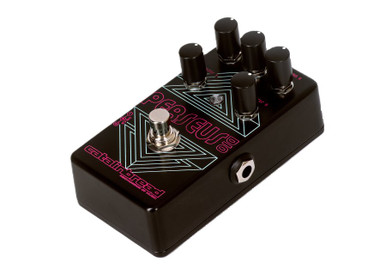
Often overlooked, all analogue fuzz sub-octave pedals have to be one of the coolest effects ever invented…turn any single-line melody into a gargantuan wall of riffy carnage with just a click of a button and some knob tweaking. It’s a perfect recipe for awesome! The Catalinbread Perseus Dio is no exception. Taking off from where their original Perseus pedal left off the Perseus Dio ups the ante by giving you the ability to blend in an additional octave and filter for even more synth-like chaos!
Here’s what Catalinbread say about the Perseus Dio
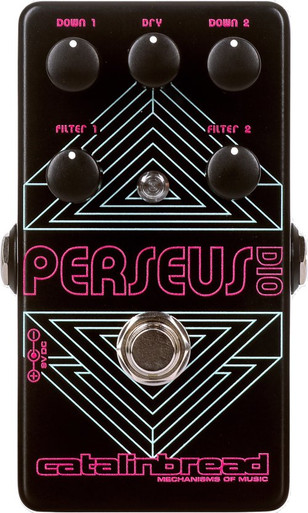
What kind of octave-down boxes do you like? For most of us, there are two answers: Beefy video-gamey square waves dripping with harmonics, and clean octaves that serve to compliment one’s tone and fill out the low end. For some reason, you normally get one or the other. Not this time! The Perseus Dio gives you a three-channel mixer for your dry signal, one octave down and two octaves down, along with heavy-duty low-pass filters for each octave channel. Mix in your ideal volume levels for each channel as you see fit, then transform them from blistering square waves to complimentary octaves with the twist of a knob. Mix in some dry signal for a three-voice onslaught, remove it for some low-end thump, or just use the Dry knob alone for some pleasing light distortion that has more than enough volume to push any amplifier.
Overview
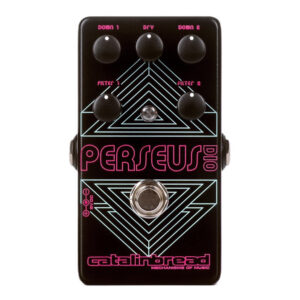
Fewer things give guitarists that fabled “riff face” more than a fuzz mixed with an analog octave down, and our original Perseus was a trailblazer in that regard. With that said, the Perseus Dio is a rightful successor to that box. The Perseus Dio greatly expands on the concept of our original device, giving you a three-voice all-analog octave down device with adjustable octave filters. Three knobs control the mixer section, giving you one octave down, two octaves down, and a dry, boosted distortion. The Dry knob gives you a really great light distortion sound that’s more than capable of pushing your amp into overdrive, but the fun starts when you control the levels of octave down signals with their accompanying low-pass filters. With no filtering, the octaves are harmonically rich square waves that sound like old-school Nintendo, but turning up their accompanying filter knobs smooth out the harmonics and turn into clean octaves down. Let’s get pixelated.
Controls
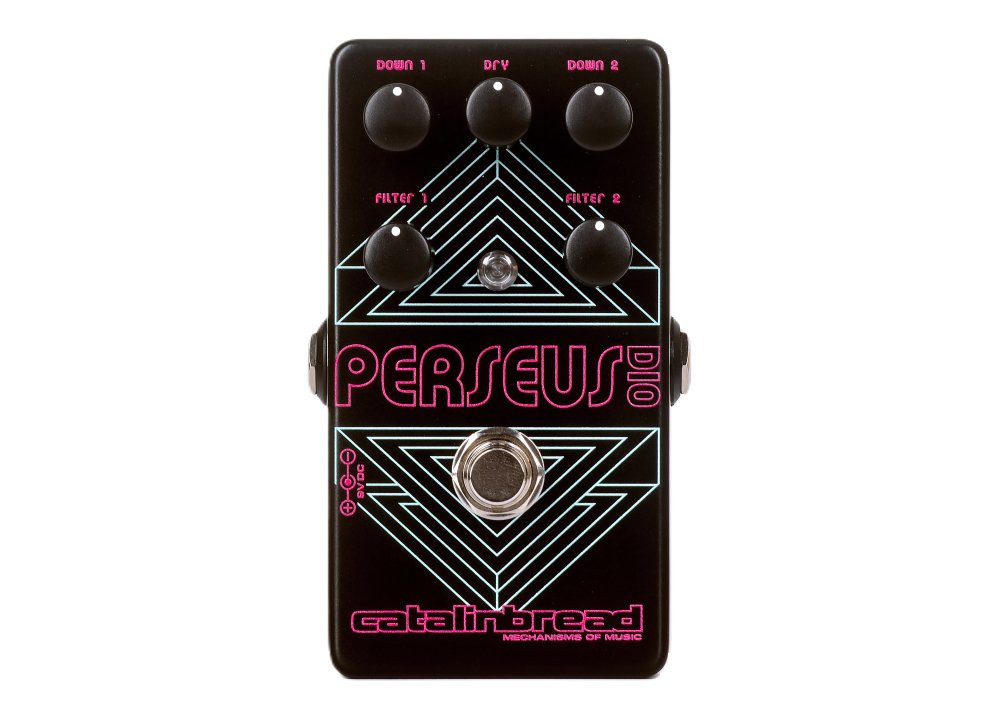
- DOWN 1: Controls the volume level of the 1-octave-down signal. Both this and the 2 Down control have been tuned to provide the best possible tracking across all positions on the fretboard.
- FILTER 1: This control governs the cutoff point for a second-order low-pass filter on the 1 Down knob. At minimum, the cutoff point is ~7KHz, retaining all the harmonic richness and video game-esque qualities. At maximum, the cutoff point is ~280Hz, giving you a clean octave down with bubbling harmonics lying underneath.
- DOWN 2: Just like Down 1, Down 2 controls the level of the 2-octave-down signal.
- FILTER 2: This control governs the cutoff point for a deeper second-order low-pass filter on the Down 2 knob. At minimum, the cutoff point is ~7KHz, just like “1 Filter.” However, at maximum, the cutoff point is ~140Hz to really let the “oomph” shine through at higher settings.
- DRY: This knob controls the volume of the dry signal. It is not your true clean guitar signal, but rather a boosted version of it, allowing it to mix better with the octaves. There’s plenty of volume on tap and it sounds great just by itself.
Power Supply
You can power your Perseus DIO with any 9VDC quality power supply designed for use with effects pedals.